


Chimpanzees, orangutans and gorillas lack it, as do Neanderthals and other ancient hominids closely related to our species. In fact, we are the only primate with a pointed chin, a bony structure that protrudes beyond the line of our teeth. It is such a distinctive feature that it is used to quickly recognize human skulls from those of other similar species. Yet, it is not clear what it is for. Indeed: it is not even clear whether the chin actually serves any purpose. That is, whether evolution has shaped its shape to offer us some advantage, or not. And the results of new research published on Plos One they go precisely in this direction, confirming that there are no traces of selection in the appearance of the human chin, and that it is therefore, in all probability, a structure born from the changes imposed by evolution on other parts of our face.
A unique structure
As we were saying, the chin is a unique morphological characteristic of our species. Appeared after we had separated evolutionarily from our closest relatives, living and extinct: great apes, and other now extinct hominid species such as Neanderthal man. It is therefore natural that anthropologists study this structure with interest, to try to understand its nature and function.
In evolutionary terms, we try to understand whether it is an adaptive character, shaped by evolution because it gives an advantage to our species, perhaps making us able to chew better, or helping us to articulate our spoken language. Whether it is the result of what is called “sexual selection”, i.e. a character that has established itself because it helps to attract a partner. Or whether it is not rather a morphological characteristic born by pure chance (the result of the so-called genetic drift which determines random changes in the genome), or as a by-product of other morphological modifications selected – these yes – by evolution. At the moment there are no certainties, and this is why the authors of the new study have decided to get to work.
The study
In their study, researchers from the University at Buffalo used an analysis methodology known as “Lande’s generalized genetic distance” which allows them to establish how quickly genetic traits differentiated in related species. And which can also be used to establish which traits have been subjected to selective pressure by evolution and which have instead appeared purely by chance.
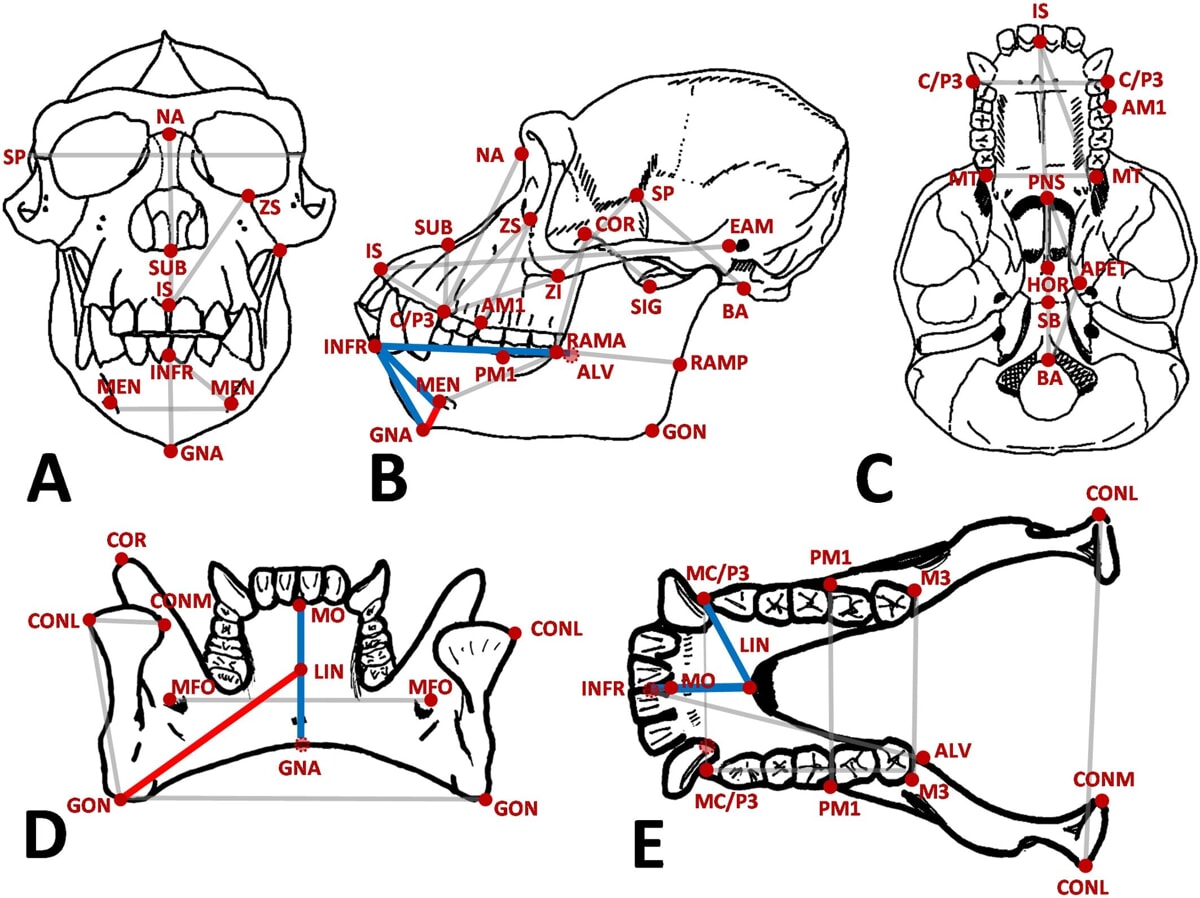
Using this method, they analyzed 532 skulls and jaws of hominoids (hominids and great apes), belonging to all species evolutionarily close to ours. And they got the answer they were looking for: the results allow us to exclude that the evolution of the chin is the result of random genetic drift. The shape of the human skull was therefore shaped by natural selection, and this also determined the appearance of our characteristic chin. However, looking at the traits that show signs of direct selection during our evolution, the authors believe that the clues all point in one direction: the chin was not selected for any evolutionary utility, but arises from changes that occurred in other areas of the skull and jaw.
A plume of human evolution
When a biological characteristic is not the result of direct selection, but the byproduct of another change shaped by evolution, evolutionists call it a “spandrel,” or architectural spandrel. A term coined by the two great scientists Stephen Jay Gould and Richard Lewontin in analogy with the splendid plumes decorated with mosaics of the Basilica of San Marco in Venice.
Architectural elements that are necessarily created when you want to place a dome on arched pillars, and which are often then frescoed or embellished with decorative elements so as not to leave them bare. But they are not chosen by the architect for their usefulness or beauty: they are the by-product of the selection of a domed vault resting on arches. In the same way, our chin would arise from the changes that occurred in other anatomical structures, which pushed the bony structure at the base of the jaw forward: not an adaptation, but an evolutionary plume, however unique and characteristic.
Next time you scratch your chin, remember that you are touching a beautiful, unique and absolutely useless random product of our evolution.