

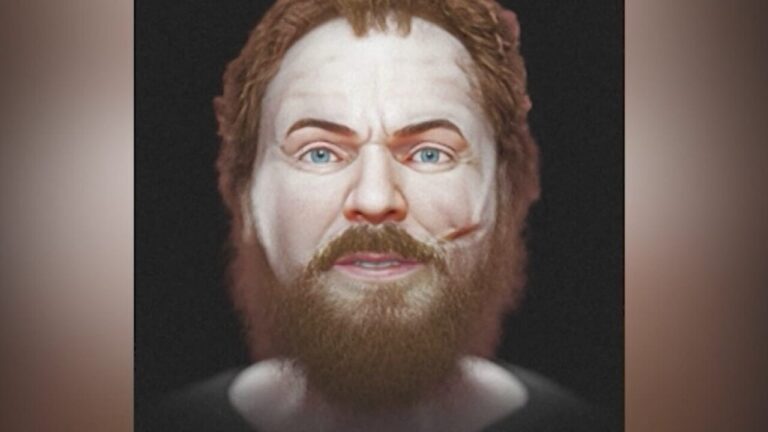
A team of scientists has recreated the face of a man who died 400 years ago, an alleged “vampire”, whose remains were mutilated to prevent his “transformation”.
The “vampire” of Racesa
Found in a cemetery in Racesa, eastern Croatia, the body had been mutilated and buried over four centuries ago. Experts explained that in the Slavic tradition of the time, it was believed that a person’s soul remained attached to the body for 40 days after death. If it was feared that the individual might be resurrected as a vampire, preventative measures such as impaling, burning, or beheading the corpse could be taken.
The face reconstructed after 400 years
The scholars managed to virtually reconstruct the man’s skull using artificial intelligence and CT data. The Racesa vampire lived in the 15th or 16th century, was approximately 1.63 m tall and is believed to have been between 40 and 50 years old when he was killed. The wounds indicate that he was a person accustomed to violent clashes, perhaps a soldier or a bandit. His grave was discovered in 2023 and is one of more than 180 burials found in the fortress, located 70 miles southeast of Zagreb.
“Death by violent death”
Archaeologist Natasa Sarkic, a member of the excavation team, said that the fear aroused by the man in his death could derive from the fear he himself had aroused in life: “Bioarchaeological analysis has shown that this man often took part in violent conflicts and died a violent death. During his life he suffered at least three episodes of serious interpersonal violence. In one of these attacks he was left with a disfigured face, which may have caused fear and revulsion, leading to social exclusion. Finally, before recovering from the trauma, he suffered a final fatal attack.”
“He may have been considered a ‘vampire’ or supernatural threat due to his facial disfigurement and outcast lifestyle,” she added. “These beings were thought to be restless, vengeful, and capable of harming living things, spreading disease, and killing people or livestock.” As confirmed by the doctor, the burial clearly indicates “practices commonly associated with ‘anti-vampire’ rituals of the time”.