

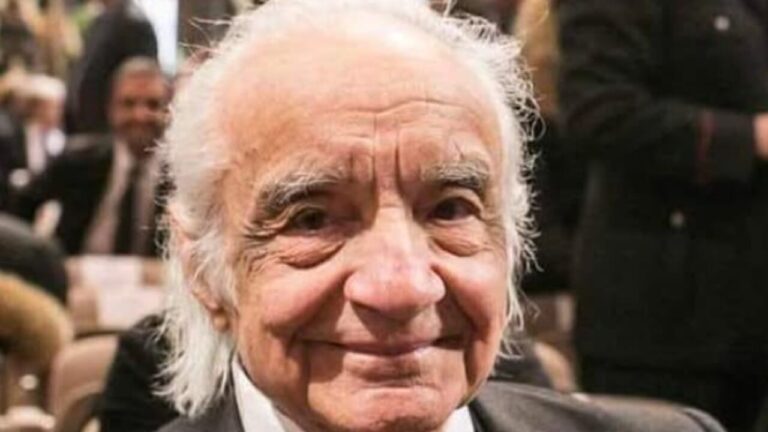
The Zichichiate paradox: how a “scientific” truth is fabricated
Antonino Zichichi was, without a doubt, one of the most authoritative Italian scientists of the second half of the twentieth century. Physicist and scientific communicator, he has carried out research in the field of elementary particle physics, i.e. the study of the fundamental constituents of matter and the forces that govern them. Professor emeritus of Higher Physics at the University of Bologna, president of the National Institute of Nuclear Physics from 1977 to 1982, director and founder (in 1963) of the “Ettore Majorana” Scientific Culture Center, he contributed to building scientific institutions of international importance and created the Gran Sasso National Laboratories. He carried out intense dissemination work also thanks to his television appearances. His role as a bridge between science and public space is destined to remain in history even after his death on 9 February 2026, at the age of 96.
Science, faith and the complexity of life
Antonino Zichichi was known for his battles against astrology, horoscopes and superstitions, and also for his position on the topic of the origin of life. Zichichi did not deny the existence of evidence in favor of the evolution of species, including man, but he rejected the idea that life could only be explained as the result of random biological mechanisms. According to him, in fact, living organisms would show such a complexity that they cannot be born “gradually”, but only with the simultaneous appearance of already perfectly functioning elements: a thesis that most scientists dispute. Zichichi also supported the absence of contradictions between scientific discoveries and the hypothesis of a Creator, moving the debate on the origin of life to not only a scientific, but also a philosophical and cultural level.
Academic credibility and transversality of knowledge
The figure of Antonino Zichichi shows how the highest academic level in a discipline does not automatically guarantee adherence to evidence in transversal areas. Zichichi has often used his academic authority to intervene on topics such as biological evolution, climate change, and the relationship between science and faith. In these interventions, the problem was not the right to express an opinion – sacrosanct – but rather the confusion, in media discourse, between personal opinion and consolidated scientific knowledge.
What happens when scientific authority goes beyond the boundaries of available evidence? In the public space, the academic title often functions as a cognitive shortcut. When a highly authoritative figure expresses minority opinions or those not supported by scientific consensus, the symbolic weight of his voice amplifies the message: after all, “if a scientist says it, it must be true”. But the question that, as readers or listeners, we should always ask ourselves is: does he say it with authority or with authority? No: they are not synonymous.
“Zichichiate” on the climate
While confirming the existence of an environmental crisis and inviting public opinion to pay more attention to good practices – reducing pollution, safeguarding ecosystems – Zichichi has always denied the correlation between human activities and global warming. “Global warming”, the professor argued, “depends on our source of energy and heat: the Sun. It is the activity of our star that affects the climate. It is unthinkable that human activity could cause the same effects as the Sun”.
On 5 July 2017 Il Giornale published an article signed by Zichichi in which climate change of anthropogenic origin was defined as an “eco-hoax”, climatology a form of “terrorism”, and climate modeling radically discredited. At the end there was an alleged “Science Appeal against eco-hoaxes”, which was said to have been signed by around twenty international scientists.
It’s a shame that that appeal, in fact, doesn’t exist. According to journalistic reconstructions and subsequent checks, several names indicated as signatories would not have confirmed having signed that text (or sharing its contents), while others would have traced their signature – if present – to different and generic contexts, without references to climate denial theses.
Zichichi’s legacy leaves an urgent question: How to preserve the integrity of scientific discourse in an age when individual authority can override collective evidence? This case, like others, shows that misinformation does not arise only from ignorance, but also (and perhaps above all) from the improper use of prestige. And this is where academia needs to look in the mirror: freedom of speech does not absolve one from responsibility. If you have a recognized role in the production or communication of knowledge, you must take the same care in distinguishing what presents itself as fact from what remains opinion.
Regardless of the controversies, in the field of particle physics and in the construction of scientific institutions his name remains a reference for generations of scholars.