

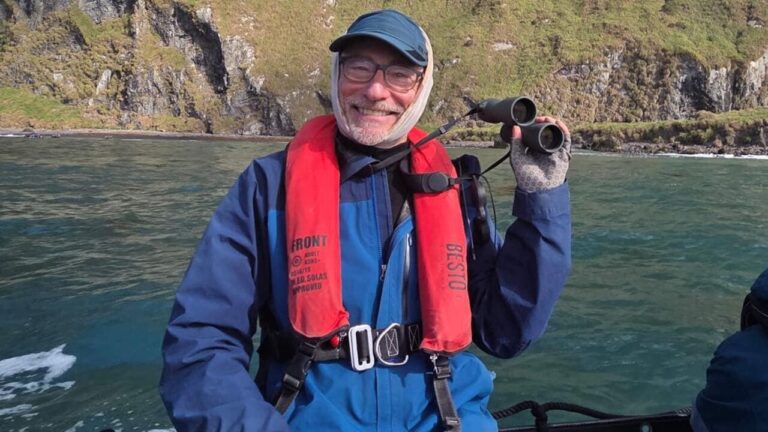
It was supposed to be a relaxing and fun holiday, but for Stephen Kornfeld it turned into a health emergency to manage. The doctor, a retired oncologist for over ten years, originally from Bend, Oregon (United States), is one of the passengers on the Mv Hondius, the cruise ship that left last April 1st from Ushuaia, in the Argentine Tierra del Fuego, on which an outbreak of hantavirus broke out.
The hantavirus emergency on the Mv Hondius
Kornfeld, also known for being a renowned bird watcher, hoped to enjoy the five-week journey, among paradisiacal destinations and dream scenery, but shortly after leaving the Falklands, the first infections of the virus emerged on the ship, which in this specific case would have to do with the Andes strain, one of the few capable of transmitting from human to human after prolonged contact.
From passenger to ship’s doctor
The situation worsened in a very short time and even the on-board doctor was infected. At that point, Kornfeld had to take matters into his own hands, as told to CNN, taking off the role of simple passenger to effectively become the ship’s doctor: “I found myself in the role of ship’s doctor almost without realizing it. I assisted several passengers with high fever, extreme weakness and breathing difficulties. Many worsened within 12-24 hours.”
Traveling to Spain
Three people have currently died from the infection, including an elderly couple of Dutch origins. The on-board doctor was transferred to intensive care in South Africa, while other patients were taken to Holland and Switzerland. As reiterated by Kornfeld, transferring patients in serious conditions was fundamental: “On the ship it would not have been possible to guarantee adequate intensive care. With the hantavirus, survival depends on how quickly you access an equipped hospital.” The ship, with 146 people on board, is en route to Spain, with arrival in the Canary Islands scheduled for Sunday 10 May.