

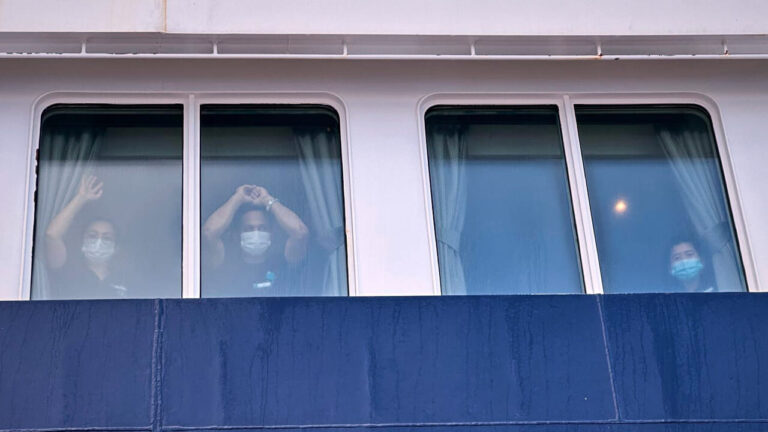
The hantavirus “hotbed” ship was forced to dock in port. After days of tension in the Canary Islands, the Mv Hondius, the cruise ship on which the cluster of the rare virus transmitted by rodents developed, entered the industrial port of Granadilla, in Tenerife. The decision came due to the worsening weather conditions and for safety reasons: according to the port authorities, the Harbor Office recommended docking to allow the disembarkation of the last passengers and part of the crew still on board.
The measure, the authorities explain, should last “the minimum time necessary” to make the evacuation easier and safer. But the ship’s entry into the dock rekindles local fears. The Canary Islands government had opposed the docking precisely for fear of exposing the island to a health risk, even though the World Health Organization and European health authorities have so far indicated the risk to the general population as low.
Fear of rats in port
The new area of concern concerns rodents. Not so much for contagion “at a distance” from the ship, but for the fear that possible rats could move between the boat and the dock. It is a well-known risk in maritime healthcare: in ports, prevention procedures include the use of anti-rat barriers on mooring lines, control of gangways, closure of accesses and surveillance against traces of rodents. Rats, in fact, are excellent climbers and can also swim; For this reason, port guidelines recommend keeping lines out of the water and using protective devices on mooring ropes.
While the human-to-human spread of hantaviruses (including the Andean strain that infected cruise ship passengers) remains limited, the main risk remains exposure to rodents or their excrement.
The disembarkation of the last passengers
The Hondius had arrived in Tenerife after a long standstill in the Atlantic. On board there were passengers and crew of different nationalities, subjected to a complex evacuation operation, with staggered transfers, health checks and repatriations to their countries of origin. Two evacuated passengers tested positive in France and the United States, but all passengers will be isolated until at least early June because the incubation period can be long and new cases can emerge in the days following exposure.
Health authorities therefore chose a prudent approach: isolation, temperature monitoring, use of protective equipment and contact tracing. The biggest concern is to avoid unnecessary contact, prevent the circulation of any rodents, complete the disembarkation safely and then proceed to sanitize the vessel. Once the evacuation is complete, the ship is expected to leave Tenerife with a small part of the crew and reach Rotterdam for disinfection operations.
The risk for the population
The authorities continue to urge caution, but also to avoid alarmism. The main risk remains for those who have been on board, for those who have had close contact with suspected or confirmed cases and for those who may have entered environments contaminated by rodents.
For Tenerife, now, the issue is above all logistical and sanitary: getting the last passengers off, protecting the operators involved in the evacuation, keeping the ship on the dock as little as possible and checking every possible route for rodents to pass through. This is where the new fear of “swimming” rats arises: not an immediate threat to the island, but a technical risk that is taken very seriously in ports.