

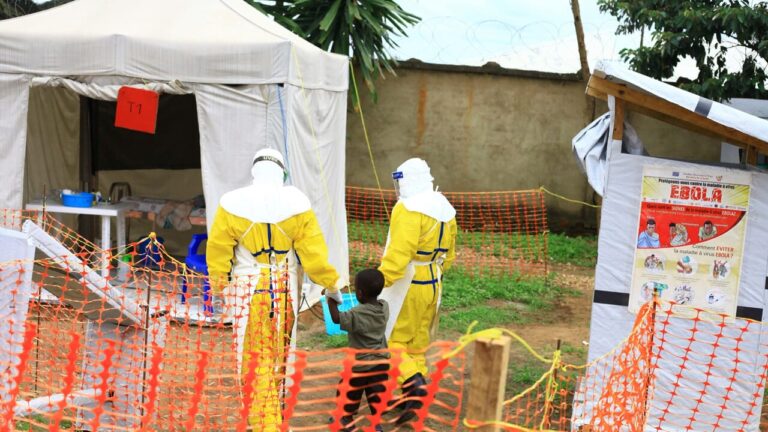
Ebola has returned to Congo. The Africa Centers for Disease Control and Prevention has confirmed that a new outbreak is underway in the Democratic Republic of Congo. An initial toll, still provisional, speaks of at least 246 suspected cases and 65 deaths.
The Ebola outbreak in Congo
The affected area is the province of Ituri, on the border with Uganda and South Sudan. According to Africa CDC experts, there is a risk of spread due to the urban context of Bunia and Rwampara, intense population movement, mining-related mobility in Mongwalu, insecurity in the affected areas, contact list gaps, infection prevention and control challenges, and the proximity of the affected areas to Uganda and South Sudan. “Given the high population movement between affected areas and neighboring countries,” said Africa CDC Director General Jean Kaseya, “rapid regional coordination is essential. We are working with the Democratic Republic of Congo, Uganda, South Sudan and partners to strengthen surveillance, preparedness and response and to help contain the outbreak as quickly as possible.”
“Low risk for Europe”
Despite the outbreak that occurred in Congo, at the moment the risks for Europe would be “very low”, as underlined in a note from the ECDC, the European Center for Disease Prevention and Control: “Although the situation is evolving, the probability of infection for people residing in the European Union/European Economic Area (EU/EEA) is currently considered very low. Based on the information available and the current uncertainties – specifies the agency in a note – the probability of infection for residents of the EU/EEA or for travelers to the province of Ituri is assessed as low for the general population of the EU/EEA, the probability of infection is very low due to the limited possibility of importation and subsequent transmission in Europe”.
“The ECDC – reads the note – is monitoring the epidemic through its epidemiological intelligence activities and remains in close contact with the main partners, including the African Centers for Disease Control and Prevention”, the Africa CDC, “the European Commission and the WHO. The ECDC assessment will be updated as soon as new information becomes available”.
WHO: “We are working to contain the epidemic”
Reassurances also came from the WHO (World Health Organization): “The current Ebola epidemic is the 17th Ebola epidemic recorded in the Democratic Republic of Congo (DRC) since the virus was identified for the first time in 1976. Today I had a telephone conversation with the Minister of Health of the African country regarding the outbreak which is affecting the north-eastern province of Ituri. Currently, the World Health Organization is aware of 13 cases of Ebola confirmed by the Institute National Biomedical Research Institute (INRB) of Kinshasa”.
A first alarm had arrived at the beginning of the month, as explained by WHO Director General Tedros Adhanom Ghebreyesus: “On 5 May the Agency received a report of suspected cases and sent a team to Ituri to support DRC health officials in the investigations and collect samples in the field, which initially tested negative for Ebola. The samples were subsequently sent to the INRB, which yesterday confirmed the positivity of some of them.”
“The Democratic Republic of Congo – he added – has a solid experience in the response and control of Ebola. The WHO Representative in the DRC and other experts from the agency are in Ituri at the moment and are working side by side with the country’s health authorities to respond to and contain the epidemic. Additional WHO experts in risk communication and community engagement, in infection prevention and control, clinical assistance and logistics will join the team already present on the territory in the coming days. We have sent medical supplies and protective equipment for prevention and infection control in Bunia, the capital of the province of Ituri. Today I have allocated 500 thousand dollars from the WHO emergency fund to immediately support the response”.
Ghebreyesus also listed the priority actions to be implemented: “These include risk communication and community engagement, strengthening epidemiological surveillance, active case detection and contact tracing, infection prevention and control in health facilities, expanding access to safe clinical care and increasing laboratory testing capacity. WHO will continue to work to support the Democratic Republic of Congo in bringing this Ebola epidemic under control and will deploy resources, collaborate and will mobilize partners across the region to contain its spread and care for those affected.”
Bassetti: “It causes hemorrhagic fevers for which there is no cure”
Infectious disease specialist Matteo Bassetti, director of infectious diseases at the San Martino polyclinic hospital in Genoa, also expressed his opinion on the topic, with a comment posted on social media: “The Ebola virus is transmitted through contact with body fluids and causes haemorrhagic fevers for which there is no cure and which are very often lethal. The current one is located in the province of Ituri, on the border with Uganda and South Sudan”.
The identikit of the virus
It was September 1976 when in a microbiology laboratory in Antwerp a young scientist, Peter Piot (now 77 years old), found the Ebola virus under the microscope. In the eyes of the expert, who went down in history together with other colleagues for having traced his identikit, it was still an unknown pathogen, discovered inside vials of blood taken from a Flemish nun missionary in Zaire (now the Democratic Republic of Congo), who died of a mysterious disease that was killing dozens of people on the banks of the Ebola river. Piot flew with a team of white coats into the rainforest to track it to its source, the bats. In his eyes he had the agony of the sick, including fever, dehydration, vomiting, diarrhea and hemorrhages. In 2026, that worm-shaped virus, composed of only 7 genes, continues to represent a threat, even if over the years some progress has been made on the vaccine and treatment front and others are in the development phase. Today’s news is of a new epidemic that the Africa CDC (Africa Centers for Disease Control and Prevention) is “carefully monitoring” in the province of Ituri, Democratic Republic of Congo: around 246 suspected cases and 65 deaths, mainly in the health areas of Mongwalu and Rwampara. The virus has already been detected in 13 of the 20 samples analyzed. An outbreak that led to the strengthening of cross-border surveillance and the preparation of a coordinated response.
The 2014-2016 epidemic
And it is automatic that memory returns to one of the Ebola emergencies of the past that most alarmed the world, the largest and most complex recorded so far: between 2014 and the beginning of 2016 the virus infected over 28 thousand people, with over 11 thousand deaths, and from West Africa the epidemic arrived in the EU, including Italy, and in the USA, brought by those who had been in the countries at risk for work reasons. The first infected were healthcare workers: in November 2014 it also happened to the doctor from Catania Fabrizio Pulvirenti, who was then in Sierra Leone as a volunteer for Emergency, and to the Sardinian nurse Stefano Marongiu, also a volunteer with the same NGO, both recovered. Since then, outbreaks in the African region have followed one another over the years. The one underway for the Democratic Republic of Congo would be the 17th recorded within the country. The latest one dates back to just at the end of 2025, the even earlier one occurred in 2022. And in between, other countries in the region had launched alerts, for example Uganda with an outbreak in 2023 from another of the Ebola strains (Sudan ebolavirus).
Serious and often fatal
Ebola remains a rare disease globally, but it is serious and often fatal in humans. The average lethality rate (Case Fatality Rate, CFR, calculated on diagnosed cases) is around 50% (it has fluctuated in previous outbreaks between 25% and 90%). The disease is caused by viruses belonging to the Filoviridae (filovirus) family. To date, 6 species of Orthoebolavirus have been identified, 3 of which are known to cause large epidemics: Ebola virus (Ebov or Zaire Ebolavirus), Sudan virus (Sudv) and Bundibugyo virus (Bdbv). For only one (the Ebola virus) there are authorized vaccines and therapies. Early intensive care, including rehydration and treatment of specific symptoms, can improve the chances of survival. As for transmission, fruit bats of the Pteropodidae family are believed to be the natural hosts of the virus, which can be transmitted to the human population when people come into close contact with the blood, secretions, organs or other body fluids of infected animals (from bats to non-human primates to other species in the rainforest). Human-to-human transmission occurs through direct contact (through skin or mucous membrane lesions) with the blood or body fluids of a person ill or deceased from the virus and with contaminated objects or surfaces. People cannot transmit the disease before symptoms appear and remain contagious as long as the virus is present in their blood. The incubation period varies from 2 to 21 days. For Ebola virus disease, the World Health Organization has recommended treatment with two monoclonal antibodies. And there are two approved vaccines, one of which is recommended as part of the response to a possible epidemic. For other family diseases such as Sudan virus there are several candidate vaccines in different stages of development and candidate drugs. Experts on the front lines of the outbreak response focus on community involvement, which is considered crucial for control, along with interventions on clinical care, surveillance and contact tracing, laboratory services, and infection prevention and control in health facilities, safe and dignified burials, vaccination (for Ebola virus disease only).