

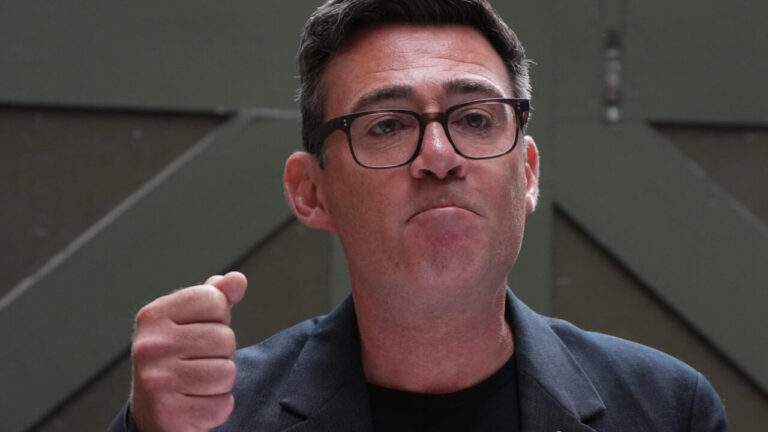
The Burnham government is less to the left than its promises: here’s who really rules Downing Street
The populist posture of the new British Prime Minister, Andy Burnham, with his language filled with slogans such as “end neoliberalism” and “eliminate homelessness” should not be misleading. The populist does his job: he tells the people what they want to hear. What he then does is another story.
And what Burnham did in forming her government is, after all, what one would have expected from an operation started by the Blairite wing of Labour, a few days after Tony Blair’s attack on former prime minister Keir Starmer, in which he asked him to get back in tune with the Trump administration. In May, however, it became obvious that then-Health Minister Wes Streeting did not have the numbers to win the leadership. To oust Starmer he needed Labour’s left, which had its point of reference in Burnham. It was then a question of finding an agreement.
What happened behind the scenes is made clear to us by the formation of the cabinet. Burnham had promised it “inclusive” but instead shaped it as an exclusive club for non-Frontists only, in true Boris Johnson style. A story already read.

The choice of John Healey for the Treasury, in particular, tells two stories. The first concerns the economic direction of the government: Healey belongs to the New Labor universe and his positions hardly suggest an economic turn to the left. The second story concerns, however, the fall of Starmer: it was precisely Healey’s resignation from Defense that made the crisis of his government irreversible. When he left, the game was over.
This is where a hypothesis emerges. Healey had left Defense after a clash with then-Chancellor Rachel Reeves over the need to find new resources for rearmament. Reeves had opposed the proposed measures: an increase in tax pressure or a new debt issue. From here, Healey’s appointment to the Treasury would raise suspicions of an agreement: to bring down Starmer with the prospect of landing the ministry from which it would be possible to obtain defense resources. How he will do it without increasing the tax burden, violating the electoral manifesto, remains to be seen.
Shabana Mahmood’s confirmation at the Interior also tells a different story than the one suggested by the slogans. An exponent of the most conservative wing (Blue Labour), Mahmood has been pursuing one of the most restrictive lines in the country’s history on immigration for a year. Starmer appointed her, so Burnham will be moving in the same direction.
The chessboard of powers: who are the new loyalists
Another interesting appointment is that of Wes Streeting at Defence: Blairite, friend of Peter Mandelson and staunch supporter of Palantir. His promotion appears, on the one hand, as recognition of the role played in Burnham’s rise and, on the other, as a possible change of pace in relations between the Ministry of Defense and the technological giant founded by Peter Thiel and led by Alex Karp. In short, Streeting could unlock deals that the Starmer government was blocking.
Three key ministries, therefore: interior, treasury and defence, assigned to personalities belonging to the right wing of the Labor Party, confirming that Burnham’s populist speeches are a decoy.
Labour’s ring leaders of the left – Ed Miliband, Lucy Powell, Louise Haigh and Angela Rayner – who, by Haigh’s own admission, plotted for over a year to bring Burnham to power, are also being rewarded. They do not get the government of the hard and pure left to which they aspired, but rather some sops: Foreign Affairs (in a reality where foreign policy is now mainly conducted by prime ministers), Education, Secretary of State, Construction.
Even the exclusions tell a story. Rachel Reeves, the only Starmer loyalist invited by Burnham, rejected the offer, choosing not to join the government. With her, former deputy prime minister David Lammy, Darren Jones (former Secretary of State), considered one of Labour’s most promising figures, and environment minister Steve Reed end up behind her. It was Reed who made his views against Burnham’s operation explicit in his resignation letter: “Keir Starmer showed me loyalty by appointing me to his cabinet. I make no apologies for returning that loyalty. It is what is expected of good teams, and I hope that those who showed no loyalty to Keir will now show it to you. I am proud to have acted with integrity at every step over the last turbulent months.”
SUN EXCLUSIVE
Keir Starmer resigned as PM – and went straight to the pub for some pints
Fair play. https://t.co/xZnrdSw1nt pic.twitter.com/tDac2Ct7dx
— Jack Elsom (@JackElsom) July 20, 2026
All things considered, the Burnham government tells a different story to that of the slogans. The promised reconciliation did not result in a synthesis between the different souls of Labour, but in the marginalization of the leadership group that remained faithful to Starmer. The rhetoric looks to the left while the composition of the government shows a political orientation closer to Washington.