

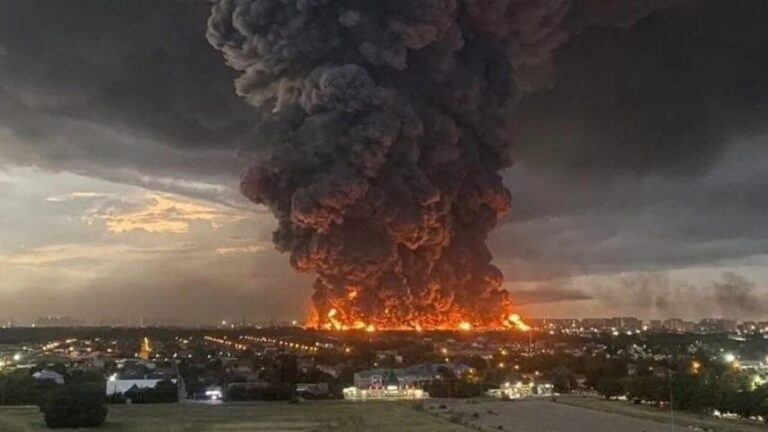
The Ukrainian drone war no longer affects only refineries, fuel depots, airports and military factories. On the night between 21 and 22 July, two large logistics centers of Wildberries, the main Russian marketplace, were attacked: one in Krasnodar and the other in Nevinnomyssk, in the Stavropol territory. The first occupies approximately 150 thousand square meters, the second approximately 120 thousand. Verified images show columns of smoke visible from kilometers away.
It is the second attack in just a few days against the infrastructure of what is often called the “Russian Amazon”. On July 18 the drones had reached the hubs of Elektrostal, in the Moscow region, and Kotovsk, in the Tambov region.
They are not simple warehouses
The strategic value of Wildberries does not just depend on the buildings affected. The platform handles over twenty million orders per day and hosts more than one million sellers. In 2025, online sales in Russia increased by 28 percent, reaching 11,500 billion rubles. According to the Russian government, the total activities carried out on digital platforms are now worth around 8.5 percent of the gross domestic product.
Wildberries is therefore a national logistics network, not just a site to buy clothes or electronic products. Its large hubs collect the goods of thousands of traders, sort them and distribute them to the most remote areas of the country. Hitting a hub of this size means slowing deliveries, forcing the company to redesign routes and increasing storage and transportation costs.
According to two real estate consultants interviewed by the Russian economic newspaper Vedomosti, the centers of Elektrostal and Kotovsk alone represented approximately 350 thousand square meters, equivalent to 7 percent of Wildberries’ overall logistics area. The first assessment indicated over 20 billion rubles for real estate and up to 50 billion considering equipment and goods. Higher estimates, released by analysts and independent media but not confirmed by the company, assume losses of more than 100 billion rubles and, in the extreme scenario, close to 180 billion: around 2.3 billion dollars at the exchange rate indicated by Reuters.
The risk passes from the warehouses to the sellers
The deepest vulnerability concerns third-party merchants. To reduce delivery times and get better conditions from the platform, some small sellers concentrate a large part of their inventory in one or two centers. When a hub is destroyed, the company can simultaneously lose the goods ready for sale, the capital advanced to suppliers and the liquidity needed to purchase new products.
The problem is exacerbated by changes to contracts. Wildberries’ new offer, published on July 1st and effective on the 7th, considers the use of weapons and drones, military operations and states of emergency as causes of force majeure that free the platform from responsibility for the loss of goods. If the attacks were to continue, the consequence could be a liquidity crisis spread across thousands of micro-businesses. The most exposed subjects are those who buy on credit, work with low margins or depend on imports, including goods from China and products arriving in Russia through the so-called parallel import channels. The damage would therefore not stop at the platform: it could reach suppliers, transporters, textile producers, shops and consumers.
Why Kiev hits Wildberries
Ukraine claims that the first centers attacked were involved in the distribution of drone components and navigation systems. The Kremlin denies that Wildberries handles military supplies. From a military point of view, the choice is however understandable. Refineries can be protected, repaired or compensated by increasing imports. A commercial network, on the other hand, is made up of inventories, software, contracts, truckers and thousands of businesses dependent on each other. Repeatedly hitting its main nodes produces less visible but potentially more widespread costs: delays, unsellable goods, rising prices, lack of liquidity and mistrust in the state’s ability to protect the territory.
A graphic also appeared on Ukrainian channels with the twenty largest Wildberries hubs and some flames next to the structures already affected. It is not possible to verify its origin or consider it an official list of objectives. Its function is above all psychological: to suggest to sellers, workers and Russian authorities that no large logistics center is now out of reach of drones.
The general who broke through the barricade
The new campaign against Russian logistics coincides with a change in the Ukrainian military leadership. Volodymyr Zelensky has appointed Major General Mykhailo Drapatyi as the new commander-in-chief of the armed forces, replacing Oleksandr Syrskyi. In the speech announcing the decision, the president specified that the program of in-depth attacks and that of medium-range operations must continue “with absolute precision”.
I have decided that Mykhailo Drapatyi will become the new Commander-in-Chief of the Armed Forces of Ukraine. Together with Mykhailo, Yevhenii Khmara, and Pavlo Palisa, we determined how the General Staff of the Armed Forces of Ukraine should be reconfigured. It is a fact that… pic.twitter.com/spK2B2ppHP
— Volodymyr Zelenskyy / Володимир Зеленський (@ZelenskyyUa) July 21, 2026
Drapatyi, 43, belongs to the generation of officers trained fighting Russia since 2014, rather than in the structures inherited from the Soviet Union. He became famous on May 9 of that year in Mariupol. He commanded the second mechanized battalion of the 72nd Brigade and was traveling in the armored vehicle at the head of a column headed to rescue some besieged Ukrainian policemen. When the convoy encountered a barricade more than a meter high, he ordered the driver to accelerate: the armored vehicle passed it like a ramp, opening the passage to the units that followed.
In the same year Drapatyi led approximately 260 soldiers and more than thirty vehicles out of an encirclement. In 2024 he helped stop the Russian advance in the Kharkiv region. As commander of the land forces he supported the personal responsibility of officers, the flexibility of the departments and the use of new technologies. In 2025 he resigned after a Russian attack on a training center, publicly taking responsibility for the deaths of soldiers, before returning to an operational role.
Mykhailo Drapatyi comes to command the Ukrainian Armed Forces following the recent dismissal of Defense Minister Mykhailo Fedorov. Tensions had emerged between Fedorov and the previous military summit led by Oleksandr Syrskyi over the modernization of the armed forces, the use of drones, digitalisation and the reform of the chain of command. Drapatyi is considered one of the officers closest to this approach: a more technological, decentralized army capable of entrusting greater autonomy to commanders on the ground. His appointment can therefore be read as an at least partial correction of the line chosen by Zelensky. Fedorov does not return to the ministry, but part of his strategy survives in the rise of a general who shared many of his priorities. It is not necessarily evidence of a direct relationship between the two decisions, but the signal that Kiev does not intend to abandon the technological transformation of the army just as it intensifies attacks in depth against the Russian logistics and production system.