

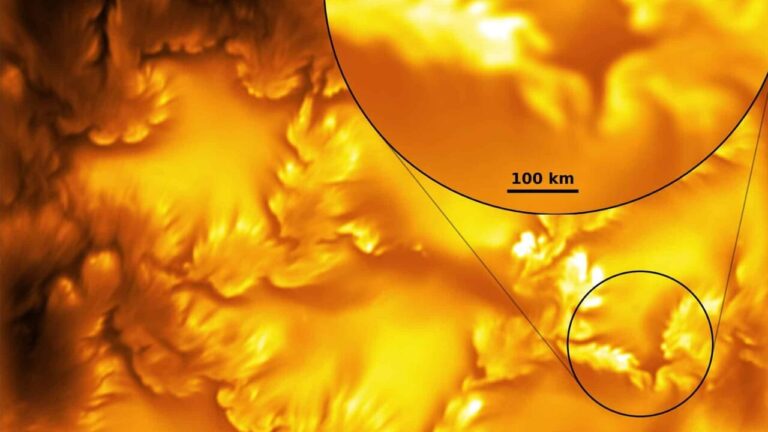
They are vortices just a few tens of kilometers large, practically tiny compared to the size of the Sun. For the first time, scientists have managed to observe them directly. And they could help explain how our star accumulates the enormous amount of energy that it then releases through flares and eruptions capable, in the most intense cases, of disturbing satellites, communications, GPS and electrical grids on Earth.
The discovery was made thanks to the Daniel K. Inouye Solar Telescope, in Hawaii, the largest solar telescope in the world. The study, published August 5, 2026 in the journal Natureprovides the first observational confirmation on the visible surface of the Sun of a phenomenon that physicists had predicted for some time: the so-called Kelvin-Helmholtz instability. Behind a rather complicated name there is actually something that we can also observe on Earth.
Imagine two masses flowing past each other at different speeds. Waves and vortices can form at the point where they meet, a bit like what happens when the wind blows over the water or in some particular cloud formations.
Something similar happens on the surface of the Sun. With one fundamental difference: there we don’t have water or air, but plasma, the extremely hot and electrically charged gas that makes up our star, crossed by very powerful magnetic fields.
The Inouye telescope managed to observe these vortices at the edges of the magnetic regions of the photosphere, that is, the layer of the Sun that we normally see as its “surface”. The images reached a resolution of about 19 kilometers, allowing us to distinguish structures that until a few years ago were too small to be seen directly.
The scientists analyzed 47 vortices: the characteristic distance between the structures was about 65 kilometers, while their sizes varied approximately between 25 and 170 kilometers. Huge numbers on Earth, but microscopic compared to a star with a diameter of almost 1.4 million kilometers.
Why discovery is so important
The point is not just to have photographed something never seen before. These small vortices could in fact play a much more important role in the Sun’s activity.
The solar surface is continuously crossed by magnetic fields. We can imagine their lines as a giant skein of elastic threads: when they are moved, twisted and intertwined, they accumulate energy. At some point they can suddenly regroup, releasing some of that energy.
It is one of the mechanisms underlying phenomena such as solar flares and coronal mass ejections, gigantic eruptions that can hurl particles and magnetic fields into space. When they reach Earth, the most intense ones can interfere with satellites, GPS navigation, radio communications and, in extreme cases, with electricity grids.
The problem is that scientists have not yet fully understood what causes the continuous entanglement of the magnetic field at the smallest scales. The vortices just observed could be one of the missing gears: they are continuously born at the boundaries of magnetic regions and could contribute to twisting and deforming the field lines, favoring the accumulation of energy which subsequently fuels solar activity.
The discovery could also contribute to the solution of one of the oldest puzzles in astrophysics. The visible surface of the Sun has a temperature of approximately 5,500 degrees Celsius. Higher up, however, in the solar corona, the temperature reaches millions of degrees. It’s as if moving away from a stove suddenly makes the room much hotter.
For decades, scientists have been trying to understand precisely how so much energy is transferred to the star’s outer layers. According to the researchers, the vortices produced by the Kelvin-Helmholtz instability could help transport and dissipate energy in the upper atmosphere, thus becoming one of the pieces needed to solve the so-called corona heating mystery.