

Europe could end up in Tehran’s sights. As revealed by the Financial Times, Iran is considering the possibility of striking US military targets on European territory if US President Donald Trump decides to escalate the war and attack Iranian infrastructure.
The Financial Times indiscretion
According to the source close to the regime cited by the British newspaper, Tehran’s forces have been examining possible attacks against US assets in south-eastern Europe, including Bulgaria, which last month authorized the use of the Bezmer air base by American aircraft for in-flight refueling. Cyprus was also identified among the potential targets, where in March a British base was hit by a drone. According to the British newspaper, Iranian forces would also have studied the ability to attack underwater fiber optic cables in the Strait of Hormuz in the event of a further escalation.
One of the sources explained that Tehran was preparing to widen the conflict if Trump carries out his threats to hit Iranian infrastructure, while the other said that Iran would place “no limits” on its response to a new American military action. Last month’s raid on a US base in Jordan, which cost the lives of three American soldiers, is considered by Tehran to be the most precise long-range Iranian attack conducted so far and a demonstration of the ability to hit even more distant targets. “This was also a message to Europe: it can be reached by missiles and therefore it must know which side to take in this war – said one of the sources -. A very serious mistake, such as hitting our infrastructure, could take the war beyond the region and into Europe”.
“Hormuz is ours”
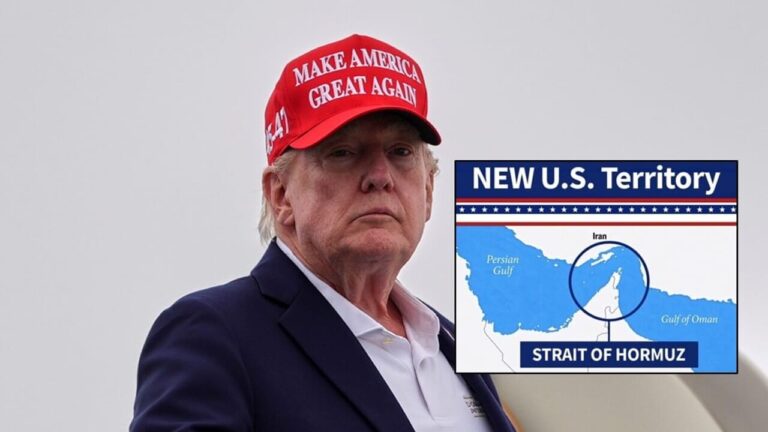
Meanwhile, no signs of détente are arriving from the American front. “There are no ongoing or planned talks or contacts with the Islamic Republic of Iran – underlined Donald Trump in a post on Truth -. The naval blockade remains fully in force. The Strait of Hormuz is open and operational. All mines have been removed or detonated”. What further inflamed the conflict was the American president’s idea – announced during a speech in New York last Friday and reiterated in the Oval Office on Monday – to make the Strait of Hormuz a US territory. And so, again on Truth, the tycoon published a map of the strategic sea route, marked as “new US territory”. On social media, several comments have also pointed out that Qatar and Bahrain are missing from the map posted by the president, apparently “sunken” in the Persian Gulf.
Tehran: “Trump is deluding himself”
Tehran’s reaction was not long in coming. The Iranian government has rejected the designation of the Strait of Hormuz as a “new US territory” and warned that what Tehran considers an “illusion” will soon be “corrected”. “His illusion about the Strait of Hormuz will soon be corrected or we will be the ones to correct this man’s illusions,” Tehran’s deputy foreign minister, Kazem Gharibabadi, wrote in X. The goal of the United States in the war was to force Iran to surrender, but “we will not give up, the United States is now begging us to negotiate on our terms,” Iranian Foreign Minister Abbas Araghchi said, according to Al Jazeera, explaining that the memorandum of understanding signed with the US contained “13 provisions in our favor and one in their favor”, and accusing Israel of having done everything possible to sabotage and prevent its implementation.
“We won the war and we also won diplomatically, forcing the enemy to accept our conditions,” he stressed, adding that Iran’s military capabilities and strength demonstrated on the battlefield gave greater weight to Tehran’s diplomacy during the negotiations. “We informed the mediators that we do not accept a simple ceasefire. On the contrary, we said that the war must end,” Araghchi later said in an interview with Iranian media.
Pressures and concessions
The speaker of the Iranian Parliament, Mohammad Bagher Ghalibaf, accused the United States of wanting to increase pressure on Tehran to obtain concessions which, he claims, were not foreseen in the memorandum signed by the parties. In a message published on X, Ghalibaf criticized in particular the Treasury Secretary, Scott Bessent, and the head of the Pentagon, Pete Hegseth.
“The Americans think that increasing pressure on Iran will lead to concessions that were never part of the deal,” wrote Ghalibaf, who then directly attacked Bessent and Hegseth, saying their handling of the crisis “is well beyond their capabilities.” The president of the Iranian Parliament continued with a highly sarcastic tone towards the Trump administration: “Stop waiting for this team of clowns to pull a rabbit out of the hat and clean up the mess you have created.”