

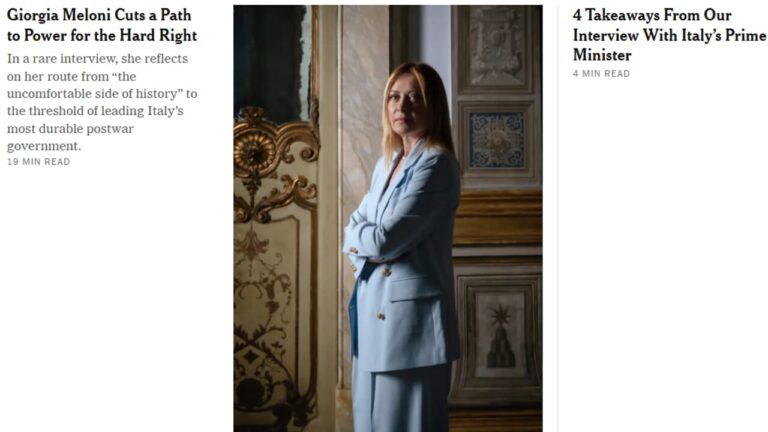
Giorgia Meloni talks about herself in a rare and long interview with New York Times signed by Roger Cohen. The meeting takes place in her office in Rome and reconstructs the trajectory of the leader who entered the post-MSI right at a very young age and went on to lead an executive close to becoming the longest-serving in republican Italy. But it is Meloni’s words about Trump that are causing discussion.
The relationship with Trump: Meloni hasn’t heard from him for weeks
Meloni explains that he imagined a simpler relationship with the American president. “It’s clear that I thought it would have been easier with Donald Trump, given our converging positions on immigration and ‘woke’ culture. But things went differently. However, I continue to believe that Western unity is fundamental. I don’t decide the Italian strategy based on my personal relationships.”
In June, Trump accused Italy of behaving “very badly” after Rome’s refusal to grant the use of bases for US operations against Iran, going so far as to indicate Meloni among the most bitterly contested allies.
For weeks, the prime minister now says, the two have not spoken. To Cohen, who asks her if they will talk again after the summer, she only replies: “Well, we’ll see.” However, Meloni claims one point: “The unity of the West is fundamental. I don’t decide the Italian strategy based on my personal relationships.”
“I should have done theater”
The interview also explored Meloni’s political and personal construction. The prime minister jokes: “I should have done theatre. Imagine how much fun I would have had. I don’t know how it ended up here, but I ended up there. I believe that what brought me this far was the courage to take the uncomfortable side of history, to go against the grain”, she says. Then the story becomes personal: “I grew up with the idea that I was worth nothing. My reaction was to work with all of myself to prove the opposite.” And he adds: “I don’t like others telling me what my limits are. A ‘no’ is one of the things that motivates me the most.”
“I don’t like the idea of a subjugated Italy, of an Italy that considers itself inferior to others.”
Giorgia Meloni at the New York Times
On Italy’s international role, he rejects the idea of a subordinate or inferior country and speaks of the need for a “revolution of pride”.
It is in this passage that Cohen also addresses the relationship with the right’s past. On fascism, Meloni replies: “Clearly, if we look at this story today, it’s one thing. If we had seen it while being in the middle of those events, we probably would have perceived it differently, right?”. Immediately afterwards he recalls the political violence of the post-war period and the Years of Lead: “I know the name and history of all the young people sacrificed on the altar of anti-fascism”.
What does he say about Giorgio Almirante
Cohen then asks her about Giorgio Almirante, historic secretary of the Italian Social Movement and central figure of the political tradition from which the post-fascist right comes. Above all, the prime minister claims a political lesson: “She taught us something very important in terms of values”, she says, and that is “that one can fight one’s battle with dignity even starting from a very marginal initial position”.
Another chapter of the interview concerns Meloni’s relationship with feminism and the choice, maintained since taking office at Palazzo Chigi, to be defined as “the Prime Minister”. The prime minister claims that the feminist movement has fought “the wrong battles”, citing gender quotas and language disputes among the examples. And she explains her position like this: “What interests me is whether I am free to become president of the Council of Ministers. This is equality, not being called ‘the president'”. However, when asked whether she defines herself as a feminist, she does not give a clear answer.
“I am Giorgia” and the battle over identity
The conversation finally returns to one of the speeches that most marked Meloni’s political image, the one that became famous with the words “I am Giorgia, I am a woman, I am a mother, I am Italian, I am Christian”. The New York Times he asks her why those phrases managed to have such a strong resonance.
Gas, defense and finance: this is how Italy has transformed into an El Dorado for Trump’s USA
The prime minister’s response: “Because it touched a sensitive chord that millions of people felt.” That cord, he explains, is “the feeling of being threatened in one’s most authentic and fundamental identity.” And he summarizes the meaning he attributes to that speech today: “He gave a simple name to an emotional rebellion.”