

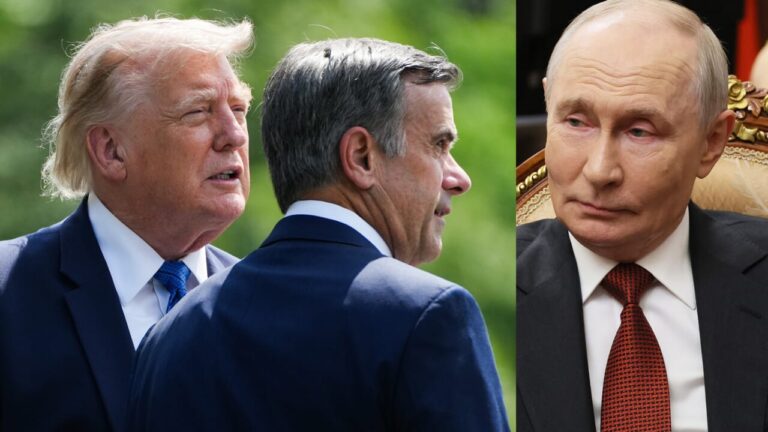
An American military plane landing in Moscow, a column of diplomatic cars crossing the Russian capital and, a few hours later, the discovery that one of the most important men of the Trump administration is on board: John Ratcliffe, director of the CIA. A lightning mission, which lasted about eight hours, was not announced either by Washington or the Kremlin and whose real objective continues to be shrouded in secrecy.
The visit of the American intelligence chief on August 25 was later confirmed by the Kremlin. Dmitrij Peskov explained to Washington Post that it involved “contacts between security services”, without providing any other details. The trip, however, comes at one of the most delicate moments of the Ukrainian conflict. And some elements suggest that it was not a normal consultation between intelligence apparatuses. First of all, the fact that it was the first visit by an American intelligence chief to the Russian capital since the February 2022 invasion of Ukraine. The last time, former director William Burns attempted to dissuade Putin from attacking Kiev.
- The United States may have wanted to test Moscow’s willingness to reopen negotiations on the hypothesis of a free economic zone in Donbass
- The mission comes as the Europeans and Ukrainians seek to strengthen military cooperation, through joint military exercises and the joint production of drones and medium-to-long-range missiles
- Ratcliffe would also have asked Putin for help in getting Trump out of the Iranian quagmire
The American military plane arrived in Moscow
The secret mission was revealed by the transponder signal of the C-17A Globemaster III used by the Americans traced by Osint sources. The tactical transport aircraft departed from Andrews base, outside Washington, stopping in Riga before reaching Moscow’s Vnukovo airport shortly after 9am. The plane left the Russian capital shortly after 5.30pm: approximately eight and a half hours passed between arrival and departure.
Before the trip, Washington had warned Ukraine of the arrival in Russia of a high-ranking US delegation, asking Kiev to temporarily avoid attacks against Moscow, St. Petersburg and some northern Russian regions. A precaution that at least confirms the importance attributed by the United States to the mission.
What Ratcliffe might have said to the Russians
The content of the talks remains officially secret. But the Wall Street Journal placed the visit in a particularly worrying context. According to the American financial newspaper, US intelligence has gathered information on Russia’s first preparations for a possible new military mobilization and on plans intended to “test” NATO’s determination.
It does not mean that Moscow has decided to attack an Alliance country. Nor is there any confirmation that Ratcliffe flew to Russia for this very reason. The temporal coincidence, however, explains why in the United States the mission is also read as a possible warning to the Kremlin against further escalation.
The precedent, after all, weighs heavily. The last known visit by a CIA director to Moscow was in November 2021. Then William Burns was sent by the Biden administration to communicate directly to Vladimir Putin that Washington knew about Russian military preparations and to warn him of the consequences of an invasion of Ukraine. Three months later the large-scale attack began.
Just in these days the authorities Germans are closing the investigation into the attempted drone attack on Leipzig airport, one of the main European logistics hubs and also used by NATO and Antonov Airlines for the transport of military supplies. Last August 4, a drone, loaded with explosives, was found near a Ukrainian Antonov cargo plane also used for military transport. A second unmanned aircraft may instead have collided with a DHL cargo ship shortly after the temporary closure of the airport. Ten days later investigators would have identified a third drone and approximately 50 grams of a powerful military explosive.
The other dossier: Iran
Then there is a second front that could explain at least in part the trip: Iran. Russia and the Islamic Republic have built close military, economic and diplomatic cooperation in recent years, while Washington is attempting to increase pressure on Tehran.
Just on the eve of Ratcliffe’s arrival in Moscow, the US Treasury launched theOperation economic outcasta new sanctions campaign aimed at targeting the Iranian economy and foreign companies that allow Tehran to circumvent American restrictions.
The dossier is also particularly delicate due to the crisis in the Strait of Hormuz. According to some rumours, Ratcliffe asked Russia directly to convince Iran to completely reopen the Strait, threatening, otherwise, sanctions against Russian banks and companies.
Putin and the decree on private companies
The mission also comes as deep-dive Ukrainian attacks are increasing the economic cost of the war for Moscow. On August 24, Putin signed a decree allowing the state to take over temporary management of infrastructure considered critical if the owners fail to adequately protect them from attacks or quickly repair damage.
The definition includes very broad sectors: energy, industry, telecommunications, transport and essential services. The extremely broad formulation of the decree could create the conditions for a progressive acquisition by the State of private companies and assets, also with the aim of increasing public revenues and transferring fewer support costs to damaged companies to the State coffers. At the same time, the Russian Ministry of Finance is studying postponements of tax and contribution payments and other forms of support for companies that have suffered significant losses due to the Ukrainian attacks.
Also in Moscow was the envoy of Pope Leo XIV
At the same time, another Western emissary was in Moscow: Archbishop Paul Richard Gallagher, secretary of the Holy See for Relations with States and de facto Vatican Foreign Minister, met Sergey Lavrov.
💬 FM Sergey Lavrov to Archbishop Paul Richard Gallagher, the Holy See’s Secretary for Relations with States:
Despite global upheavals, Russia & the Vatican have preserved a mutually respectful dialogue, enabling the search for workable solutions.https://t.co/YuTwS1rDBt pic.twitter.com/6GaQmnx5aN
— MFA Russia 🇷🇺 (@mfa_russia) August 25, 2026
Unlike Ratcliffe’s, Gallagher’s mission was announced in advance and will continue until August 28:. Gallagher reiterated that the war “cannot be resolved by military means” and that the conditions must be created for a political and diplomatic solution. The Vatican, he explained, will continue to offer diplomatic and humanitarian support and a space for dialogue.
A small concrete signal could come from the humanitarian front. Russia and Ukraine are preparing a new prisoner exchange of significant dimensions. Russian Human Rights Commissioner Yana Lantratova confirmed that the lists are being finalized.
Moscow rejects Donbass plan
On the political terrain, however, the distances remain enormous. The Kremlin has rejected a US-backed proposal to create some sort of special economic zone in Donbass administered by a third party as part of a possible agreement.
“Donbass is the territory of the Russian Federation,” Peskov argued, adding that it would be “unlikely” to entrust the administration of what Moscow considers its own region to external parties. Russia also continues to consider the presence of soldiers from NATO countries in Ukraine unacceptable even after a possible ceasefire.
What will these military exercises of the Volunteers for Ukraine be like (in which Italy does not want to participate)