

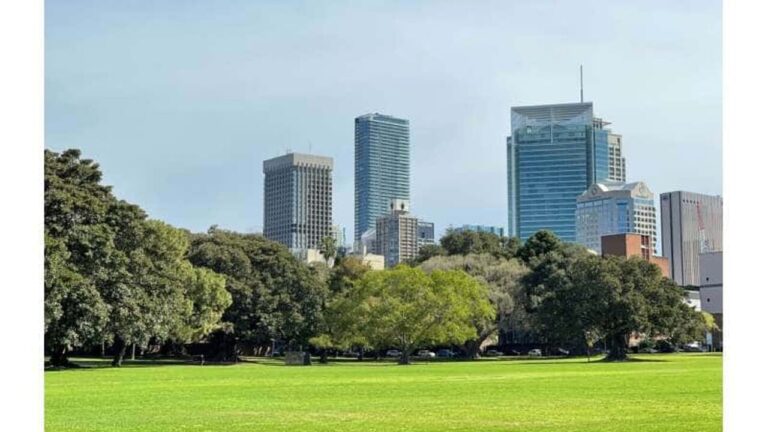
If cutting greenhouse gas emissions remains the only long-term solution to climate change, it is now clear that it will not be enough to return to experiencing a more clement climate. Global warming is here to stay, and adaptation interventions in our metropolises will become increasingly fundamental to survive hot summers, floods and extreme weather events. One of the most effective strategies for lowering temperatures in urban environments is to focus on green areas. But in Europe, unfortunately, few seem to have understood it: research conducted by the Martin Luther University of Halle-Wittenberg and the Justus Liebig University of Giessen examined the local action plans for climate adaptation of twenty-five large capitals and urban centers on the continent, highlighting how interventions based on the planting of trees, the creation of parks and the protection of green spaces represent a minimum percentage of the planned interventions.
An overlooked strategy
The investigation, published in the magazine Progress in Disaster Sciencereviewed approximately 2,500 measures contained in the official urban planning documents of the main European cities. Of the total projects examined, only 11.6 percent involve the direct use of green areas or open spaces. Not that there is a lack of will or attention to the climate: the data collected shows that almost all administrations have included the fight against the climate crisis among their strategic priorities.
However, the approach remains mainly focused on the reduction of polluting emissions (the so-called climate mitigation), leaving adaptation to the already visible effects of global warming completely in the background. An aspect that should not be overlooked, given that the average increases in temperatures recorded in recent years are not destined to disappear, even if we were to suddenly completely eliminate the dependence on fossil energy sources and climate-altering emissions.
More nature against heat and floods
The strong overbuilding, the population density and the extension of asphalted surfaces make urban environments particularly vulnerable to extreme weather events. Increasingly frequent heat waves, water bombs and torrential rainfall generate direct risks for the population and infrastructure. And research has now shown that the integration of more trees and vegetation in inhabited contexts offers effective solutions at low costs.
The plants and tree cover in fact contribute significantly to lowering local temperatures through shading and evapotranspiration, counteracting the “heat island” effect typical of historic centres. At the same time, permeable soils and parks act as natural sponges capable of absorbing excess volumes of water during heavy rainfall, reducing the load on the sewer system and preventing street flooding.
The gap between research and planning
According to the authors of the research, the delay of European cities in adopting green infrastructure does not derive from a lack of scientific evidence. The socio-ecological benefits of natural spaces, in fact, are widely documented and recognized internationally. The gap would rather lie in the methods of administrative management and in the distribution of economic resources: urban planning tends to favor traditional engineering interventions or energy efficiency policies, considered easier to quantify immediately compared to the maintenance and long-term management of public green areas. At the same time, the European Union’s climate targets – aimed solely at reducing emissions – also probably play a braking role on the adoption of urban adaptation measures.
To guarantee the resilience of inhabited centers in the coming decades, scholars recommend a profound revision of the guidelines with which our cities are designed: the objective must be the systematic integration of nature into territorial development policies.
“The percentage of measures aimed at protecting against the already visible consequences of climate change is increasing,” adds Victoria Dietze, researcher at the Justus Liebig University of Giessen. “Green spaces feature much more prominently in adaptation strategies than in plans focused solely on mitigation, but still remain underrepresented overall.”