


The new draft of the EU regulation on short-term rentals is provoking indignant reactions from liberals and centre-right representatives. At least in Italy. Brussels’ aim is understandable: to slow down the rise in prices in historic centers caused by overtourism and the spread of B&Bs. It is the way in which the objective is pursued that leaves some doubt. Let’s see why.
What the draft EU regulation says on short-term rentals
The draft of the Affordable Housing Act – this is the name of the text – introduces criteria to identify areas under “housing stress”. This denomination includes areas in which houses cost too much compared to the average income of the inhabitants (i.e. in a ratio of “equal to or greater than 8”) and if prices have risen in the last 10 years. The squeeze concerns second homes: mayors will be able to impose maximum ceilings, stringent licenses and even curb the purchase of properties not intended for first homes. There are no restrictions, however, for those who rent their main home.
In short, those who own a home located in an area “at risk of high rents” could face restrictions. We are talking – it is better to clarify this immediately – of rules that have yet to be approved, but the controversy has already started. If the new regulation were approved, the Municipality would have the legal authority to deny permission to rent one’s home to tourists or to block advertising on the platforms. The most problematic step, however, is another. And it provides that local authorities may adopt “measures which restrict the acquisition or use of land and residential properties which are not acquired or used for the purpose of a principal residence, whether occupied by the owner or by another person”.
In essence, the text formally authorizes local authorities to introduce rules to prohibit the sale of second homes that fall within areas under “housing stress”. Ultimately, the EU wants to create a legal shield so that mayors can place limits on those who buy properties for uses other than their first home. But only, of course, in areas where particularly extreme and unfavorable economic conditions are created for the residents. In the same draft, however, the Municipalities are invited to adopt less drastic solutions such as the introduction of a maximum limit on the number of licences.
Why the European plan is criticized
The theoretical objective of the EU is to curb real estate speculation and limit the power of large funds or small investors who buy up properties in historic centers, removing them from the residential rental market for families. The rule will probably concern very few owners, but it establishes a principle that some people find radically wrong.
And in fact Brussels’ plan is making the liberals go gray. Deputy Luigi Marattin, secretary of the Liberal Democratic Party, underlines that the EU is “thinking of making a regulation – therefore immediately applicable – in which it will be possible for Municipalities to prohibit the buying and selling of properties in some areas, if not used in the way that the Municipality decides. Pure Soviet Union” he writes. “Then one says that anti-EU sentiments are growing.”
Among those outraged is also the president of Confedilizia Giorgio Spaziani Testa: “Let’s clarify one concept regarding the draft EU regulation on housing” he writes. “Here it is not a question of defending short-term rentals (as those who deal with them legitimately – and rightly – do) or of opposing them (as the well-known lobby which has always only looked at its particulars) painfully does. Here we need to defend economic freedom and the right to property. In particular when faced with the idea of limiting the sale of properties, as well as the fair rent-style ramblings on housing stress”.
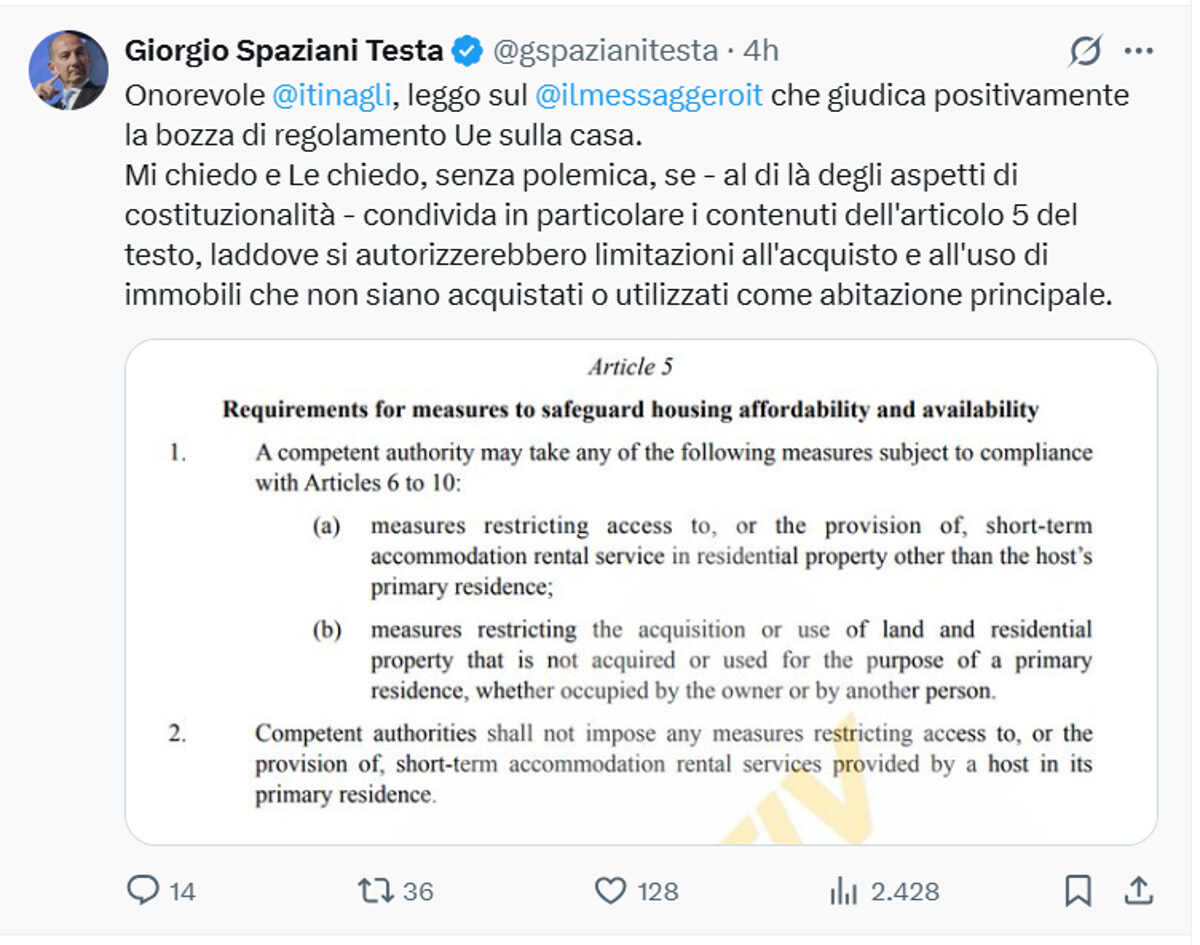
The Brussels proposal is also rejected by the president of Forza Italia deputies Enrico Costa, who defines it as “a further step in the progressive compression of contractual freedom and the right to home ownership. It is not a single provision – he explains -, but the cumulative effect of a plurality of rules which, over time, have affected the possession, the characteristics of the property and the owner’s freedom to decide how to use it”.
Federalberghi applauds the regulation: “In Italy there is nothing to fear”
But there is no shortage of voices in favor of the new regulation. Like that of Bernabò Bocca, president of Federalberghi: “The EU’s intervention on the topic of short-term rentals and their possible limitation in areas under housing stress represents a very important step for the accommodation system in general and, above all, for the quality of life itself in the cities most oppressed by the phenomenon. Apparently, the document will be presented shortly in Brussels: our category applauds a Europe that shows itself to be sensitive to a problem that is certainly not local, but universal”.
“Finally – underlines Bocca – Europe has realized the complexity of the matter, giving mayors the power to regulate the number of short-term rentals in the Municipalities. In the case of Italy, we have reason to believe that the owners of short-term rentals in our villages will have nothing to fear, as these destinations will not fall within the limitations imposed by Europe”.