

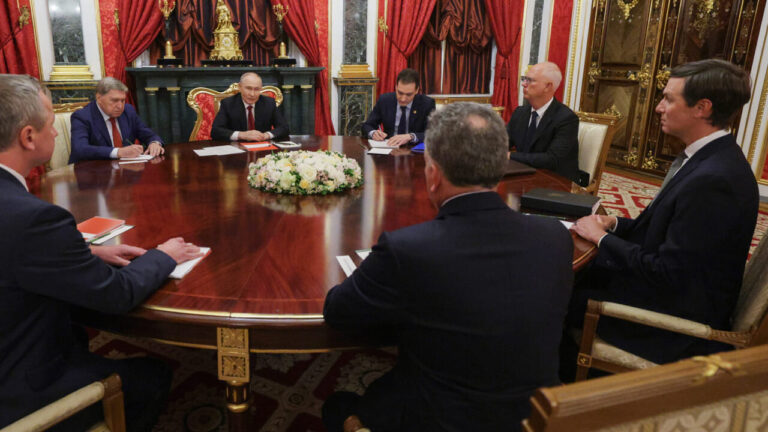
Between Putin’s bluffs and Trump’s “builders” peace remains distant for Ukraine
But what a surprise: yet another trip by the men chosen by Trump to deal with Moscow does not seem to have produced much. The only tangible result was a temporary suspension of attacks on capitals, agreed above all to guarantee the safety of American envoys.
It is especially striking that Trump continues to entrust diplomatic negotiations of this level to Steve Witkoff and Jared Kushner, two men who come first and foremost from the world of business and real estate. They are not without diplomatic experience, but they remain figures external to American professional diplomacy and personally linked to the president’s circle.
Trump has long-standing diplomats, a State Department and a secretary like Marco Rubio. Yet he prefers Witkoff and Kushner. The most plausible explanation is that he really believes that the rules of commercial negotiations can also work in geopolitics: pressure, threats, incentives, economic advantages and finally the “deal”. The problem is that the world doesn’t always work that way.
The propaganda trap
Putin, for example, did not start this war to make money. The war is costing Russia enormously. Its objective is first and foremost political and imperial. For him the economy is an instrument of power, not necessarily the ultimate goal.
Trump, on the other hand, often seems to conceive international politics as a great negotiation in which, in the end, everything can have a price. Putin listens, smiles, keeps the dialogue open and then continues to pursue his goals.
This is the first reason why not much may come of the talks. The second is perhaps even more interesting.
The strategic node
According to Reuters, which cites a source close to the Kremlin, Putin is convinced – based on reports received from his commanders – that the Russian army can conquer the part of the Donetsk region still controlled by Ukraine by the end of the year. Here a question arises: how reliable is the information reaching the Kremlin from the front?
The land front remains largely static. Russian forces continue to advance in some sectors, but very slowly. Moscow has gained territory in 2026, but at a pace that makes the idea of seeing Kramatorsk and Sloviansk fall within a few months extremely ambitious.
Yet in recent months, strong discrepancies have emerged several times between the achievements claimed by the Russian military hierarchies and those that can be documented on the ground. Gerasimov has repeatedly presented data and maps that are much more optimistic than what can be verified through satellite images, geolocalized videos and independent sources.
There is no need to imagine a military conspiracy to lie to Putin. In highly verticalized systems, something much simpler can happen: each level of the chain of command tends to present the most favorable version of reality possible to the superior. A success is inflated, a difficulty downsized, a goal described as close. And the relationship, rising from level to level, ends up transforming.
If Putin really received a systematically too optimistic picture, many of his choices would become more understandable: the closure towards a ceasefire, the belief that a few more months will be enough, the willingness to listen to the Americans without conceding anything and above all the certainty that time works for Moscow.
It is possible that the phrase attributed to Putin is merely a muscular statement to strengthen Russia’s position in the negotiations. But it is also possible that a distorted perception of the war has consolidated in the Kremlin.
It had already happened on the eve of the 2022 invasion, when Russian plans seemed to be based on completely incorrect assessments of Ukrainian resistance and Western reaction. If today Putin were again the victim of overly optimistic information, every diplomatic attempt would be doomed to fail as long as Moscow continues to believe that military success is just a few months away.
And this is perhaps the most important question: not what Putin wants to get out of the war, but what he really thinks he knows about how the war is going.