

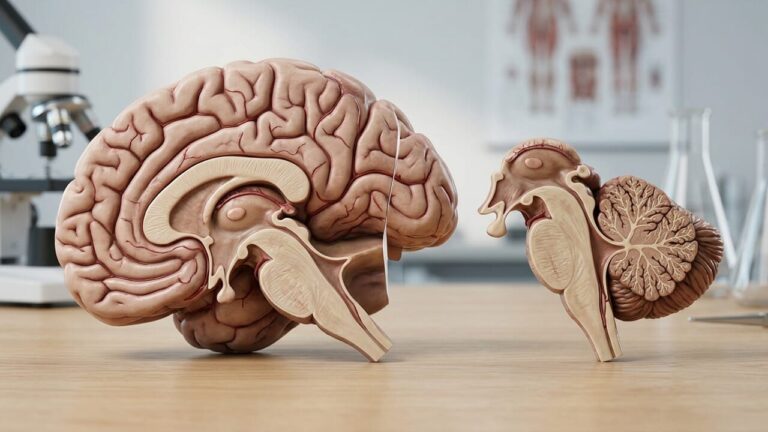
We consider it the center of our being, the steering room of our organism. Yet the brain may not be a single organ, but the fusion of two distinct biological structures, with separate embryonic and evolutionary origins. This was revealed by a study published in Nature Neurosciencewhich denies the scientific paradigm established for decades according to which all brain regions derive from a single type of progenitor cell. Researchers have demonstrated, however, that the anterior and posterior portions of the central nervous system follow parallel and never overlapping developmental paths from the early stages of embryonic development.
The double origin of the brain
For a long time, neurobiology hypothesized that a single cell population gave rise to the entire brain (the main part of the central nervous system, contained within the skull). By analyzing embryonic development in mouse embryos, the team of researchers led by the California Institute of Technology and the University of California at San Francisco instead identified two separate groups of progenitor cells from which brain structures originate.
A group of cells, characterized by the expression of the Otx2 gene, is destined to form the prosencephalon and the midbrain, the areas responsible for higher cognitive functions such as (in our species) language, abstract thought and consciousness. Another group, characterized by the expression of the Gbx2 gene, instead gives rise to the hindbrain, the posterior structure that includes the brainstem and regulates autonomous vital functions such as breathing, heart rhythm and sleep.
The analysis of chromatin, the structure in which DNA is packaged, confirmed that the two groups of cells have completely different configurations. An “architectural” diversity that binds each group to a specific biological destiny, preventing the two cell populations from transforming into each other.
An evolutionary legacy
The discovery of this double evolutionary track in the mammalian brain has prompted researchers to investigate the situation along the entire evolutionary tree. Analyzes of chickens, zebrafish, and even enteropneusts — small, spineless marine organisms that share an ancient common ancestor with vertebrates — have shown the same separation. According to the authors of the research, evolution therefore did not create the brain as a single block, but brought together in space two very ancient pre-existing nervous systems that originally performed separate functions. A union that made it possible to combine the control of primary vegetative functions with superior cognitive abilities.
Understanding this duality is not only of theoretical interest, but could help solve a problem that has hindered laboratory research on brain structures for years. Until now, in fact, cultivating hindbrain neurons in test tubes had always been almost impossible. And the problem, according to the authors of the study, arose precisely from the use of cell populations coming from the wrong group: they had always tried to produce structures of the hindbrain using cells intended for the anterior portions of the brain.
By decoding the hindbrain-specific developmental pathway, the team succeeded in converting human pluripotent stem cells into functional brainstem motor neurons. These test-tube neurons show regular electrical activity and synthesize proteins typical of the structures that control facial muscles and swallowing. The availability of this cellular model opens up new avenues for studying pathologies that currently lack definitive treatments, such as amyotrophic lateral sclerosis (ALS) and spinal muscular atrophy (SMA), the analysis of which was limited by the impossibility of taking samples of posterior brain tissue from living patients.
“We finally have a model with which to better understand these terrible diseases, and work to develop regenerative therapies to help patients,” underlines Rayyan Jokhai, a Stanford researcher who contributed to the study. “This is an extremely exciting new frontier for neuroscience.”