

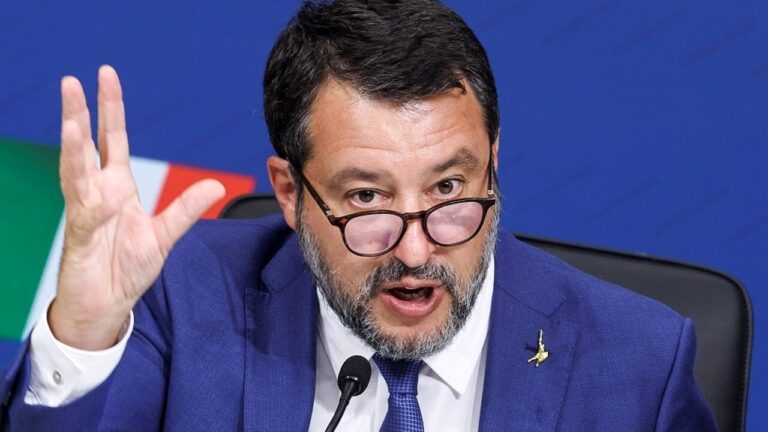
The Meloni government does not stop at the suspension of car and motorbike tax, although for the moment it only concerns 2027 and there is no certainty about what will happen from the following year onwards, i.e. after the political elections, nor about any financial coverage. At least in words. “The tax cut, as far as I’m concerned, is not a point of arrival, but a starting point”, said the deputy prime minister and minister of transport, Matteo Salvini, today on RTL 102.5, after the decision announced in the last few hours by the prime minister, Giorgia Meloni.
Salvini and the super tax
Salvini then confirmed that the objective is to make the tax stop “stable over the years”, as well as to increase the power of the cars involved. Precisely regarding the super stamp, the leader of the League wanted to make a clarification. “I am making estimates at the ministry and it brings in around 250 million euros in revenue per year,” he continued. The tax, he further analysed, includes cars of a certain power, “of those who use them for work as sales agents, taxi drivers and VAT numbers and also the Ferraris of those who can afford it”.
“My idea is not for everyone immediately, but to start raising the power, the displacement for which the super tax is paid” to “increase a market that will bring the State more money than what a 50 million cut would cost”, he reiterated, explaining that it would be “a win-win measure”.
A tax surcharge
The super tax is also defined as “a tax surcharge” to the more traditional car tax: it is payable to the owners (or usufructuaries) of vehicles with a power exceeding 185 kW (kilowatt). The tax was introduced in 2011 with the aim of taxing high-end, high-performance vehicles more. The amount to be paid is calculated based on the power of the car itself and costs 20 euros for each kW that exceeds the threshold of 185 kW, approximately 252 horsepower, to be added to the normal car tax.
Again with respect to the super tax, the amount to be paid decreases as the years pass from the date of registration of the vehicle. The reductions are applied considering 60% for payments after five years from the construction date (12 euros/kW), 30% for payments after ten years from the construction date (6 euros/kW) and 15% for payments after 15 years from the construction date (3 euros/kW).