

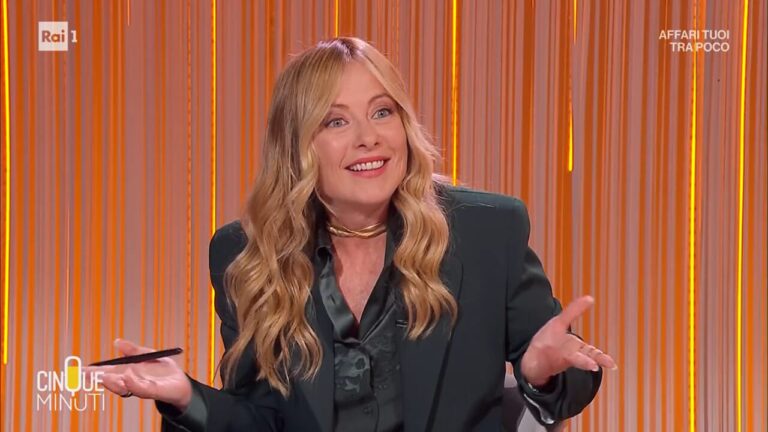
Giorgia Meloni calls Sergio Mattarella into question to defend the government’s proposal to limit the presence of foreign students who do not know Italian in school classes to 30%. The Prime Minister thus responds to the controversy that arose from the words uttered by the Head of State during the inauguration of the school year.
“When the President of the Republic was Minister of Education he drew up circulars that invited not to concentrate foreign children in the same class, it is a measure of common sense. It seems to me it is right to continue it”, states Meloni in the interview with Cinque Minuti, broadcast on Tuesday 22 September on Rai 1.
The response to Mattarella
The comparison was triggered by the speech given by the head of state in Amatrice, where he inaugurated the 2026-2027 school year at the Sergio Marchionne all-inclusive institute, on the tenth anniversary of the earthquake.
Mattarella recalled the constitutional principle of schools open to all, recalling its role in building a society capable of integrating people with different backgrounds and experiences. The school, he said, must help not to form ghettos and not raise barriers, promoting family trust and social cohesion.
My interview just now on “Cinque Minuti”, by Bruno Vespa. pic.twitter.com/qQ68GmYqKN
— Giorgia Meloni (@GiorgiaMeloni) September 22, 2026
Guest on “Cinque Minuti”, a program hosted by Bruno Vespa on Rai 1, Meloni comments: “I don’t think the President of the Republic is afraid of the ghetto classes: I have read this prevailing interpretation”, states the prime minister, explaining that she does not agree with the interpretation of those who consider the head of state’s speech a contestation of the government’s initiative. “Personally I don’t read it that way, because the President of the Republic says that schools must overcome ghettos, not create ghettos.”
According to Meloni, the executive’s proposal would go in the direction of creating “more balanced classes”. The Prime Minister also specifies that the 30% ceiling concerns foreign children “who do not speak our language”.
Meloni attacks Istat: “I don’t know if it underestimates Italians or the government”
In the same interview, the prime minister returns to the public accounts and the failure to reach the 3% threshold in the deficit-GDP ratio. “I’m sorry because we have done a very complex job in recent years which has led us to reduce the deficit, we must remember this from 8.1% when we took office to the current 3.08%”.
Meloni underlines that going below 3% would have allowed Italy to exit the European excessive deficit procedure early. The Prime Minister then contests the statistical revisions of Istat, which updated economic growth for 2024 to 1.1%, initially estimated at 0.7%.
“Now I don’t know if Istat underestimates Italians or underestimates the government, but it’s always happening and I would be very sorry if this happened in two years’ time and if in two years’ time we were to discover that in reality we were below 3% but the estimates were, let’s say, too conservative.”
Car tax, the reply to the M5s: “I’m still paying the 200 billion in building bonuses”
Finally, Meloni defends the car tax exemption scheduled for 2027, rejecting the Regions’ accusations on possible cuts to healthcare resources. “The measure which costs 2.4 billion is not paid by the Regions. The Regions are reimbursed by the State for the resources that they do not clearly collect with the car tax”.
A 172 billion “hole”: how the Superbonus became the heaviest bill in the history of Italy
The prime minister then attacks the 5 Star Movement, which accused the executive of wanting to finance the electoral campaign through the provision. “When I hear a sentence like that from members of the 5 Star Movement, given that I’m still trying to pay the 200 billion euros of building bonuses that we used to allow Giuseppe Conte to say that people could renovate their homes for free, it makes me quite smile.”
The free car tax (but not only) comes from the Pnrr: so the government has “moved” 1.7 billion into the catch-all decree
Meloni assures that nothing will be taken away from regional healthcare and claims that the presidents of the Regions against the measure could decide not to join, renouncing the state contribution and continuing to collect the tax. The prime minister then defined the criticisms of the regional presidents belonging to the opposition parties as “instrumental”.