

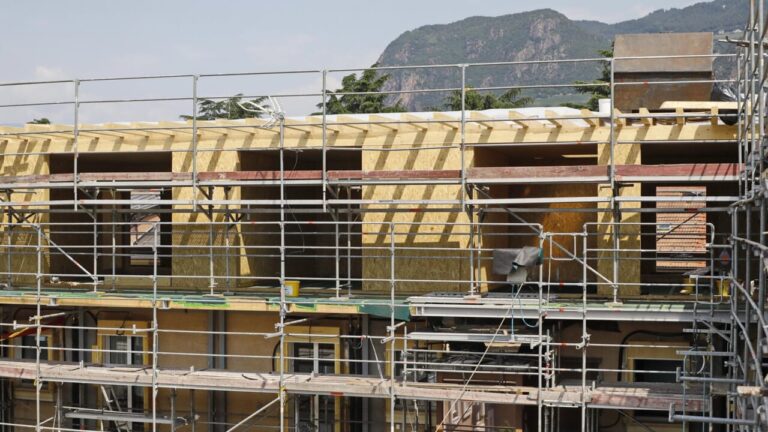
The work on the economic maneuver for 2027 has started. It is the last budget law of the Meloni government’s legislature. Yesterday the Council of Ministers gave the green light to the public finance policy document (DPFP): the text contains the main points of what will be the next budget, together with the related coverage. The economic context is not the best, due to the increase in energy costs and the grip of inflation. Among the interventions the government is looking at there are also those on home bonuses, starting with the ecobonus.
From 50% to 65%
“We must work on incentives for energy efficiency because there we can raise the bar higher and we have no problems with the accounts” for the European flexibility clause, said the deputy minister of Economy, Maurizio Leo, in a meeting with Confartigianato, speaking about the possibility of raising the deduction for energy requalification costs from 50% to 65%.
We are in the realm of hypotheses, of course, at the moment. Rates, permitted interventions and precise conditions will still have to be defined. Deputy Minister Leo made a distinction between private and public assets. For the first, “we try to raise the bar higher than 50%”, he explained, citing the thermal coat and solar panels. For the second, however, he indicated the possibility of intervening on healthcare and school structures.
According to the current rules, for expenses incurred in 2026 the ecobonus is worth 50% for owners or holders of a real right who intervene on the main residence, 36% in other cases. In 2027, without a new legislative change, the two percentages will drop to 36 and 30% respectively. A possible move to 65% would therefore mark a reversal compared to the reduction already envisaged. We’ll see.
The list of admitted works
Which interventions would fall under the ecobonus discounts? Without prejudice to the fact that the conditional is currently a must, recently Enea (the National Agency for new technologies, energy and sustainable economic development) updated its handbook on the incentive. It did not introduce anything new, but clarified the scope and the technical rules of the deduction, as they have been in reality since last January. However, the document becomes an important starting point for understanding what the ecobonus could be like next year.
Enea divides its list into more than 13 points (here is the complete list): they range from the global redevelopment of buildings to insulation and biomass heat generators, through heat pumps and fixtures. Regarding the common areas of the condominium, Enea makes several clarifications:
- the intervention must concern the envelope of the common parts of condominium buildings delimiting the heated volume towards the outside and/or unheated rooms and/or the ground;
- the intervention must affect more than 25% of the dispersing surface;
- it must be configured as a replacement or modification of existing elements (and not as a new construction in expansion);
- if the works are carried out at the same time, the intervention can also include the replacement of windows including frames, the installation of solar shading that insists on the same surface of the casing as the object of the thermal insulation intervention and interventions on the common heating systems.
The insulation
The costs for the insulation of the structures are also eligible, as long as the intervention is configured as insulation of the existing opaque structures (and not as a new construction in expansion) and delimits an already heated volume towards the outside, towards unheated rooms or against the ground. It is in this area that the thermal coat falls.
Windows and fixtures, screening and solar collectors
The ecobonus also includes works related to the “replacement of windows, skylights and doors including frames, delimiting the heated volume towards the outside or towards unheated rooms, which comply with the UW thermal transmittance requirements (W/(m2 x K))”. The same applies to “purchase and installation of solar shading and/or mobile blackout technical closures” that are “mounted integrally with the building envelope or its components and installed inside, outside or integrated into the glass surface”.
The ecobonus also applies to the “installation of solar thermal collectors for the production of domestic hot water for domestic or industrial uses and for covering the hot water needs in swimming pools, sports facilities, hospitalization and care homes, schools and universities”.
Biomass heat generators
Enea then mentions the “installation of winter air conditioning systems equipped with heat generators powered by combustible biomass”, provided that it is a total or partial replacement of the existing winter air conditioning system. These are biomass boilers, pellet stoves and thermo-fireplaces, wood-burning thermo-fireplaces and wood-burning stoves.
Boilers, heat pumps and hybrid systems
Condensing boilers (air or water), high efficiency heat pumps (or low enthalpy geothermal systems) and the replacement of heat pump water heaters are also eligible for the deduction. It then mentions the “complete or partial replacement of winter air conditioning systems with systems equipped with hybrid devices, consisting of a heat pump integrated with a condensing boiler (or biomass in the cases foreseen), created and designed to work in combination with each other”.
Micro generators and building automation
The list of works eligible for the ecobonus also includes “the purchase and installation of micro-cogenerators powered by renewable sources to replace existing systems that lead to primary energy savings (PES) ≥ 20% with electrical power < 50 kWe". The list closes with the installation "of building automation systems for the personalized automatic management of heating or domestic hot water production or summer air conditioning systems, including their remote control through multimedia channels".