

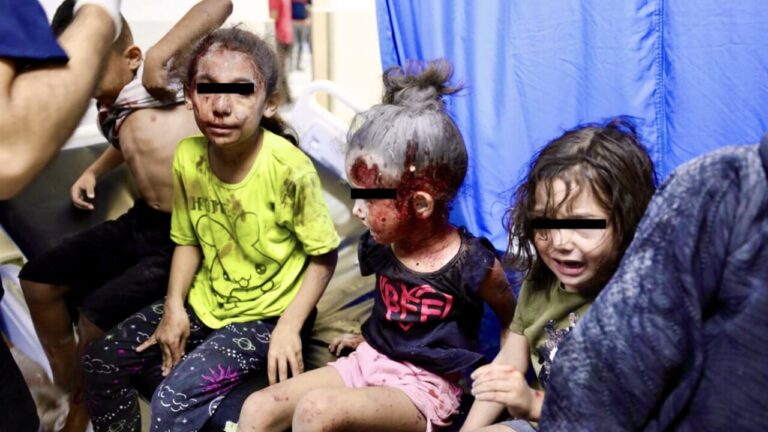
Civil collateral damage. In Israeli military jargon they say Nazaand it is the title of the documentary that is filling cinemas. Whoever pulled the trigger, or operated a drone, tells how many civilians they were allowed to kill to hit a target. I spoke to one of these “collateral damages”: he is a child, he is 13 years old, his name is Ismail and an explosion took away part of his skull.
Only the skin protects his brain
Ismail and his mother connect on WhatsApp from the Gaza Strip. From the screen I see a dark room, objects stacked on top of each other and little else. An interpreter is on the line with us and it is he who allows me to speak with Ismail’s family and listen to their story. The words, coming through another voice, arrive a few seconds late but the expressions on their faces need no translation and Ismail even manages to smile at me.
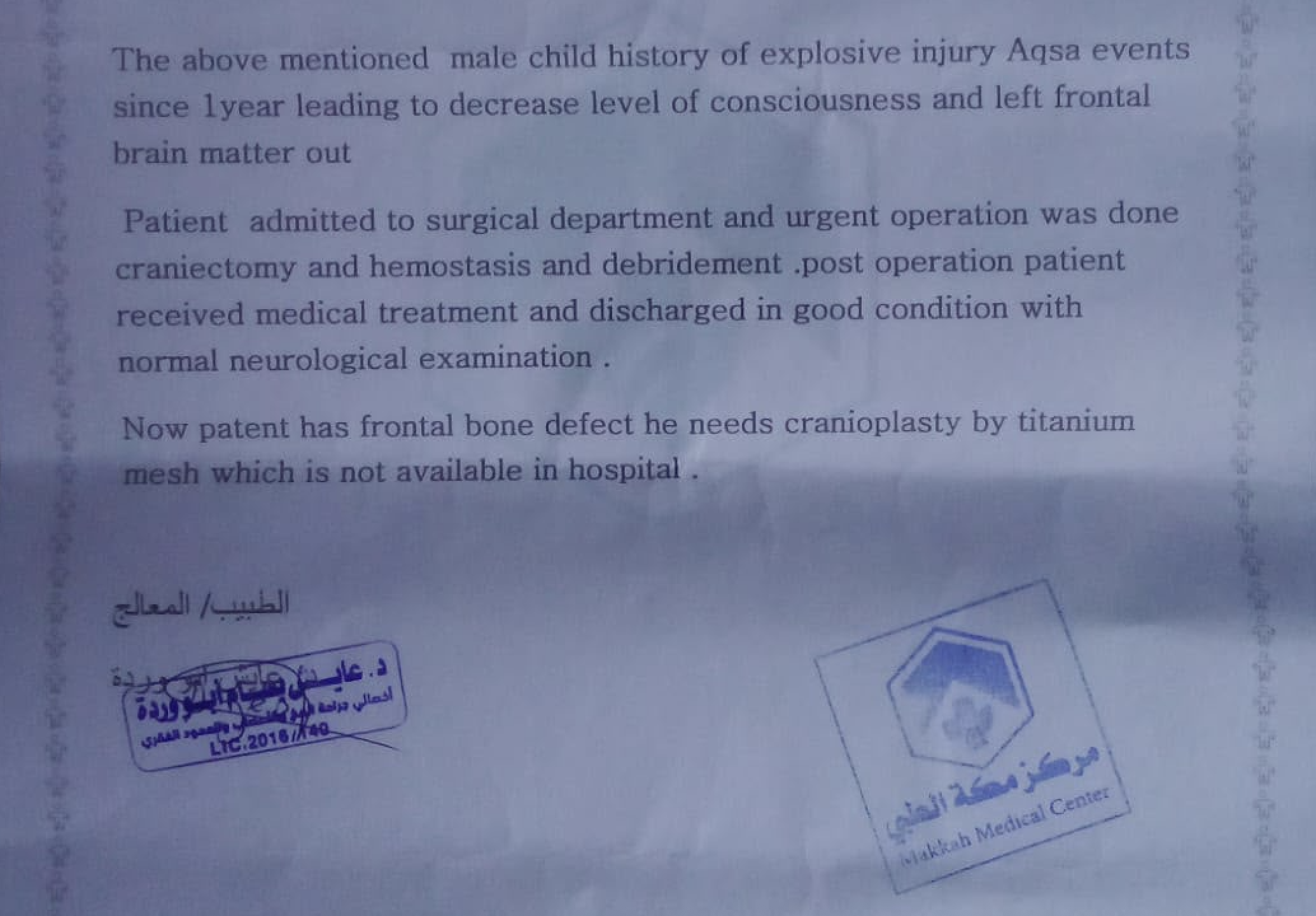
“As-salāmu ʿalaykum,” they greet me. The woman wearing the hijab is called Noah, she is Ismail’s mother and she tells me what happened. Just over a year ago, Ismail arrived in hospital after an explosion with his consciousness impaired. The wound on the left front of the skull had exposed brain tissue. The doctors operated on him urgently: they removed part of the bone, stopped the bleeding and cleaned the wound. Ismail survived and was discharged after a normal neurological exam, but that piece of bone is no longer there. At that point his brain is protected only by his skin. Every fall, every bump, even a run can be a danger.
I read his report, issued by the Makkah Medical Center, a medical center in Gaza City at the northern end of Shari’ al-Nafaq. To close that gap, a cranioplasty with a titanium mesh would be needed. The hospital writes it clearly: that material is not available there. Ismail has already had a video consultation with a specialist in Italy but the humanitarian corridors are interrupted and to date there is no exit from the Strip. Ismail is not alone. According to the WHO, more than 18,500 patients are awaiting medical evacuation. The Rafah crossing was closed on 28 February 2026 and in April the WHO suspended its international relief operations. According to the Gaza Ministry of Health, between six and ten patients die every day while waiting to leave.
What the wounds in hospitals tell us
In September 2025 the Dutch newspaper de Volkskrant published an investigation by Maud Effting and Willem Feenstra named after What the wounds are telling uswhich translated means “what the wounds tell us”.
The two journalists interviewed 17 foreign doctors and one nurse, arriving from the United States, the United Kingdom, Australia, Canada and the Netherlands, who have worked in six hospitals and four clinics in the Strip since October 2023. Fifteen of them reported having treated children under fifteen who had been hit by a single bullet to the head or chest: 114 cases in all, documented with x-rays, photographs and clinical notes. Many did not survive. The real cases are probably more, because those who die before arriving at hospital are not counted. The investigation received the Distinguished Reporting Award of the European Press Prize 2026.
California trauma surgeon Feroze Sidhwa said: “It’s targeted fire. Someone pulls the trigger on a child.” In June 2026, the UN Independent Commission of Inquiry examined the injuries of 17 children aged between 3 and 16 who were hit by firearms. Of the 15 cases analyzed in full, in 12 the wounds were compatible with a single targeted shot, fired by snipers or drones. Head injuries have become one of the pediatric emergencies in the Strip. According to a study from the neurosurgery departments of the European Hospital in Gaza and the Nasser Complex, between January and September 2025 almost half of patients with penetrating head trauma were 18 years old or younger, with a median age of 13. Three in ten died. Ismail, wounded by an explosion and hit in the head, is among those who made it.
What will be the future of Ismail
Ismail no longer goes to school and has missed more than two years of education. Medicines for his condition are often not available and Unicef warns that, without essential medicines, injured children suffer more and risk infections and complications. Noah, his mother, is afraid that he might suddenly lose consciousness. Yet, Ismail’s gaze is curious, like that of every child: he observes me through the screen, smiles at me, greets me.
I ask him if he liked going to school. He shakes his head in the negative. It’s the same reaction my niece has when you talk to her about school. Ismail is not a number in a bulletin or a diagnosis in a report, but a boy who feels what all kids his age feel. Except that his right to childhood was taken away.
Money to Hamas, fight against the moderates: Israel’s seven mistakes – by Fabrizio Gatti
In genocide, one of the most effective weapons is dehumanization: when a population stops being described as made up of people and becomes an indistinct mass, everything becomes bearable. The tents, the hunger, the schools destroyed. Even a child who lives with part of his skull exposed while, a few hours’ flight away, there is someone who could operate on him becomes one. At the end of the call Ismail waves goodbye and the screen goes black. There are those who would insist on calling him collateral damage, but I think we should call him by his name: Ismail, a human being.
Dossier is the exclusive subscription investigative section of The Vermilion. If you want to support our journalistic work and subscribe, Click here.