

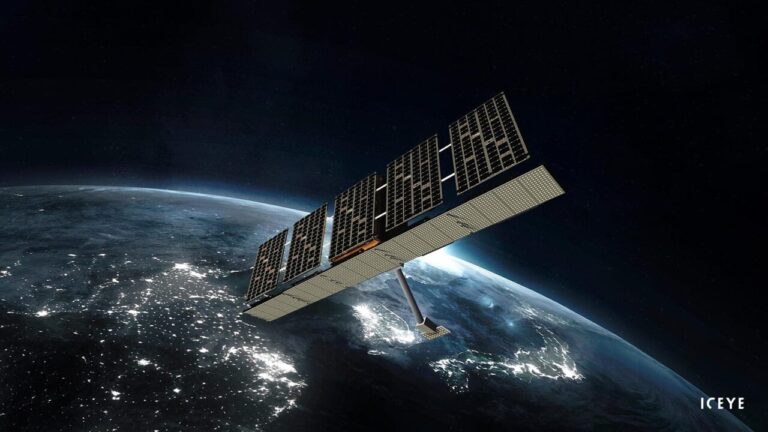
The war in Ukraine is also spatial. Through a maneuver that began hundreds of kilometers away, a Russian satellite, Kosmos 2612, arrived just 100 meters away from a Finnish one that provides military intelligence data to Kiev’s armed forces. The proprietary company that suffered the Russian approach is Iceye. The methods of the operation are considered particularly unusual and could represent, according to specialists, a demonstration of Russian military capabilities in space.
What IceEye does with its satellites: the Russian submarine hidden under a tarpaulin
The same company, on its website, shows the capabilities of its satellites and the different applications of the available technologies. Founded in Finland, it operates a constellation of radar satellites that observe the Earth’s surface and provide images and analysis to governments, militaries, intelligence services, insurance companies and organizations involved in emergency management. Examples include a photo of the Russian naval base in Sevastopol, in occupied Crimea. The released satellite photo identifies it as the probable Russian submarine Rostov-on-Don, covered by a protective sheet.
In fact, SAR technology allows us to observe military vehicles and infrastructures even at night and through clouds, analyzing the radar signals reflected by objects. Other examples published by the company show two Mi-26 military helicopters at Khmeimim air base, Syria, imaged on November 5 and 7, 2024, and damaged aircraft at Sana’a airport, Yemen.
The pursuit in space: from 350 kilometers to a few hundred meters
The sequence of maneuvers was reconstructed by companies specialized in monitoring objects in orbit, including LeoLabs, and by independent analysts. The Russian satellite Kosmos 2612, launched in April 2026 together with other Russian military satellites, had begun to modify its orbit already on September 30, to progressively align itself with the trajectory of Iceye-X36, which operates in low Earth orbit – called Leo – at around 550 kilometers altitude.
Between October 15th and 16th, according to data released by LeoLabs and reported by CNNthe Russian satellite reduced the distance to the western medium from hundreds of kilometers to less than five. Over the following days, it remained nearby, making further trajectory adjustments and moving in front of and behind the commercial satellite.
According to orbital data analyzed by the agency Afpon October 18 the two satellites would arrive within 100 meters of each other. LeoLabs provided a more conservative estimate, indicating an approach of about 500 meters and underlining the uncertainty of the measurements.
The maneuver of weeks: “I no longer have doubts, Russia is interested in the satellite”
The Russian craft repeatedly changed its orbit to reach and follow the other satellite, using fuel and sophisticated navigation capabilities. The specialized bulletin of Isr University, in issue 155 of 14 October 2026, had reconstructed the changes in the orbit of Kosmos 2612.
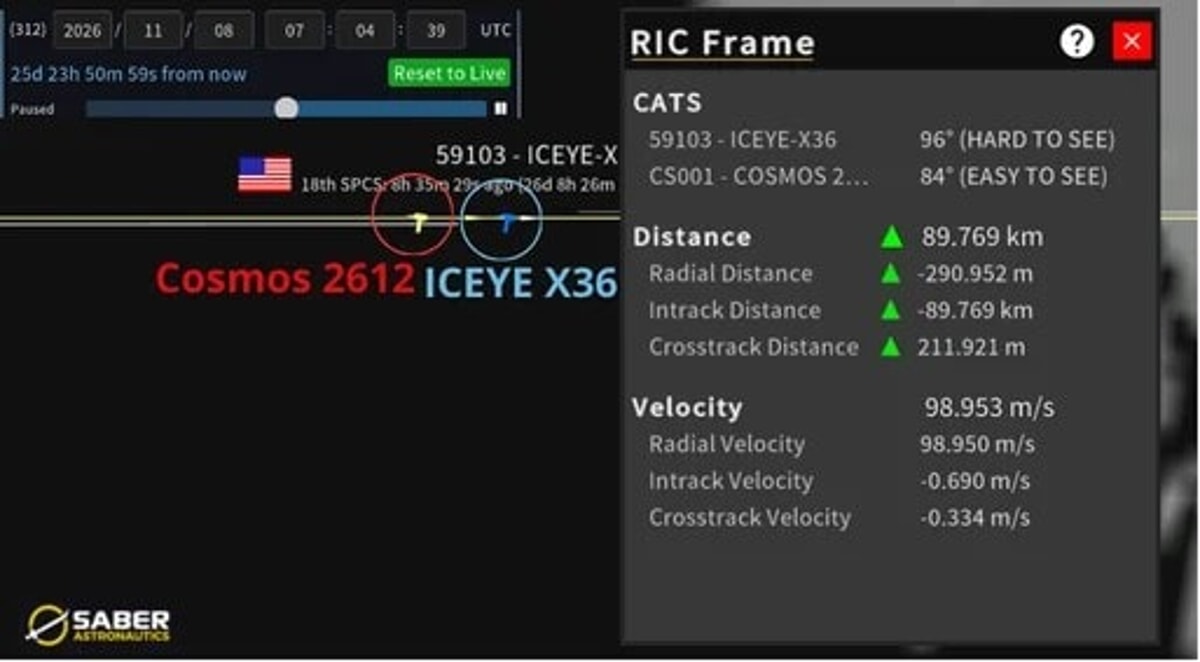
The analyst’s editorial comment, published before the closest approach, reads: “I initially thought that the September 30 orbit raise meant that Kosmos 2612 was moving away from Iceye-X36. It was exactly the opposite.”
“This is the patient, efficient and well-executed preparation of an approach, which eliminates for me any remaining doubt that Kosmos 2612 is interested in Iceye-X36. A Russian military satellite now has an orbital plane and orbit shape matching that of a commercial radar satellite supporting Ukraine. All that remains to be filled is the distance along the orbit, which Russia can reduce with limited fuel consumption and on its own time. Further updates will follow.”
Why Russia is hunting satellites
The Sar “filters” of the Iceeye satellite make it possible to monitor military installations, vehicle movements and changes on the ground even when visibility is reduced, such as at night, through clouds and disturbances. On January 19, 2026, Iceye officially announced the expansion of collaboration with a body of the Ukrainian Ministry of Defense, ensuring greater access to radar images of its constellation.
Researcher Juliana Suess, of the British Royal United Services Institute, had already examined the Russian maneuvers, identifying three possible objectives: intimidating Western operators, intercepting or jamming the satellite’s communications or preparing physical interference.
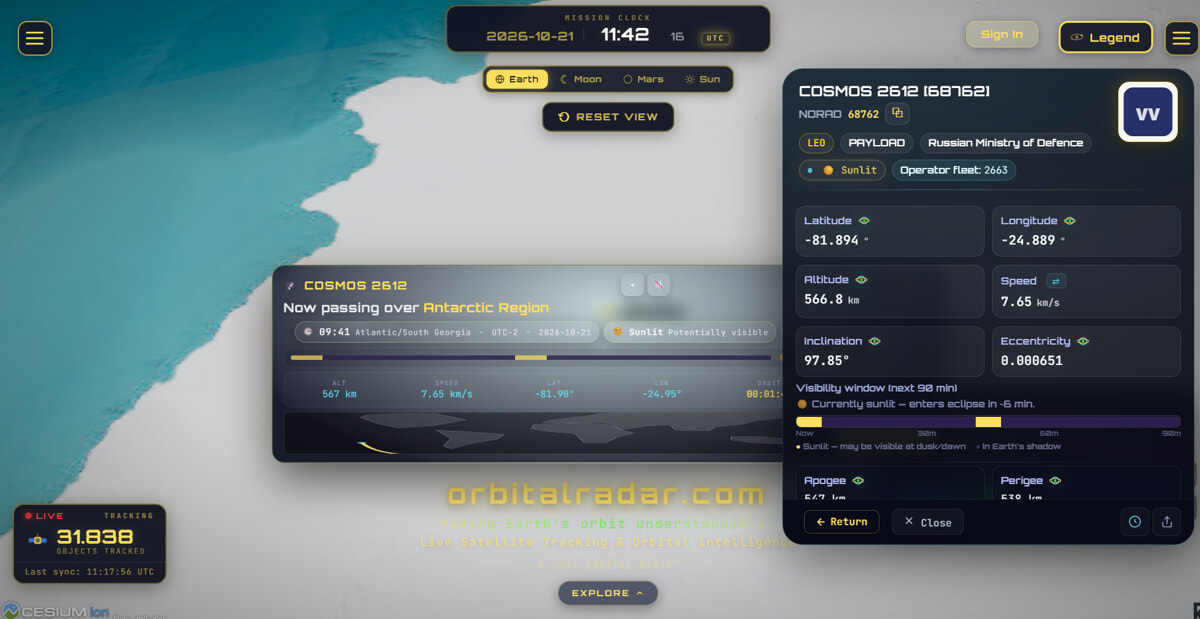
Kosmos belongs to the Russian Defense Ministry. Over 2,000 are active on the Orbitalradar satellite monitoring site. At the time this article was written, Cosmos 2612 was over the Antarctic. Others in the fleet are identifiable in other parts of the world, especially in passages over Ukraine and central Europe.
The precedent concerning Italy: the Athena-Fidus satellite
Close-in operations of Russian satellites against Western infrastructure are nothing new. A documented precedent directly involves Italy. In September 2018, the then French Minister of the Armed Forces, Florence Parly, had denounced an espionage attempt attributed to the Russian satellite Luch-Olymp, which in 2017 had approached Athena-Fidus, a telecommunications satellite developed jointly by Italy and France for their respective armed forces and civil security structures.
What is true in the disappearance of Russian bots after Ukrainian attacks on Yandex
Regarding the latest story, Iceye made it known that he is aware of the incident and is following its developments. The Russian satellite has moved away. Questions about his actual intentions and the nature of the capabilities demonstrated during the approach remain unanswered.