


One million one hundred thousand transfers that may never have happened because finding a house costs too much. It is one of the less visible effects of the European housing crisis, which does not limit itself to eroding family incomes, but also ends up affecting professional opportunities. The phenomenon is quantified by a study by the International Monetary Fund, according to which difficulties in accessing housing may have prevented approximately 1.1 million movements to expanding regions in the European Union over the course of a decade.
The starting point is a paradox: the cities that offer the greatest employment opportunities are often also those where living costs the most. And this can prevent workers from moving, even when they could find better work elsewhere.
The work is there, but moving costs too much
The mechanism is simple. A worker finds a higher-paying job far from home, but when he starts looking for an apartment he discovers that a large portion of the salary increase would be absorbed by rent. At that point, changing jobs may no longer be worthwhile.
To verify how much this phenomenon weighs on the economy, researchers analyzed the movements of workers in Germany and in several large European regions, comparing them with the trend in demand for personnel.
The results show that, when employment opportunities increase in an area, more workers arrive if housing is affordable. However, where housing costs are high, the ability to attract new residents decreases.
In Germany, for example, the study found that areas where housing costs less are able to attract more workers when employment opportunities increase. Conversely, where rents and house prices are high, the presence of new jobs also pushes fewer people to move.
How many transfers have been missed for the expensive home
Economists have also tried to quantify the phenomenon. For Germany they estimate around 86 thousand missed transfers between 2010 and 2020 due to difficulties in accessing housing. Extending the calculation to the European sample, they arrive at approximately 1.1 million potentially missed trips over ten years.
However, there is an important clarification: it does not mean that a million people have actually rejected a job offer. It is a statistical estimate, obtained by comparing the observed transfers with those that could have occurred if the cost of housing had been less high. The researchers themselves point out that the European calculation is less precise than the German one.
The underlying problem remains: when changing cities becomes too expensive, finding a better job can also become more difficult. An awareness that is making its way into several cities of the Old Continent. According to recent estimates, based on a study by the Deutsche Bank Research Institute, renting a house in the center of Lisbon involves an expense equal to 116% of the salary of residents in the Portuguese city. Things are not better even in other cities or even in Italian ones: in Milan the expenditure would be 71%, in Rome 65%. And often things don’t get much better even when moving to the suburbs, as we have underlined in this in-depth analysis.
Rents eat up more than half of income
Those who pay the highest price for the housing crisis are above all families with low incomes living in cities.
According to the study, tenants in the poorest income bracket typically spend between 35% and 45% of their disposable income on paying rent. For the wealthier ones, however, the share fluctuates between 10% and 18%.
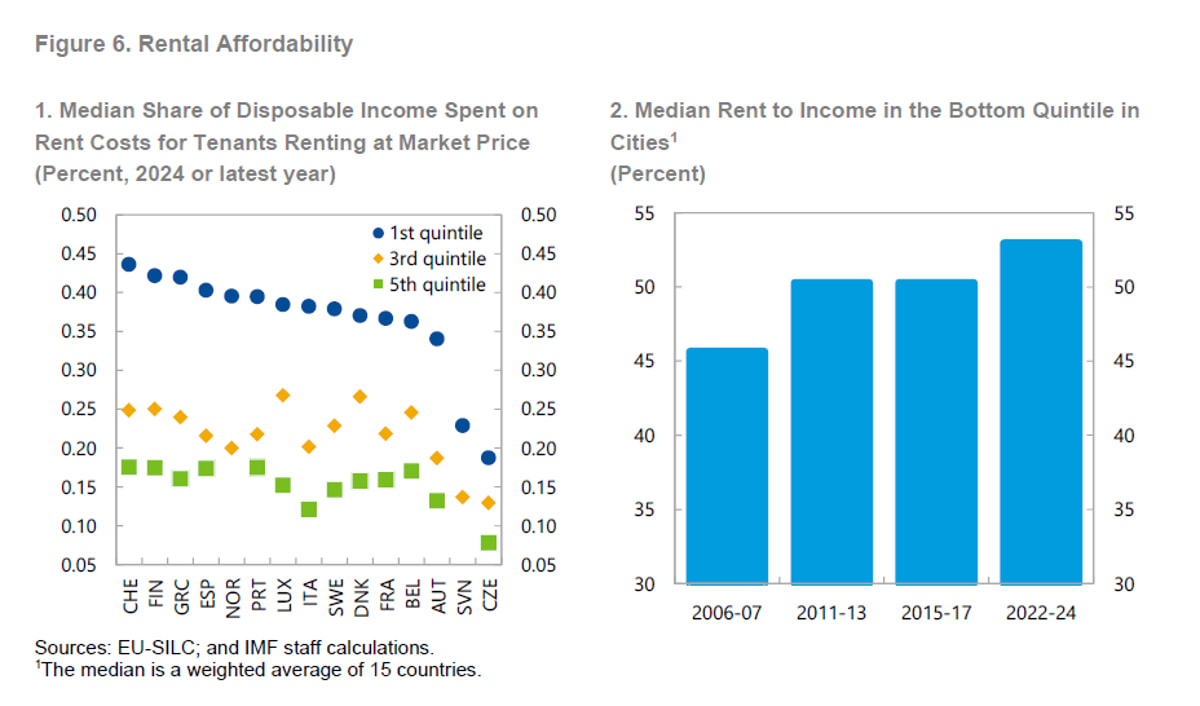
In urban areas the situation is even more difficult. For renters belonging to the poorest fifth of the population, the median ratio between rent and disposable income rose from 46% in the 2006-2007 period to 53% in the three-year period 2022-2024.
It means that, for some of the most vulnerable families, over half of the available economic resources are absorbed by housing. And if it is already difficult to afford the cost of a house in the city where you live, moving elsewhere to look for new opportunities can become prohibitive.
Buying a house has also become more difficult
The cost of living isn’t just about rent. The study highlights that it has become progressively more difficult for European tenants to buy a home, especially in cities.
The situation is particularly complicated for economically vulnerable families, i.e. those who do not have sufficient savings to face an unexpected expense. For this category, the estimated probability of transitioning from renting to owning fell below 2% in 2022-2024, less than half compared to the years before the 2008 financial crisis.
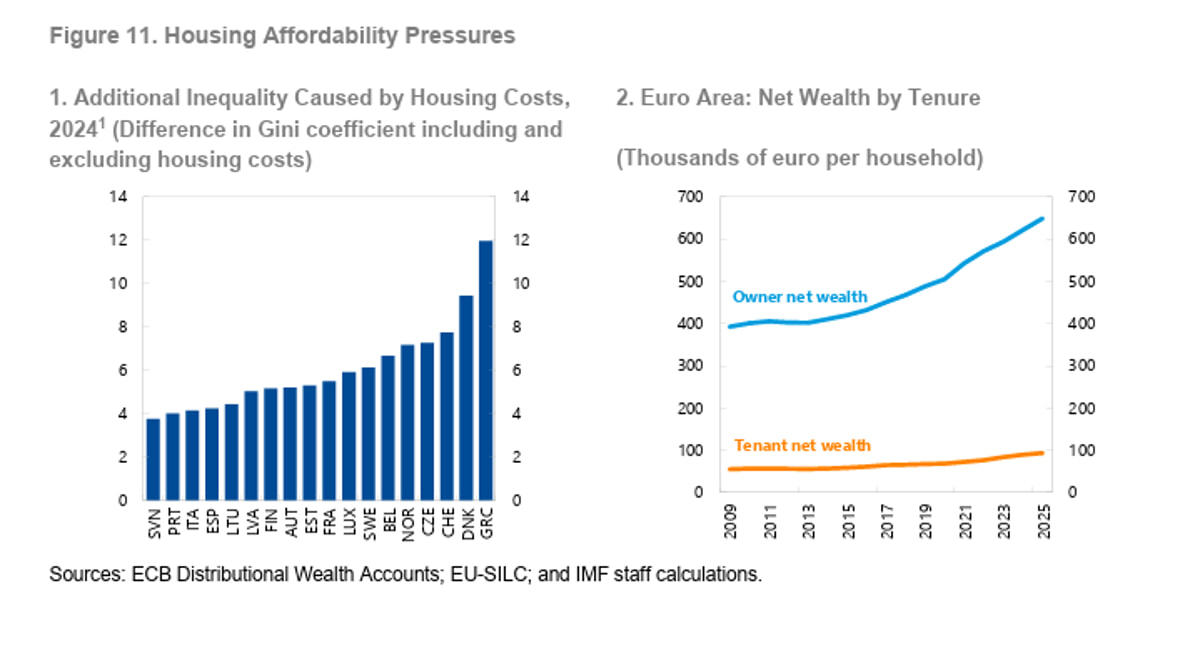
The result is that the gap between those who already own a home and those who live in rent risks widening. Landlords can benefit from rising property values, while tenants must allocate an increasing portion of their income to housing costs, with less opportunity to save.
But why have house prices become so high? According to economists at the Monetary Fund, the causes have changed compared to the past.
Before the 2008 financial crisis, the increase in prices was mainly favored by the expansion of credit and the greater ease of obtaining mortgages. In recent years, however, the shortage of new homes has taken on increasing importance.
The shortage of workers in the construction sector and the difficulties in financing companies contribute above all to slowing down construction in Europe. In many countries, such as Italy, the problem is also the structural lack of public housing for decades. The result is that, in many areas, the supply of homes is failing to keep pace with demand.
The economic cost of missed transfers
The cost of housing does not only weigh on families. When workers are unable to move to areas where there are more opportunities, companies can also face difficulties in finding staff.
Economists have tried to measure this effect in Germany, estimating that, without the mobility obstacles linked to expensive housing, GDP could be higher by between 0.02% and 0.10%. However, a similar estimate is not provided for the entire European Union: the available data do not allow an equally reliable calculation, but the estimates could be similar.
The solutions indicated? Simpler construction procedures, better access to finance for builders and interventions to address construction labor shortages.
Another important role can be played by social housing and affordable rentals, especially for families with lower incomes. An activity which, at least in Italy, has been disinvested in for decades.