

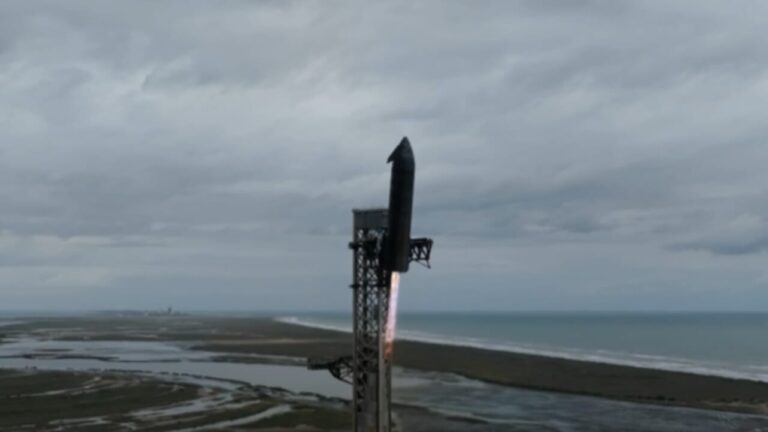
SpaceX writes a piece of history by managing to recover the upper stage of a conventional orbital rocket. Until now, after every space launch, half of the rocket was recovered while the other half burned up in the atmosphere, lost forever. SpaceX, for the first time in the history of astronautics, has instead completed the return to orbit of the entire rocket.
This is one of the greatest engineering achievements in aerospace history. The result could pave the way for its future reuse. To reach distant destinations such as the Moon or Mars, a spacecraft must first be refueled while in Earth orbit by other “tanker” Starships. This operation requires dozens of close launches in just a few weeks. With the new system, a rocket could be refueled and launched again in a matter of hours or days, making space travel much cheaper and more frequent.
Mechazilla catches Starship! Congratulations to the entire SpaceX team on this incredible achievement! https://t.co/YJzmGUZb2B
— SpaceX (@SpaceX) November 14, 2026
“Kudos to an incredible team,” Elon Musk wrote on X. Jared Isaacman, the head of NASA, said “congratulations to Elon Musk! It was almost magical, one step closer to the Moon”.
Congrats to @elonmusk and the @SpaceX team! It was almost magic..Making more believers by the day….one step closer to 🌖🇺🇸 https://t.co/PYs9yNQMdg
— NASA Administrator Jared Isaacman (@NASAAdmin) November 14, 2026
Because SpaceX makes history
SpaceX launched the mission, expected to last 22 hours, on Friday afternoon despite the nationwide ban on ground flights due to communications problems. Rockets use tracking and navigation systems different from those used by aircraft.
In an unprecedented maneuver, the Starship spacecraft descended with pinpoint precision and was welcomed into the arms of the launch tower in South Texas.
Today’s success comes after SpaceX engineers warned that the company could abort the attempt at any time if problems arose. Company spokespeople stressed several times that, given the nature of the risks, those responsible for the flight should have taken a prudent approach. To reach the launch tower, Starship had to fly over populated areas of Texas and Mexico.
With this step, the progress is manifold. Costs are reduced. Saving part of the rocket means no longer having to spend hundreds of millions of dollars rebuilding all the components every time. Until now rockets have been small and expensive, with a huge and reusable rocket, entire pre-assembled space stations, large telescopes or enormous quantities of materials can be brought into orbit to build permanent bases.
Inspecting ship 42 right now https://t.co/mazv15Dxtk
— Elon Musk (@elonmusk) November 14, 2026