

Employees and VAT number, among the most compared categories ever. The 2027 budget law reignites the debate: who earns more and who is more “advantaged” by the various schemes and active cuts? The financial maneuver itself could rewrite the answer. The benefits change between flat-rate schemes, flat taxes and Irpef cuts.
VAT numbers, who saves the most with the flat tax
The flat rate regime is already one of the main benefits reserved for professionals and small entrepreneurs. In 2026, natural persons with revenues or compensation not exceeding 85 thousand euros can access it, respecting the other requirements established by law.
The substitute tax is equal to 15%, reduced to 5% for the first five tax periods in the case of new activities that satisfy the specific conditions established by law. The advantage also derives from the method by which taxable income is calculated. Not all revenues are taxed: a profitability coefficient established on the basis of the activity carried out is applied and the compulsory social security contributions paid are deducted from the result, according to the rules of the regime.
A professional with a coefficient of 78%, for example, on 60 thousand euros of compensation determines a flat-rate income of 46,800 euros before the contribution deduction. It is on this basis, subsequently reduced by deductible contributions, that the substitute tax is applied.
Flat tax up to 100 thousand euros in 2027: savings can exceed 13 thousand euros
Article 9 of the 2027 budget bill proposes to permanently raise the limit for applying the flat-rate regime for the purposes of income taxes and the subsidized contribution regime from 85 thousand to 100 thousand euros. The novelty, however, only concerns direct taxation. For VAT exemption the threshold of 85 thousand euros would remain, giving rise to a system with two different limits. Anyone who exceeds 85 thousand euros without exceeding 100 thousand can continue to benefit from the flat rate taxation on income, but loses the VAT exemption according to the specific temporal rules established.
The potential benefit is significant. In the hearing on the 2027 budget, the Parliamentary Budget Office presents a comparison between taxpayers with the same actual income. A professional with 100 thousand euros of revenues and a profitability of 78%, corresponding to 78 thousand euros of income, would have a theoretical substitute tax of 11,700 euros. Applying the ordinary Irpef, the average rate would instead be close to 32%. The result is a saving of approximately 13 thousand euros in state tax alone.
For the trader, with a profitability coefficient of 40%, the picture changes: on 100 thousand euros of revenues and 40 thousand euros of actual income, the PBO calculates an Irpef saving of around 4,200 euros.
Employees, how much you will save with the Irpef cut of the 2027 budget
For employees, the main general fiscal intervention contained in the maneuver concerns the extension of the second Irpef bracket. In 2026 there are three ordinary rates: 23% up to 28 thousand euros of taxable income, 33% between 28 thousand and 50 thousand euros and 43% on the excess part.
The bill proposes, for 2027 only, to move the upper limit of the bracket taxed at 33% from 50 thousand to 55 thousand euros. Savings grow progressively: 100 euros on a taxable amount of 51 thousand euros, 300 euros on 53 thousand euros and up to 500 euros from 55 thousand euros and above. The cut concerns all taxpayers subject to ordinary Irpef who satisfy the conditions, therefore including self-employed people who are not flat-rate.
On salaries we are in a bad situation, very bad, compared to other EU countries. The average is 34,213 euros gross
But there is another fact to consider. According to the Parliamentary Budget Office, for employees with taxable incomes between 32 thousand and 40 thousand euros, the progressive reduction of deductions brings the effective marginal rate above 50%. This means that on an increase in taxable income in that range, the additional income tax levy can exceed half of the increase. An employee with 52 thousand euros of taxable income, however, in 2027 would have a rate of 33% on the amount affected by the new bracket.
Paycheck bonuses, bonuses and contractual increases: benefits for employees
However, employees have further benefits, some already in force and others proposed for 2027. Among the structural measures is a cut in the tax wedge: a tax-free sum for certain incomes up to 20 thousand euros and a further deduction of 1,000 euros for total incomes exceeding 20 thousand and no more than 32 thousand euros, which is progressively reduced until it reaches zero at 40 thousand euros.
Who can have (almost) tax-free bonuses that increase their salary
Furthermore, for 2026 and 2027, preferential taxation of 1% on productivity bonuses that comply with the legal requirements, within a maximum of 5 thousand euros, and the exemption of fringe benefits within 1,000 euros, increased to 2,000 euros for employees with fiscally dependent children, are already foreseen.
Bonuses for mothers and vouchers for the self-employed: what changes in 2027
Employees and VAT numbers have various family support tools available. Article 57 of the maneuver proposes a bonus of 100 euros per month for working mothers with at least two children, provided that the income from work does not exceed 40 thousand euros per year and the other requirements are met. The benefit would concern both employees and self-employed workers registered with mandatory social security schemes, including professional funds.
For self-employed parents registered with INPS management, article 60 instead proposes a new voucher for educational and babysitting services, up to 500 euros per month for a maximum of three months, as an alternative to parental leave. The measure would be experimental for the three-year period 2027-2029, with a spending limit of 15 million euros per year.
Who really earns the most between employees and VAT numbers? The simulations
The gross annual salary of an employee and the turnover of a self-employed person are different quantities. The employee benefits from paid holidays, severance pay, contributions also paid by the employer and protection for illness, maternity and involuntary loss of employment.
The professional must instead finance the costs of his business and face the economic risk linked to the continuity of assignments and collections. Even self-employed people can access certain social security and welfare benefits, such as Iscro for those registered with the separate management if the requirements are met.
Where the rent doesn’t eat up your salary: here are the Italian cities that are still cheap
The first data, in light of the 2027 budget, is this: among the beneficiaries of the new budget measures, the largest individual saving is that estimated for taxpayers who will be able to switch from the ordinary regime to the flat rate thanks to the new threshold of 100 thousand euros.
Istat estimates around 8 thousand euros less in taxes for them, while for the beneficiaries of the expansion of the Irpef bracket it calculates an average advantage of 450 euros. By changing the basis of the comparison, the result also changes. But for some professionals with salaries between 85 thousand and 100 thousand euros, the new flat rate threshold would represent a particularly significant tax benefit. Let’s give some examples.
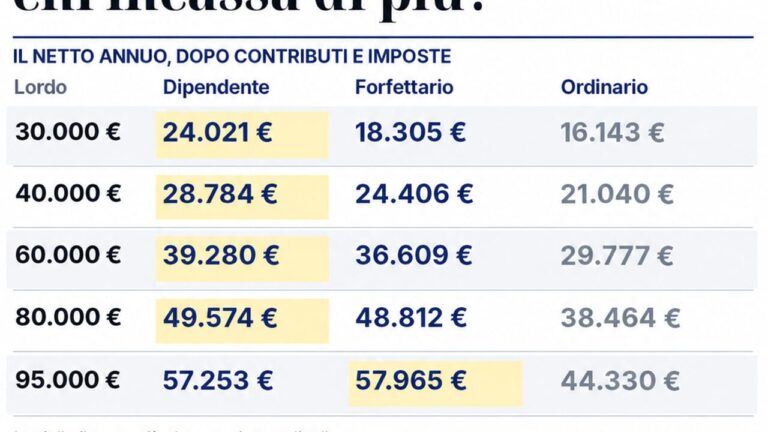
Out of 30 thousand euros gross, the employee retains around 24 thousand euros net, compared to 18,305 euros for the flat rate and 16,143 euros for the ordinary self-employed person. At 60 thousand euros, the net amounts become 39,280, 36,609 and 29,777 euros respectively.
Giulio, 24 year old state employee with a salary of 4,600 euros net per month: “Having so much money at my age is indecent”
The distance then decreases as the amounts increase. At 95 thousand euros, the lump sum could keep 57,965 euros, compared to 57,253 for the employee. But precisely this range would be affected by the increase in the threshold envisaged by the 2027 budget: the taxpayer who cannot currently benefit from the flat rate could obtain, in the simulation, approximately 13,635 euros net per year more than the ordinary regime.