

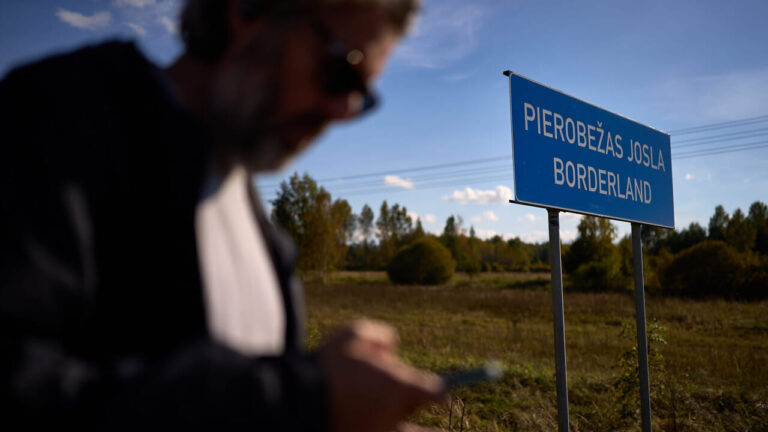
Silene is a Latvian village located just over two kilometers from the border with Belarus and where, to protect the border, a train of reinforced concrete horses of Friesland has been parked. The majority of the population of this region, Latgale, thinks, speaks and sings in Russian. Since the Riga government decided to close the border with Moscow’s ally, for fear that tanks coming from the east could advance into the plain and build a large clearing between Kaliningrad and the Baltic, the same language has also been used to complain.
What’s happening on NATO’s eastern flank
“Russian and Belarusian customers no longer come to us,” says Inga, a young entrepreneur who manages the Silene Resort, an elegant estate on Lake Sila, a – until shortly before the start of the war – of substantial tourism coming from the state commanded by the dictator Lukashenko. At the border, even closer to the resort than the village, this year alone around 12 thousand migrants have been removed, whom Minsk, according to accusations from the Riga government, is clandestinely pushing into Latvian territory in an attempt to destabilize the internal politics of the small state that freed itself from the Soviet Union in 1991.
Latvia defines illegal immigration as “an instrument of hybrid warfare and a provocation”, which would be implemented by both Belarus and Russia. “If we stop you in the off limits zone we will fine you and arrest you,” underlines an officer of the Latvian Border Guard from Daugavpils, the second city in Latvia with a Russian majority. Officers in military uniform can also be seen in Silene, driving military green pick-ups, disguised under balaclavas and mirrored glasses.
The vast military operation
The law enforcement operation along the eastern Latvian borders is called “Vilkatis” – “werewolf” in Italian. It started last August 11th and is scheduled until at least December 31st. Among houses with asbestos roofs, a market where you can buy a bit of everything, with the spirits counter playing the protagonist role and the Marianna restaurant, in Silene there is a noticeboard where public notices are posted. Two report the sale of material such as gravel, sand, manure and firewood, while one is signed by the Border Guard and has some sort of motivational character. In addition to listing 24-hour phone numbers, the flyer calls on locals to take action.
The information requested by the police is that relating to reporting cases of sightings of people defined as “strangers, unknown or suspicious”. The detail is significant: the doubt can easily be dispelled thanks to the “external” aspect which indicates how the identified subjects may be “third country citizens”. The reference to skin color is not there, but it seems obvious. In the event that any resident comes across Pakistanis, Bangladeshis or Somalis, just to give some examples and to remember how in Latvia aiding and abetting illegal immigration is punished by up to five years in prison, the Latvian Border asks to be informed. “We guarantee anonymity,” the command says.
The anonymous support of the Latvian people
Last October 10, a group of hunters from Konstantinova reported the passage of eight migrants. The police intervened, reported them and sent them back to Belarusian territory. Interior Minister Jānis Dombrava warned the Minsk government: “Belarus must understand that such incidents could lead to much more serious consequences.” Among the posters present in the Silene square there is also that of Namejs 2026, a vast exercise which took place from 2 September to 8 October throughout the national territory of Latvia and which saw around 12 thousand soldiers employed between the Riga armed forces and NATO forces.
All to “test operational readiness, integrated national defense and cooperation with civil institutions”. During operations, at the end of September, several Italian soldiers were involved in an accident. Four people were injured by the so-called “friendly fire”, transported to hospital, one of whom had suffered serious injuries.
What Russians think of Daugavpils
“What Europe and the Baltic countries are carrying out against Russia is a real conspiracy.” Yuri is a 27-year-old from Daugavpils, who says he lives in west London, where he works in finance. He claims not to be interested in parliamentary elections. “I came to visit my friend Nikolaj,” he says, sitting at a table in a nightclub, while nervously chewing some soft sheets of paper. Next to him is a forty-year-old who doesn’t understand a word of English and who mistakes the smartphone offered to him to translate his Russian into Italian for a glass. From Daugavpils to Riga it is a three-hour journey.
Along the road, in an improvised rest area, stickers appear commemorating Vyacheslav Matviienko, a Ukrainian soldier who died at the age of 21 in the battle of Azovstal. “He defended Europe from Russia,” we read. In the evening, in a club in Riga, two Englishmen from Yorkshire discuss with a waitress the date of the polls, which will make up the new legislative assembly. “Every vote counts, you have to go and vote”, they suggest when she shows indifference towards what is her right.
Elections? “I have better things to do”
“I have better things to do tomorrow,” she replies. In the evening, the streets of the capital are full of young people looking for fun. Many, too many, are dead drunk. Late at night there are people lying on the ground, stunned. In winter, with temperatures dropping to over twenty degrees below zero, overindulging in alcohol can translate into a highway to the morgue. “I like Vannacci, I always see him on TikTok,” says an 18-year-old of Italian-Bangladeshi origins (he was born in Arzignano, in the province of Vicenza, to a couple from the Asian country). The young man has been living in Norway for 8 years. He moved to the Nordic country following his parents. The father found work as a chef in an Italian restaurant. He confides to us that in the afternoon, since he and his Norwegian friend had “nothing else to do”, they went to a shooting range. “It’s not possible here – they say – and so we came here. It’s an easy opportunity for us from an economic point of view. With a few tens of euros you can shoot for an hour, no special permits are needed.”
Defense and internal security of Latvia
On the day of the last elections there were no queues at the polling stations in the center of Riga. At the end of the consultations, the PolitPro portal will give a turnout of 50.8 percent, the lowest turnout since the restoration of Latvian independence. The director of the National Theater is 54-year-old Māris Vītols. Already a member of parliament in two legislatures and Minister of Education and Science, between the late 1990s and early 2000s in the government of the popular Andris Škēle (a millionaire and considered among the three most influential oligarchs in Latvia), as well as a supporter of the abolition of compulsory military service, since he has been at the helm of one of the country’s major cultural institutions his point of view is particular.
“Some parties think more about the show than the concrete results, claiming that by changing the current political class everything will be better than before,” he says. On the international situation, Škēle underlines how “the biggest change for this country is linked to defense and internal security. The orientation is to strengthen the military structures and membership of NATO. I am sure this will remain so”. According to the director of the National Theatre, “another big change is that relating to greater discipline in fiscal matters, as the country’s annual budget could also be re-evaluated because – he concludes – we spend more than we earn. We will have to cut somewhere”.
“We don’t want black people”
The person who hasn’t cut investments and doesn’t stop looking at NATO’s eastern flank, despite the proclamations, is Donald Trump. He recently announced that the United States may consider maintaining a permanent military presence in Lithuania. Even in Vilnius they consider illegal immigration a hybrid weapon in the hands of Russia and Belarus. “We don’t want dark-skinned foreigners,” a young man explains to us outside a club, while a police intervention is underway due to a theft of bottles committed by two Latvian boys. “Is there a particular reason?”, we ask. “I don’t want them, I don’t want them”. “But have you ever had anything to do with it in your life?”, we counter. “No,” he replies dryly, “but I suspect I wouldn’t be comfortable with it.”
The new executive
The Latvian elections were then won by the United List, a centrist and pro-Ukrainian party, which refers to the outgoing prime minister Andris Kulbergs, thus capable of earning a second mandate thanks to a coalition also supported by the nationalist formation National Alliance. Together, the two parties express a narrow majority of 51 seats out of 100. Kulbergs II obtained the confidence of the Latvian Parliament (the Saeima) on 17 November, with 57 votes in favor and 34 against, taking office the following day, on the occasion of Independence Day.
Dossier is the exclusive subscription investigative section of The Vermilion. If you want to support our journalistic work and subscribe, Click here.