


The appointment is set for the second half of 2026 when, off the coast of Norway, the world’s first underwater desalination plant will come into operation. And this is not a simple technological evolution, but a paradigm shift: instead of bringing sea water ashore to treat it, the process will take place directly on the ocean floor, at a depth of around 400 metres. Flocean, the Norwegian company behind the project, ensures that in this way it is possible to reduce energy consumption and production costs, to the point of making desalination – normally quite expensive and polluting – an accessible and sustainable source of drinking water, which could revolutionize the lives of millions of people who currently do not have access to it.
Desalination costs too much
Today, desalination is a path that is pursued in arid but very rich areas, such as the United Arab Emirates, where energy consumption and production costs are not a problem. In fact, a process known as reverse osmosis is used, in which sea water is pushed through polymer membranes to separate salt and impurities from the H2O molecules. It’s a fast method, but to work it requires very high pressures, enormous amounts of energy to power the pumps, and extremely resistant infrastructure. This drives up costs and makes the adoption of desalination as a source of drinking water impractical on a larger scale.
And this is no small problem, considering that already today almost one in four people in the world (WHO and Unicef data) does not have safe access to drinking water. And that the most recent estimates indicate that by 2030 global demand for water will increase, driven by population growth and the needs of industry, to the point of exceeding supply by more than 40%. In short, there is an urgent need for new procurement strategies. And making the use of the enormous reserves stored in the oceans convenient and sustainable is certainly an interesting path.
The pressure trick
This is where Flocean’s intuition comes into play, as simple as it is radical: exploiting the natural pressure of the water in the depths of the ocean to do without the pumps of traditional reverse osmosis systems. By taking the process 400 meters deep, the pressure exerted by the column of water above is sufficient to push the liquid through the membranes without external pumps. According to the company, this system allows it to cut energy consumption by 40-50 percent compared to conventional land-based watermakers.
Going into the depths of the sea there are also other advantages: the water is much cleaner than surface water, so no polluting chemical pre-treatments are needed and the filters last longer. The waste from the process, rich in salt, is naturally dispersed by ocean currents, without damaging marine ecosystems. And there is no land use, or impact on the coastal landscape. A clear improvement across the board, in short, at least if we take the company’s statements at face value.
The first plant in 2026
For now the company has been operating an experimental plant off the coast of Norway to refine the process and machinery. Now it is ready to hit the market, with the first commercial desalination plant set to open its doors in the coming months in Mongstad, along Norway’s western coast. Initially it will produce one thousand cubic meters of fresh water per day. But the infrastructure design is modular, designed to be easily and cost-effectively scaled.
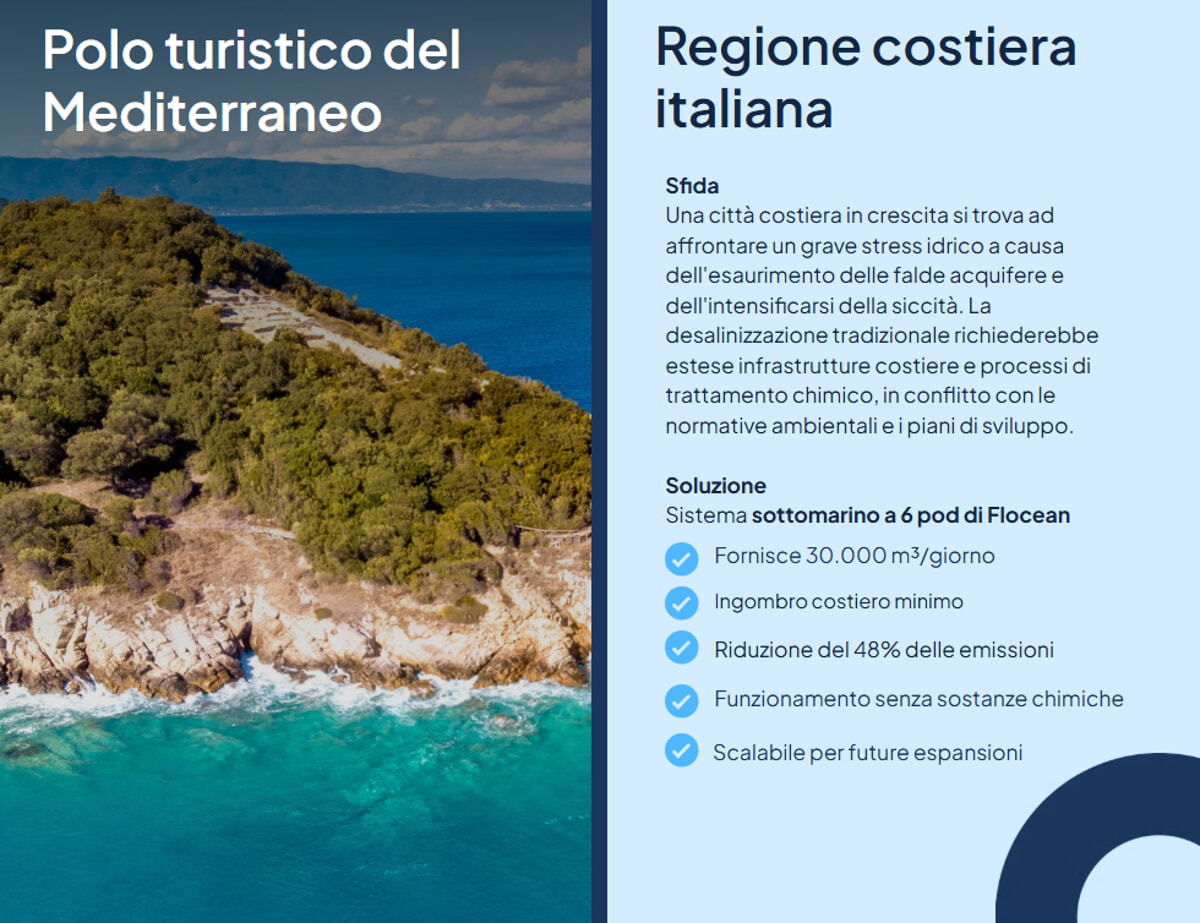
If the Norwegian watermaker confirms expectations, the implications could be global. For the moment, costs remain relatively high, but the company is working to reduce them further, extending the life cycle of the filters used for reverse osmosis, and integrating renewables into the energy mix used to power the plant. And it could be a truly sustainable alternative for bringing drinking water to many arid coastal regions of our planet.