

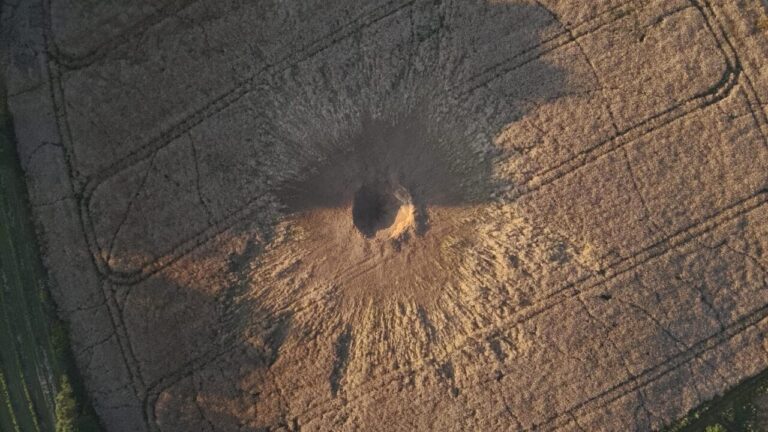
At 3:40 am today, Thursday 30 July 2026, Polish military radars detected an object in the national airspace, heading west. An F-16 was sent to identify and intercept it, but at 3:46 the signal disappeared before it was possible to establish what it was. An Mi-24 helicopter later identified the probable impact point near Tarnawa-Kolonia, Biłgoraj District.
About two kilometers from the homes, a 10-meter crater and scattered fragments of the object were found. The incident occurred as Russia was launching dozens of missiles and hundreds of drones at Ukraine, also hitting Lviv, not far from the Polish border. Precisely for this reason Warsaw had its fighters take off.
❗️ Uwaga. W godzinach nocnych narodowe i sojusznicze systemy rozpoznania wykryły intenseywną aktywność bojową lotnictwa dalekiego zasięgu Federacji Rosyjskiej. W celu zapewnienia bezpieczeństwa polskiej przestrzeni powietrznej podwyższono gotowość bojową środków systemu obrony… pic.twitter.com/gP28zkKTkx
— Dowództwo Operacyjne RSZ (@DowOperSZ) July 30, 2026
The technicians will have to analyze the fragments, the radar trajectory and any explosive residues to determine exactly what happened, but Polish Prime Minister Donald Tusk speaks openly of a Kalibr, a Russian ballistic missile that would have gone off its intended route.
Polish Prime Minister Donald Tusk, personally going to the site of the accident, confirmed that two missiles had indeed violated national airspace during the night, specifying however that one of the two quickly returned to Ukrainian territory. Tusk, however, wanted to tone down Russian intentions: “There are no reasons to think that Poland was the intended target for this missile,” he declared, underlining that the Polish Air Force was nevertheless ready to shoot down the device if it threatened inhabited areas. The incident occurred a few hours after a meeting between Tusk and Ukrainian President Zelensky, during which the two leaders discussed bilateral cooperation, including anti-ballistic defense. “Zelensky had warned me that they had precise information about Russia’s imminent massive attack on Ukraine,” Tusk said, calling the timing of the incident “a strange coincidence.” The Polish prime minister finally confirmed that the United States has expressed interest in participating in the investigation into the incident.
The bombing of Kiev
The provisional toll is at least eight dead and dozens injured, but rescue operations are still ongoing and the number of victims could increase. The areas most affected were Kiev, Lviv and Dnipropetrovsk
According to the Ukrainian Air Force, Moscow employed a total of 358 attack vehicles including 284 drones, including Shahed, Gerbera, Italmas and decoy aircraft; 61 Kh-101 and Kalibr cruise missiles; 9 Iskander-M, KN-23 ballistic missiles or S-400 missiles deployed against ground targets; 4 Zircon or Oniks missiles.
Kiev claims to have shot down or neutralized 320 targets, including 55 missiles and 265 drones. However, impacts were detected in at least 20 locations and fragments fell in another 13.
The most serious episode occurred in the Dnipropetrovsk region, near Kryvyi Rih, Volodymyr Zelensky’s hometown. A ballistic missile destroyed a family’s home: six people died, including three children aged 6, 11 and 17. Two other children were pulled alive from the rubble and at least ten people were injured. In Lviv, in western Ukraine and a short distance from Poland, a missile attack damaged two residential buildings. At least 30 people were injured, including some children and a rescuer. More than twenty buildings, a school and two kindergartens were damaged.
The Russian Defense Ministry says it hit factories and plants linked to the production of drones and missiles, as well as three cargo ships in the Black Sea.