

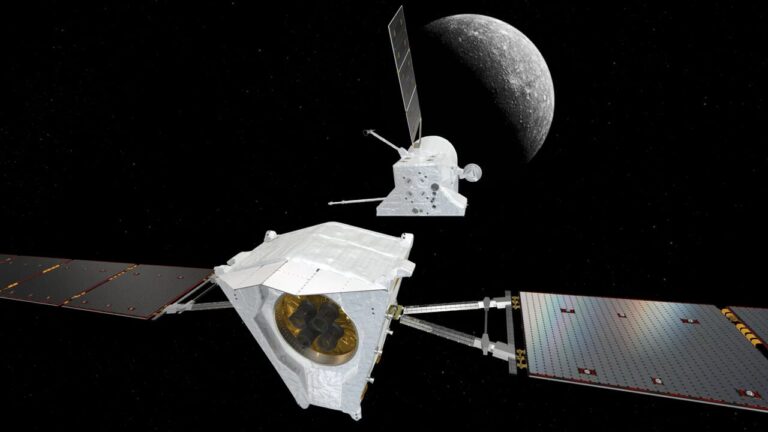
Eight years of travel, over 10 billion kilometers traveled and nine planetary overflights to reach one of the most difficult destinations in the Solar System. The BepiColombo probe (which takes its name from the Italian mathematician and engineer Giuseppe Colombo), the result of the collaboration between the European Space Agency (ESA) and the Japanese one (Jaxa), managed to enter the orbit of Mercury, the planet closest to the Sun. The success of the maneuver, which took place on Saturday 21 November, was confirmed by ESA with a message published on X on Sunday 22 November.
We’ve heard back from Bepi – the spacecraft is now in contact with the ground and the teams at ESOC are busy assessing the telemetry. Flight Dynamics has already confirmed it achieved orbital capture around Mercury! Early next week we’ll share the next update with the upcoming steps.
— BepiColombo (@BepiColombo) November 22, 2026
The flight dynamics unit confirmed the successful insertion into orbit, while technicians are examining the data transmitted by the probe to verify the outcome of the operations in detail. The mission cost approximately 1.65-1.7 billion euroswhich left Earth in October 2018, followed a path much longer than the distance that separates our planet from Mercury. To reach the destination without consuming excessive amounts of fuel, BepiColombo exploited the gravity of the planets encountered along the way. The decisive moment was the firing of the thrusters for 37 minutes, necessary to slow the spacecraft and allow Mercury’s gravity to capture it.
The separation operations of the two scientific vehicles that make up BepiColombo are scheduled between 9 and 10 December. From that moment on, each will follow its own orbit, with different tools and objectives.
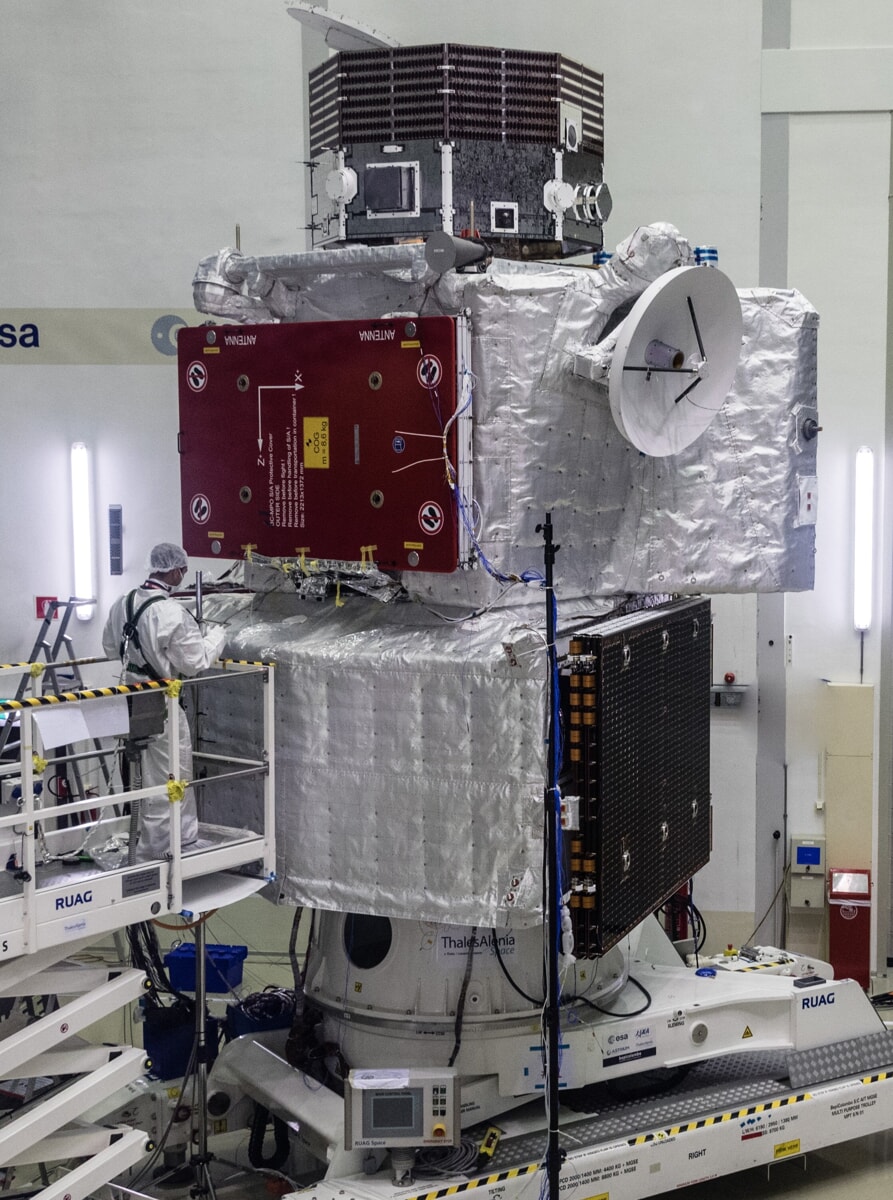
The Mercury planetary orbiter (Mpo), developed by ESA, will be dedicated above all to the study of the surface, composition and internal structure of the planet. It will be able to get as close as approximately 480 kilometers from the surface, collecting observations with unprecedented precision. The Japanese probe Mio, or Mercury magnetospheric orbiter, will instead focus on the magnetic field and space environment surrounding Mercury.
Why go all the way to Mercury
Mercury is the smallest planet in the Solar System and one of the least known. The proximity to the Sun makes it particularly difficult to explore: temperatures on the surface can fluctuate between around 180 degrees below zero and 450 degrees above zero, while scientific instruments must withstand intense exposure to solar radiation.
The first probe to reach it was the American Mariner 10, which flew past it in 1974. Subsequently, NASA’s Messenger mission managed to enter its orbit in 2011, continuing to study it until 2015. The goal is to collect information that can help reconstruct the formation and evolution of Mercury and, more generally, of rocky planets.
But what are scientists really looking for on Mercury? The European Space Agency has identified five unsolved mysteries. The first concerns the origin of the planet itself: its chemical composition suggests that it may have formed much further from the Sun, perhaps near the orbit of Mars, before being pushed towards its current position by a giant collision. Then there is the mystery of water. Despite surface temperatures of up to 450 degrees, large deposits of ice may be preserved in craters at the poles that never receive sunlight, perhaps arriving millions of years ago via asteroids.
Scientists also want to understand whether Mercury is still geologically active. Mysterious cavities have been observed on its surface which appear to have formed relatively recently. Two other questions concern the unusually dark color of the planet, perhaps due to the presence of graphite, and its magnetic field: Mercury is in fact, together with Earth, the only rocky planet in the inner Solar System to still possess a global magnetic field generated within itself. A surprising phenomenon for such a small celestial body, which could hide a still partially liquid nucleus.
As explained by Santa Martinez, mission manager at ESA, BepiColombo aims to “offer humanity and the scientific community unprecedented images of Mercury and open a new chapter in our understanding of the Solar System”.