
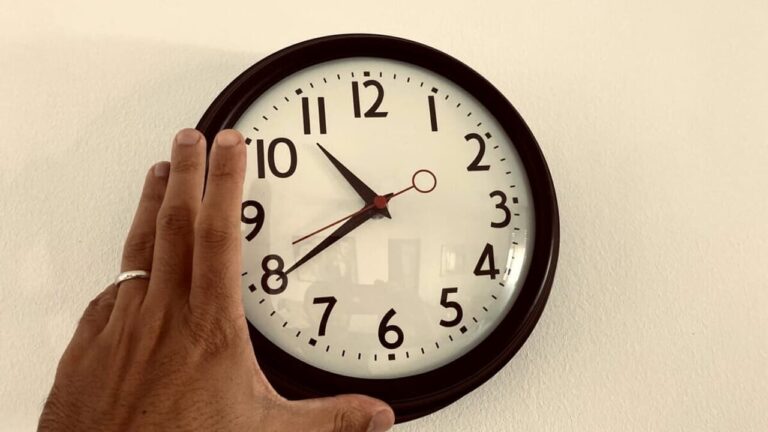
Standard time is here again. On the night between Saturday 24th and Sunday 25th October, exactly at 3am, the clock hands will have to be moved back one hour, returning to 2am. Smartphones, computers and digital devices with automatic time adjustment active will update themselves, while for analogue watches it will be necessary to intervene manually. This marks the end of the summer time period that began on Sunday 29 March. The next appointment is set for March 28, 2027, when the hands will move forward one hour again.
The change will give us an extra hour of sleep, at least on paper, but it will also have consequences on our days: the sun will rise earlier according to the clock, while darkness will arrive an hour earlier in the late afternoon. The hours of natural light will continue to progressively decrease until the winter solstice, scheduled for Monday 21 December, the shortest day of the year.
The effects of the change of time on our organism
An hour may seem like a small thing, but it could take our body a few days to adapt to the new rhythms. This is explained by Luigi Ferini-Strambi, director of the Sleep Medicine Center of the Irccs San Raffaele hospital in Milan, who in an interview with Adnkronos Salute defined the transition as a sort of “mini jet lag”.
The change can cause drowsiness, irritability and mood swings. These are generally mild and transitory disorders, destined to disappear within about five days. The reason is linked to our biological clock, which regulates the sleep-wake rhythm and is influenced by exposure to light and the regularity of daily habits. Not everyone, however, reacts the same way. The transition can be more annoying for people who are used to getting up very early and for young children, who are particularly sensitive to changes in routine.
How to get used to the new time
The return to standard time is generally less problematic than the spring switch to daylight saving time, when you lose an hour of sleep. To limit discomfort, experts recommend maintaining regular hours, avoiding accumulating tiredness and trying to expose yourself to natural light during the day. In the days before the change, it may be useful to gradually postpone meal, sleep and wake-up times, with small shifts of 15-20 minutes. It is especially important for children to maintain a recognizable evening routine.
How much we saved with summer time
The change in time arises above all from the need to make better use of natural light and reduce energy consumption. But how much is it really worth? According to data released by Terna on 23 October, in the seven months of summer time in 2026, Italy saved around 300 million kilowatt hours of electricity, equivalent to the average annual consumption of around 115 thousand families. The economic benefit has been quantified at over 90 million euros, while the reduction in carbon dioxide emissions is estimated at approximately 140 thousand tons. Broadening our gaze to the last twenty-three years, from 2004 to 2026, Terna calculates that the lower electricity consumption associated with summer time has reached a total of over 12.3 billion kilowatt hours, with an economic saving of approximately 2.4 billion euros.
Numbers that continue to fuel the debate on the opportunity to maintain daylight saving time throughout the year. However, it should be noted that the savings obtained during the summer months cannot be automatically extended to the winter, when the hours of light and the lighting and heating needs change.
The difficult agreement to stop at the time change
The debate on the abolition of the six-monthly exchange rate has been going on for years, but the European Union has not yet managed to find an agreement. In 2018, the European Commission proposed to put an end to moving the clock twice a year. In March 2019, the European Parliament approved a position in favor of the reform, with the original aim of overcoming the system in 2021. Since then, however, the proposal has remained blocked in the Council of the European Union.
The problem does not only concern the opportunity to eliminate the time change, but above all which time to adopt permanently: the solar one or the legal one. A choice that would have different consequences depending on the geographical position of the countries. In October 2025, the Spanish government led by Pedro Sánchez relaunched the request to abolish the seasonal change, judging it to be of little use from an energy point of view and potentially harmful to people’s well-being.
Proposals to make summer time permanent have also been put forward in Italy, especially on the basis of possible energy savings. But without a coordinated European decision, the current system remains in place. And so, at least for now, we will continue to move the clock twice a year.