

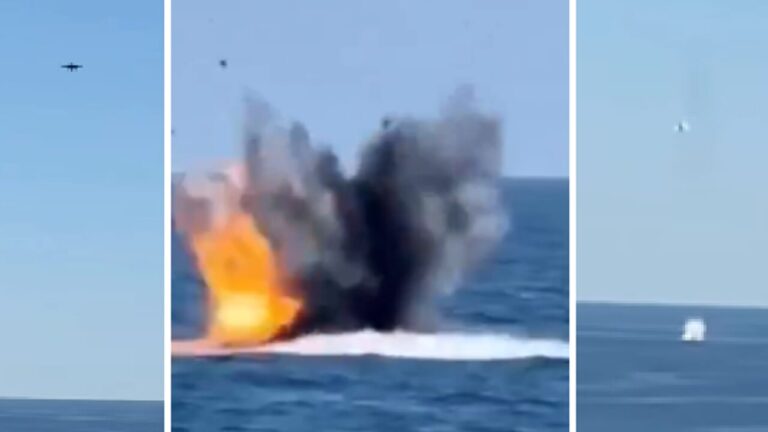
A marine drone loaded with explosives was destroyed by a Romanian Air Force F-16 fighter in the Black Sea, a few hundred meters from the works for Neptun Deep, one of Europe’s most important energy projects. The accident occurred on Thursday 20 August in Romania’s exclusive economic zone, approximately 80 nautical miles east of Constanta.
What makes the episode particularly delicate is not only the presence of the explosive, but the potential target: Neptun Deep is the gigantic offshore project that from 2027 should transform Romania into the main gas producer in the European Union. Bucharest has not yet provided definitive proof of the origin of the vehicle, but Kiev has officially announced that the drone did not belong to the Ukrainian forces. Romanian President Nicușor Dan instead pointed the finger at Moscow, speaking of a new series of “irresponsible incidents” attributed to the Russian Federation.
The drone a few hundred meters from the platform
The alarm was raised around 6.28 am, when a commercial vessel reported the presence of a small marine drone drifting near the Neptun Alpha platform. The Coast Guard notified the Ministry of Defense, which set up a command cell to manage the emergency.
According to Defense Minister Radu Miruță, the vehicle was just a few hundred meters from the area where the gas extraction works are underway. The authorities therefore decided to eliminate it to protect the people present on the construction site and an infrastructure considered strategic.
Two Romanian F-16s were scrambled with authorization to open fire. One of the fighters engaged the target using the onboard cannon and hit the drone. Subsequently, a Coast Guard vessel with a team specialized in clearing explosive devices on board was sent to the site to recover and analyze any remains.
The minister assured that the vehicle was carrying explosives. However, it remains to be clarified who launched it and what its actual destination was.
Romania’s accusation against Russia
Bucharest contacted Ukraine directly through the military communication channel established between the two countries. The answer, according to the Romanian government, was clear: the drone was not Ukrainian. Instead, President Nicușor Dan openly pointed to Russia. “I strongly condemn the intensification of this type of irresponsible incidents by the Russian Federation,” wrote the head of state, adding that Romania will remain vigilant together with its NATO allies.
European Commission President Ursula von der Leyen also weighed in, calling the episode part of a growing campaign of threats against Europe. “This is hybrid warfare,” he said.
This is not the first alarm near Neptun Deep
The episode is not isolated. Just nine days earlier, on August 11, divers from the Romanian army had destroyed in a controlled manner two other Gerbera-type drones found adrift in the country’s exclusive economic zone, also near the Neptun Deep project. Even in that case, Ukraine denied that the vehicles belonged to its forces.
The Black Sea has become one of the most delicate fronts in the war between Russia and Ukraine in recent years. Drifting mines, aerial drones and unmanned naval vessels now represent a danger also for the trade routes and energy infrastructures of NATO countries. Romania, Bulgaria and Turkey have already neutralized more than 150 mines overall and in July they decided to expand the activities of their task force with specific missions for the protection of critical infrastructure.
Why Neptun Deep is so important
And it is precisely this point that makes the incident particularly sensitive. Neptun Deep is the largest natural gas extraction project ever developed by Romania in the Black Sea. It is controlled 50 percent by OMV Petrom and 50 percent by the state company Romgaz, with total investments of up to approximately 4 billion euros.
Recoverable reserves are estimated at around 100 billion cubic meters of gas and first production is expected in 2027. According to the promoters, once fully operational the project could make Romania the largest natural gas producer in the European Union and a net exporter.
The Neptun Alpha platform was installed in the Black Sea only in July: it weighs approximately 16,500 tonnes, is over 225 meters high and is connected to the coast by a pipeline approximately 160 kilometers long. By July, six of the ten planned wells had already been completed.
It is therefore an infrastructure destined to have a direct impact on the energy security of the entire Eastern Europe. And it is just as the project enters the decisive phase before the start of production that drones have begun to appear in the waters surrounding it.