

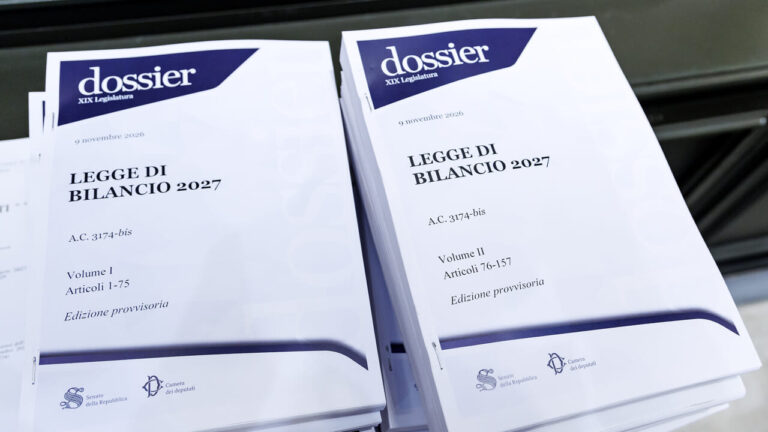
Approximately 6,600 amendments to the Economic Budget were deposited in the Budget Committee upon expiry of the deadline for presentation. The majority presented around two thousand proposals for amendments to the budget law: of these, 307 are from the Brothers of Italy and around 800 from Forza Italia, while almost 900 are the corrections sponsored by the League. We Moderates delivered 12. Over 3 thousand, however, those deposited by Pd and M5s.
The centre-left amendments
The centre-left forces have presented a package of unitary amendments that cover a wide spectrum of issues: from the minimum wage to the shift of investments from weapons to schools and from defense to healthcare construction, passing through healthcare, pensions, rent funds and hydrogeological instability, with some measures covered through resources deriving from extra profits.
Six proposals are under the Pd’s first signature: healthcare refinancing; leaves; pension revaluation; school turnover; Woman option; Zes and 5 per thousand. Five are M5s first-time signatures: minimum wage; rental fund; school (emotional and sexual education); shifting investments from weapons to schools; fiscal drag (covered with extra profits). Four are first-time Avs signatures: climate adaptation fund (with extra profits); hydrogeological instability fund (with extra profits); researchers and shifting investments from defense to healthcare construction. Finally, an amendment is first signed IV, namely the Start tax.
Pd and 5 Star Movement
There are approximately 1,600 proposals filed by the Democratic Party group, to which must be added the 18 unitary amendments signed together with the other opposition forces. The PD’s corrections affect all the main areas of the budget law: health, school, work, welfare, safety, sustainable mobility, support for housing policies and environmental protection. The central themes also include the refinancing of agricultural funds, the revaluation of pensions and interventions in favor of the new generations and against the high cost of living.
From healthcare to pensions, up to wages: here are the main proposals of the Movement. “The M5S has presented 1,500 amendments to a budget law adrift, in the throes of internal convulsions within the Government and the majority”, reads a note from the five-star deputies of the Budget Commission. “Our proposals aim to refinance healthcare properly, bridging the increasingly wide gap between the National Health Fund and public health spending, while the annual expenses incurred by private individuals explode up to 50 billion euros – say the parliamentarians -. They also aim to guarantee adjustments to average pensions, which have been brazenly used for years as an ATM by the Government; to support real salaries, devastated by inflation; to protect schools and infrastructures, targeted in recent years by continuous cuts, applied or threatened; to pay due attention to climate change, hydrogeological instability, reclamation and renewable energy”.
“Our measures – continue the deputies – also aim to lower taxes: fiscal escalator to automatically index Irpef brackets, deductions and deductions to inflation and immediately reduce the levy, thus counteracting fiscal drag; no tax area extended to 20 thousand euros for the most vulnerable; recovery of Transition 4.0 tax credits to support business investments, especially small ones; creation of a platform of transferable tax credits to guarantee liquidity to the production system; fiscal cashback to immediately and directly credit the value of deductions on expenses incurred with electronic payments to the taxpayers’ current account”.
“To relaunch growth, we will propose the establishment of a sovereign fund for the development of the economy with 100 billion in investments, open to paid and voluntary contributions from savers, businesses and institutional investors – concludes the M5s note -. We will return to proposing the minimum wage and Income 2.0, to combat a social problem which still sees over 13 million people at risk of poverty and social exclusion, alongside the refinancing of the rental fund, left to die by the current executive. Among the many coverages we envisage a real taxation of banking and energy extra profits, a progressive tax on large financial wealth, a tax on high-frequency financial transactions, the total revision of spending commitments on defense and on useless projects such as the Strait Bridge”.
The corrections of Italia Viva
“A fourteenth salary for teachers, nurses and law enforcement agencies, the elimination of VAT advances, the Start tax for the under 35s and measures to encourage the return of brains. These are some of the proposals contained in Italia Viva’s amendments to the budget, with the aim of supporting those who work, those who produce and the new generations”. Thus a note from Italia Viva to illustrate the deposited texts.
“The priorities – it is explained – also include the refinancing of the psychologist bonus, the fight against eating disorders, support for the cryopreservation of oocytes and the full restoration of App18. Funds are also provided for farmers, for traders who suffer damage to their shop windows and refreshments for elderly victims of scams. Amendments to give more value to work, reduce obstacles for those who do business and create more opportunities for young people, without neglecting social needs and fragilities. Proposals to provide answers concrete needs of families and businesses that the government’s maneuver leaves unresolved”.
The knots of the majority
Majority working this morning on the budget law in view of the deadline for presenting amendments. Coalition sources report that a meeting called by the Prime Minister, Giorgia Meloni, took place today, in which the vice-presidents of the Council, Antonio Tajani and Matteo Salvini, the leader of Noi Moderati, Maurizio Lupi, and the Minister of Economy, Giancarlo Giorgetti, participated.
At the end of the discussion, majority sources assured that “the priority attention for the adjustment of pensions, the health fund, the school and the security sector was confirmed”. But, from what we learn, pensions and healthcare still remain issues to be resolved: it would be a matter of finding the right solution for the resources to be allocated.
However, there is no holding back on amnesties: there should be three chapters dedicated to amnesties. The first aims to unblock previous amnesties, setting a deadline for Municipalities to respond to requests presented in the past, unless they impact areas at hydrogeological or seismic risk. The second, however, gives the Regions the opportunity to open new amnesties, with an impact especially in Campania. The third, still under evaluation, concerns the Municipalities and aims to regularize small non-structural interventions.