

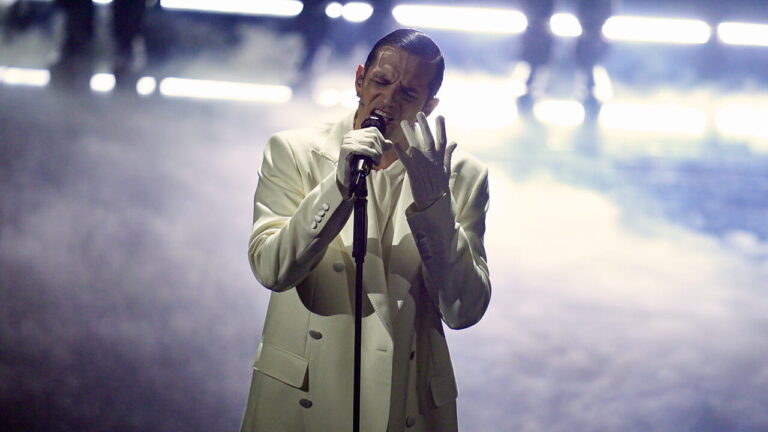
There is a common thread that links Irama’s “Wherever You Will Be”, Sinéad O’Connor’s “Nothing Compares to You”,Tears in heaven” by Eric Clapton, “Go with him” by Marco Masini and “My immortal” by Evanescence: they are all “sad” songs, which talk about loved ones who are no longer there, about the end of a love, about long goodbyes. Music and words that not only touch us closely, but to which we are even more fond than happy songs.
One confirms it research visible on Scientific reportsfrom which it emerges that the increase in cases of anxiety and depression causes modern life to affect the media and vice versa, creating a sort of vicious circle. In detail, the study analyzed the lyrics of 20,186 songs: all those that appeared in the weekly charts of the “Billboard Hot 100”, the main music ranking of the US recording industry, between 1973 and 2023.
It would be impossible to cite, here, every passage that research has explored in depth. Above all, however, “Candle in the wind” by stands out Elton Johnamong the best-selling singles of all time. Written in 1974 inspired by Marilyn Monroe to represent the possibility of premature death at the height of an artistic career, the song was revived by the British artist after the tragic death, in 1997, of his friends Gianni Versace and Lady Diana.
Well, this text, along with the other 20,185, has been processed through algorithms to evaluate their “mood”, dividing between negative and positive feelings. Like songs that dominated the charts, such as “Walk like an Egyptian” (1986) by the pop rock band The Bandles or “End of the road” (1992) by the soul vocal group Boyz II Men, the study estimated that, the closer we get to the present day, the more the songs deal with sad themes. And they are so loved that they always reach the top of the charts.
Opportunity for in-depth study
“The study led by Professor Markus Foramitti is commendable because it offers a good opportunity to remember the importance of four aspects.” Thus psychologist and psychotherapist Cristian Pagliariccio told The Vermilion. Which goes into detail: “The first aspect concerns the value of a critical approach towards individual studies. It is always useful to ask: what was actually measured? In this case, for example, there is a lack of information that helps to understand whether some social shocks have influenced the musical preferences of Americans”.
Or, alternatively, “whether the musical choices of Americans have been influenced by algorithms during some social shocks. Since the 1990s, in fact, the charts have been increasingly linked to the viral mechanisms of streaming“. So the professional, registered with theOrder of Psychologists of Lazioaddress the second element. “It is linked to a basic and well-known aspect: stress has different peculiarities and effects. Mass shocks, for example, cause acute stress. Such experiences can induce levels of discomfort and pain that facilitate the search for stimuli capable of providing relief.”
The third aspect “recalls the intrinsic importance of research, beyond the certainties it offers, also for the questions it stimulates. In this case, for example, an interesting reflection that can open up is: how can disorientation, even political, affect language and its complexity in song lyrics or in everyday life?”. Finally, “in addition to music, it is good to remember that you can always talk to psychologists, to give meaning to what you feel”, concludes Pagliariccio.
Ever simpler melodies
Democratization in terms of production, but also access to advanced technologies such asartificial intelligence and contribution of streaming algorithms, which seem to favor simpler and more impactful songs. Good or bad depending on your point of view, but that’s the conclusion he reached study of a team of researchers from the La Sapienza University of Rome and the University of Padua, who analyzed 20,000 compositions: from pop to rock to classical.
The data that emerged reveal a constant decline in musical complexity, to the benefit of increasingly predictable and redundant structures. Among the main components of this change, a central role is played by companies such as Spotify, Apple music and YouTube music, i.e. streaming platforms that use algorithms to recommend songs to their users.
These systems often reward the catchiest tracks, such as Annalisa’s hit “Sincerely”. A song with a simple, repetitive and catchy refrain thus has a greater chance of being listened to several times, triggering in users the inclination to listen more “easily” and directly. “Previous studies have already indicated that content conveyed in fast, interconnected and algorithmically curated environments, such as the internet and social networksare subject to simplification processes,” commented the team.
Playing improves the mind
The same Department of General Psychology of the University of Padua led a project, “The music ensemble”, involving 600 expert musicians and 600 non-musicians. The initiative, the results of which are visible on Advances in methods and practices in psychological scienceinvestigated whether playing a musical instrument provides cognitive benefits. He wondered what difference there is between expert musicians and non-musicians on a mnemonic level, but also on intelligence, executive functions and personality.
After involving 110 researchers from 15 countries, “The music ensemble” project revealed in musicians the presence of a significantly better short-term musical memory, small advantages in visuospatial and verbal memory, together with a slight increase in both fluid and crystallized intelligence and executive functions. And again, on a personality level it emerged that male and female musicians, coming on average from family backgrounds with a slightly higher socio-economic status, tend to be more inclined to new experiences.