

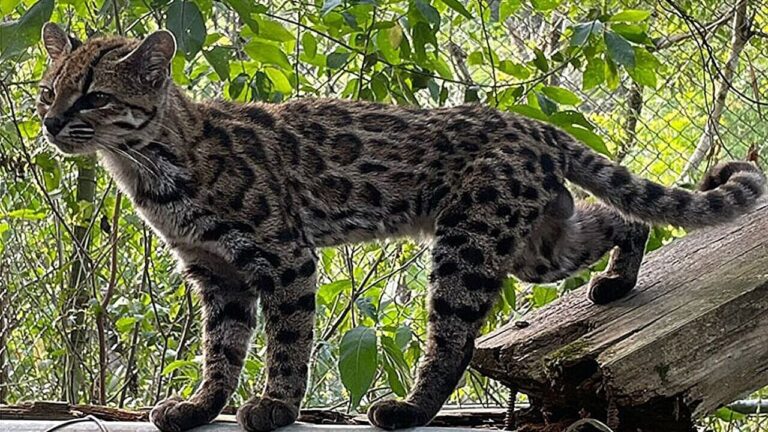
It is slightly smaller than a domestic cat and sports a polka-dotted coat similar to that of a leopard. What makes it unique, however, is not its physical characteristics, but the circumstances of its discovery: the Leopardus tilcayo it is in fact the first new species of felid formally described by science in over 100 years, that is, since the discovery of the colocolo (Leopardus colocola) in the Uruguayan pampas in 1923. The new species was identified by an international research team on the eastern slopes of the Bolivian Andes, and is described in a study recently published in the journal Current Biology.
The genesis of the discovery
The story of the discovery begins in 2016, when biologist Paola Nogales-Ascarrunz, an explorer on behalf of National Geographic, examined a specimen of a small feline welcomed at the Senda Verde animal shelter, near La Paz. The animal was found by a resident who mistook it for a domestic cat and tried for months to feed it eggs and rice before handing it over to the centre. Initially cataloged as a variant of Leopardus tigrinusthe animal however presented atypical morphological traits, such as a longer and thinner tail, a flattened snout and a different spot pattern compared to known populations of the genus.
Genomic verification
To verify the identity of the animal, the researchers conducted an extensive genomic analysis, under the coordination of ecologists Jonas Lescroart, of the University of Antwerp, and Tadeu de Oliveira, of the Universidade Estadual do Maranhão. The team sequenced the DNA of 38 individuals belonging to the species complex known as “tiger cats” from several countries in Central and South America, including historical specimens preserved in museums. Genetic data revealed that the tiger cat complex includes five distinct species and that the lineage of the Leopardus tilcayo it separated from other felines of the genus about 1.4 million years ago, showing sufficient genetic divergence to justify classification as a separate species.
Results and biology of the species
The new species, named Tilcayo cat, measures between 42 and 50 centimeters in body length, with a tail of about 25 centimeters, and is therefore on average a little smaller than a common domestic cat. The analysis of fecal samples collected in the field and images obtained through camera traps indicate that the species has predominantly nocturnal habits and feeds on small rodents. The researchers chose to adopt the scientific name tilcayo to formalize the denomination used for generations by the local communities of the Yungas, thus recognizing the traditional knowledge of the area’s population.
The official description of the Leopardus tilcayo highlights the need to deepen studies on the fauna of the mountain forests of the Andes. Currently – explain the authors of the research – information on the geographical distribution and numerical consistency of the population remains limited, also due to the frequent visual overlap with other species of small cats in photographic surveys. Since the Yungas’ cloud forests are subject to fragmentation and habitat loss, the authors of the study intend to intensify monitoring with camera traps to define the species’ range and propose specific scientific and territorial protection measures.