

The victory of the Democrats in the 2026 midterm elections has fueled strong turbulence in the financial markets, especially affecting stocks related to artificial intelligence. Big finance is worried about the mobilization against data centers and concentrations of wealth: in fact, 40 of the 41 local referendums proposing stopping large projects related to AI have passed.
The market interpreted the vote as a sign of hostility to tech development and stocks plummeted. SpaceX’s ticker fell 8 percent in the aftermath of the results. Nvidia burned through about $500 billion in value in two sessions. And here was also added the scandal of the extramarital affair between its founder Jensen Huang and an alleged Chinese spy who approached him as a successful businesswoman.
Landslides that also had repercussions in Italy where Prysmian, which also makes cables for data centers, lost 4 percent in Piazza Affari. Collapses that undermined – albeit for a short period – the assets accumulated by tech billionaires who are much more susceptible to market fluctuations than their industrial counterparts.
The Italy of old and new billionaires
The growth of personal assets linked to the highly technological, financial services and crypto sectors is also observable in Italy. In 2022 the classification Forbes of our billionaires was made up of entrepreneurs and managers involved in the manufacturing and industrial supply chains. Giovanni Ferrero, heir to the confectionery company of the same name, held the record with 36.2 billion dollars in estimated assets. Then there was Leonardo Del Vecchio, the founder of Luxottica which became the eyewear giant EssilorLuxottica. So Gianluigi Aponte, the shipowner with 16.8 billion in assets. And on the lowest step of the podium, Stefano Pessina, executive president of the multinational pharmacy Walgreens Boots Alliance (10.3 billion).
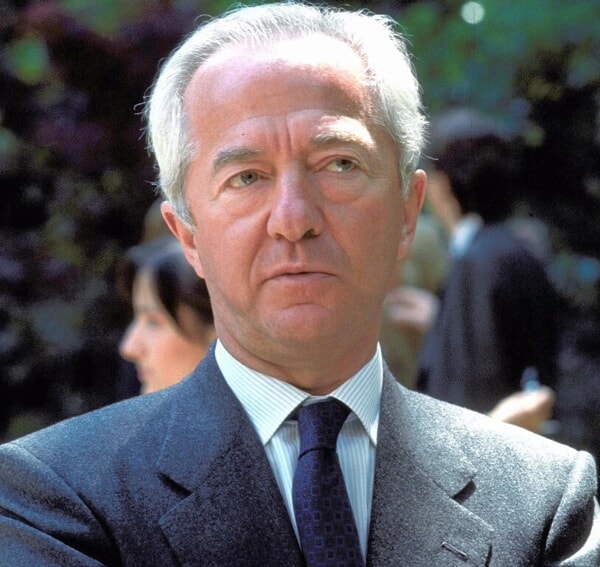
They were followed by: Giorgio Armani (7.8 billion), Silvio Berlusconi and family (7.1 billion), Massimiliana Landini Aleotti and family at the top of the Menarini group (5.4 billion), Giuseppe De’ Longhi (4.4 billion), Piero Ferrari second largest shareholder of Ferrari NV after Exor (4.2 billion), Augusto and Giorgio Perfetti of the Perfetti-Van Melle candy empire (4.1 billion), Patrizio Bertelli (4 billion) and Miuccia Prada (4 billion).
So we enriched De Longhi with home-made coffee: the Pinguino brand towards its all-time record – by Manlio Pistolesi
The situation has changed completely four years later. Forbes in March 2026 it took a snapshot of the new Italian scrooges, recording a rise in personal assets linked to cryptocurrencies, the software market and financial services. Ferrero’s dominance has been supplanted by Giancarlo Devasini, founder together with Paolo Ardoino of the cryptocurrency company Tether, the most traded stablecoin in the world: the two occupy first (89.3 billion dollars) and fourth (38 billion) positions respectively.
The heir to the sweets industry can console himself with a second place and 48.8 billion dollars of estimated assets, albeit trailed by Andrea Pignataro (42.6 billion), founder of Ion group, a software and financial data company with investments in many sectors.
How Andrea Pignataro became the richest man in Italy (with billions in debt) – by Cesare Treccarichi
The most recent ranking of Forbes continues with Francesco Gaetano Caltagirone, owner of the real estate-construction-publishing group of the same name, in fifth place (11.1 billion dollars). Massimiliana Landini Aleotti and family, of the Menarini group, remain stable in sixth place despite their assets having increased to 9.2 billion. At a distance there are Piero Ferrari and family (7.9 billion) and the Rocca brothers – Paolo and Gianfelice – of the Techint group which with its companies deals with plant engineering, steel industry and healthcare. Both have an estimated wealth of 7.3 billion.
| # | Name | Assets (in billions) |
| 1 |
Giancarlo Devasini |
$89.3 |
| 2 |
Giovanni Ferrero |
$48.8 |
| 3 |
Andrea Pignataro |
$42.6 |
| 4 |
Paolo Ardoino |
$38 |
| 5 |
Francesco Gaetano Caltagirone |
$11.1 |
| 6 |
Massimiliana Landini Aleotti and family |
$9.2 |
| 7 |
Piero Ferrari and family |
$7.9 |
| 8 |
Paolo Rocca |
$7.3 |
| 9 |
Gianfelice Rocca |
$7.3 |
| 10 |
Heirs of the Old |
$7 |
Finally, there are the Del Vecchio half-brothers: Leonardo Maria, Claudio, Marisa, Paola, Luca, Clemente, Rocco Basilico. The seven, together with Del Vecchio’s latest wife, Nicoletta Zampillo, hold an equal share of Delfin, the family safe that controls EssilorLuxottica. All of them have assets estimated at around 7 billion dollars.
Juventus and cryptodollars, how much Paolo Ardoino earns: why he bet (everything) on Trump – by Cesare Treccarichi
Who doesn’t make the top 10
Excellent names who have been part of Italian and global industrial history do not appear in the most recent top 10. Giuseppe De’ Longhi and his family hold only $6.3 billion and are 18th. In 21st place is the founder of Diesel Renzo Rosso, who with his family holds assets of 4.5 billion. Immediately followed by the founders of the Benetton textile group, Luciano and Giuliana Benetton at 4.2 billion. Then the CEO of Moncler, Remo Ruffini, at 3.9 billion. Marina and Pier Silvio Berlusconi remain behind at 3.2 billion ahead of Ugo Gussalli Beretta’s family, with assets estimated at around 2.9 billion euros.
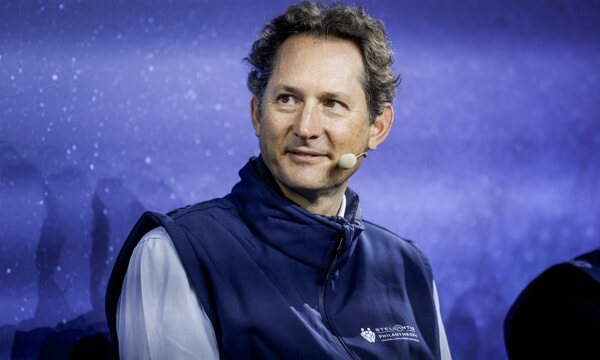
John Elkann, CEO of Exor which controls Stellantis (Fiat, Peugeot, Citroën…), drops to 41st place, with an estimated wealth that fluctuates between 2.4 and 2.5 billion euros. This figure is given by the estimated value of Giovanni Agnelli bv at 9.8 billion, a holding company that controls Exor and which in turn is 41 percent controlled by the family safe, Dicembre.
Earning 100 million a year with sweets: here’s who leads the sweet Perfetti empire – by Manlio Pistolesi
The global ranking
To understand how the concentration of personal wealth has increased, it may be useful to read the top 10 billionaires, by estimated assets, drawn up by Forbes. This is not “hard” money, liquidity available to entrepreneurs, but very often the figures represent the market value at that given moment of shares and equity investments held. Financial assets.
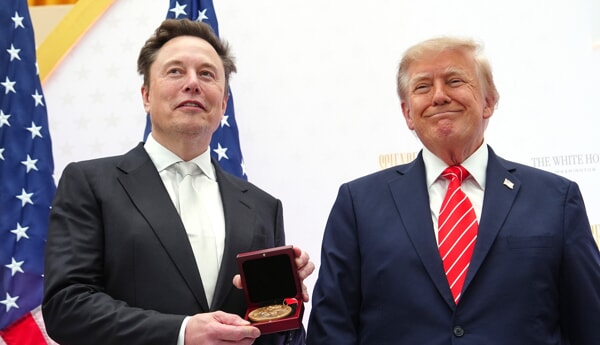
Gone are the days when Amancio Ortega Gaona, owner of Inditex (Zara), was the richest in the world. While Bernard Arnault, founder of the luxury holding company LVMH, after reaching first place more recently, can now only observe the battle for the top from a distance. In fact, as of November 10th, the top positions are occupied by the so-called “tech bros”, i.e. the big bucks who lead companies specialized in highly technological sectors, artificial intelligence and crypto.
In the lead is Elon Musk with 897.5 billion dollars in assets (made up mainly of the Tesla and SpaceX shares he owns). In second place we find Amazon founder Jeff Bezos ($384.8 billion). The bronze medal goes to Larry Page (239 billion dollars), founder of Google with Sergey Brin following him in fifth place (220).
| # | Name | Assets (in billions) | Source | Village | Age |
| 1 |
Elon Musk |
$868.8 | Tesla, SpaceX | United States | 55 |
| 2 |
Jeff Bezos |
$384 | Amazon | United States | 62 |
| 3 |
Larry Page |
$239.8 | United States | 53 | |
| 4 |
Mark Zuckerberg |
$220.3 | United States | 42 | |
| 5 |
Sergey Brin |
$220 | United States | 53 | |
| 6 |
Michael Dell |
$213.1 | Dell Technologies | United States | 61 |
| 7 |
Steve Ballmer |
$167.6 | Microsoft | United States | 70 |
| 8 |
Warren Buffett |
$161.6 | Berkshire Hathaway | United States | 96 |
| 9 |
Larry Ellison |
$159.9 | Oracle | United States | 82 |
| 10 |
Jensen Huang |
$155.4 | Nvidia | United States | 63 |
The other positions are occupied by the creator of Facebook, Mark Zuckerberg (220.3 billion), by Michael Dell (204.4) founder of the company of the same name, by Steve Ballmer (167.6) former CEO of Microsoft, by the Oracle of Omaha, the entrepreneur Warren Buffett (161.6), by the co-founder of Oracle Larry Ellison (159.9) and by Jensen Huang (155.4) leader of Nvidia who before the midterms and the scandal, was seventh at 173.7 billion.
The change
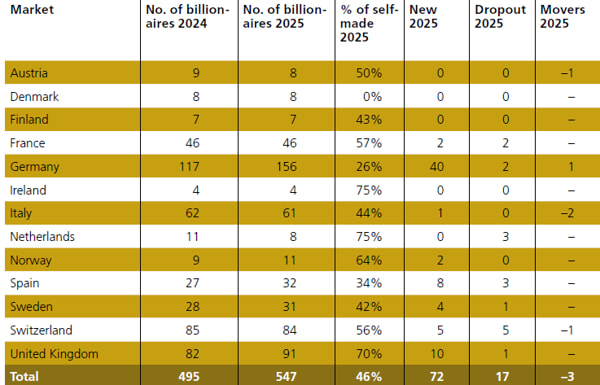
As can be seen, the technological and digital sector increasingly dominates the personal wealth scenario. This trend, however, does not yet correspond to a decline in traditional industry. In 2025, according to the 11th Billionaires ambition report of the Swiss bank UBS, 196 “self-made” billionaires were added who increased global wealth by 386.5 billion dollars, bringing it to the record level of 15.8 billion dollars. Eighty-seven of these new billionaires reside in the United States, bringing the country’s total to 924, about a third of the global total. In the United States, the report argues, this growth can be attributed to business creation and entrepreneurial successes, particularly in the technology sector.
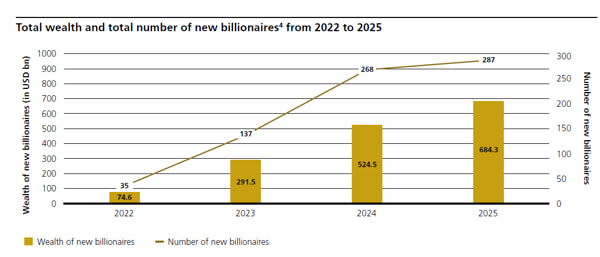
UBS also found that the majority of new billionaires in Western Europe inherited their wealth, 48 out of a total of 91 globally. Furthermore, billionaires who invested in the technology sector saw their wealth increase by 23.8 percent. While growth in the consumer goods and retail sectors slowed to 5.3 percent, as the European luxury industry lost momentum in favor of Chinese brands.
Charles Otton, one of the report’s authors, said this difference between the United States and Europe “shouldn’t surprise anyone.” “It is a reflection of the different fortunes of the two continents,” he said. “It is astonishing how much wealth has been created in the United States, and it is all concentrated in the technology, consumer goods, retail and, to a lesser extent, industrial sectors.”
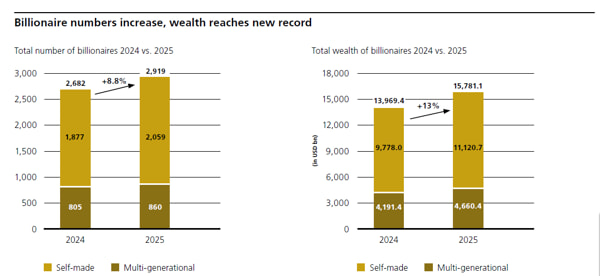
However, wealth growth in the industrial sector increased the fastest, up 27.1 percent to $1.7 trillion, with more than a quarter of that coming from new billionaires. Assets in the financial services sector rose 17 percent to $2.3 trillion, driven by booming markets and a recovery in cryptocurrencies, with self-made billionaires accounting for 80 percent of total assets.
It is still early to sound the requiem for the industry, the sector is still repaying entrepreneurs. The rise of the technological and digital sectors, however, is incessant and the (estimated) accumulated assets are redesigning the structures of global wealth.
Dossier is the exclusive subscription investigative section of The Vermilion. If you want to support our journalistic work and subscribe, Click here.