

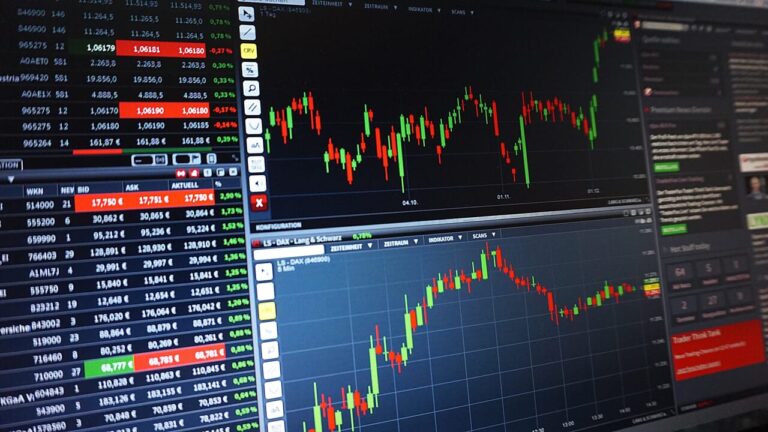
Yesterday was a disastrous day on the stock markets to say the least. Tech stocks linked to semiconductors especially fell due to fears that the results of the mid-term elections in the United States could slow or derail the boom in investments in data centers. The numbers in a nutshell: the Nasdaq lost 5.5% in one session, closing at 24,315.00 points, with stocks linked to the AI cycle such as Broadcom, Intel and AMD in free fall.
Nvidia lost 9% or more, but if we look at the last month the drop was 25%. Already in recent days the AI and semiconductor sector had suffered heavy losses in the Asian stock markets. Now, however, the contagion has also spread to the West. And not just tech stocks. The Dow Jones, the index linked to the large ‘blue chip’ giants, closed with a minus 3.44%. The fever on the markets then moved east with the Japanese Nikkei and Seoul’s Kospi leaving around 6% on the ground, while Taipei’s Taiwan Weighted index closed at -4.47%.
🚨 BLACK THURSDAY CRASH IS HERE.
Over $3.7 Trillion has been wiped out from the global stock markets today.
🇺🇸 US stock market is down -4%, wiping out $3 Trillion.
🇰🇷 KOSPI crashed -5.2%, wiping out $200 Billion.
🇨🇳 Taiwan stock market dumped -5%, wiping out $180 Billion.
🇯🇵 Nikkei dropped -2.13%, wiping out $162 Billion.Along with this, the crypto market has wiped out $140 Billion and has fully erased yesterday’s gains.
But what’s shocking is that, despite being a 10x-50x smaller industry, crypto is down even less than Nasdaq.
This is a sign of strength, and once the stock market dump settles, crypto is going to blast.
— Crypto Rover (@cryptorover) November 5, 2026
Why we talk about the “AI bubble”
So what happens? Analysts believe that the wave of sales is linked to fears that the victory of the Democrats could bring restrictions in the development of data centers, thus hindering the race of artificial intelligence.
What is certain is that for years there has been a fear among investors that the “AI bubble”, as it is called, is destined sooner or later to burst or deflate after years of a bull market. The historical comparison is that of the so-called “dot-com bubble” which exploded on March 10, 2000 after the investment boom in companies linked to the technological sector and the web which was then taking its first steps. Investors were not wrong about the fact that the Internet had the potential to change the world, but this did not stop the markets from tumbling for two and a half years, reaching rock bottom only in October 2002. Thanks to the economic and financial crisis of 2008, it took a good 15 years to see the Nasdaq return to pre-collapse levels.
A physiological correction or the beginning of a crisis?
Does history repeat itself? Of course, there is no shortage of differences between the two historical periods and it is not certain that a possible crisis linked to AI will be equally marked and profound. But the fears are all there. “The very fact that we are all asking ourselves the same question is in itself very significant,” writes Financial Times columnist Katie Martin. “Any reasonable person can see the hallmarks of an unsustainable party in AI stocks, perhaps most glaringly in the AI stocks that literally dominate US and global markets. Just pick from a list of potential sources of stress: from high levels of increasingly creatively structured debt, to doubts about real profit margins, to baffling examples of circular financing.”
The London newspaper recalls that “29% of the investments of Ai companies are aimed at other companies in the same sector, and more than half of the financing entering Ai companies comes from other Ai companies”. In short, it is a self-feeding vortex.
In this context, the signal sent by US voters could only be negatively received by the markets. The sector will now have to deal with “a much more severe regulatory and authorization framework” writes Martin.
The data centers will probably be built anyway, perhaps in less hostile states and with the Republicans in power, but rethinking the projects will cost time and money. However, the context is already complicated. Big tech companies are spending an unprecedented amount of money to develop AI and build the infrastructure needed to make it work. Investors fear that this colossal mountain of money will never translate into real revenues and dividends. At least not at the levels expected and priced by the market.
Yesterday’s crisis could have just been a physiological correction as many happen, as well as the start of something else. “A rapid conclusion to the war in Iran still represents the best opportunity for markets to regain stability” states the editorialist of the Financial Times. “But sooner or later, the warning from the AI sector will not be just an exercise.”