

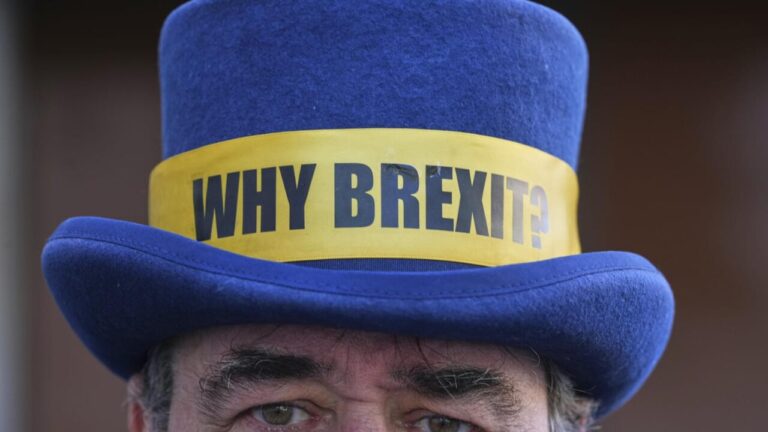
Ten years after the Brexit referendum, six years after its entry into force, the return of the United Kingdom to the European Union seems possible. The British Prime Minister, Andy Burnham, explicitly reopens the door in an interview with the program Today Of BBC Radio 4 He said he wanted to examine “all options” for the future of relations between London and Brussels, including new EU membership.
“Brexit hurt us”
“Brexit has done more harm than good,” Burnham said. “So the question is: what do we do now?” It is the same position that the prime minister had expressed the day before at the Labor conference in Liverpool: “I cannot honestly tell you that the situation we find ourselves in is very good. Brexit has done more harm than good. We must restore a higher level of growth and prosperity for Great Britain”. At the next UK-EU summit, Burnham says he will present the country with “different options” for establishing a long-term relationship with European partners.
The prime minister made it clear how wide the range of possibilities is. “We could stay as we are. It’s certainly an option, if people think this is the right place to stay,” he explained. But London could also consider “what George Osborne said about a customs union”, the Liberal Democrats’ proposal about returning to the single market or “we could go all the way”. That is, returning to the European Union.
The options on the table
“There are clearly options that need to be considered and we need to evaluate what is feasible and what the pros and cons of each would be,” Burnham added. The objective, according to the prime minister, is “to be clear about where we want Great Britain to arrive in the next decade. I have already said it, there is no point in denying it: I would like to see Great Britain rejoin the EU in my lifetime”, he recalled. But he immediately clarified that “it is not necessarily a given that this should happen now”. Burnham had expressed the same position before becoming prime minister, maintaining however that immediately repeating the referendum on Brexit would risk reopening the country’s divisions.
It is a significant change of perspective compared to the platform with which Labor had faced the 2024 elections: at that time the party had ruled out both returning to the EU and returning to the single market and customs union, as well as the restoration of free movement. Burnham, who became prime minister following Keir Starmer’s departure in July, said the commitments of that term would be honoured.
Macron: “Welcome back”, Sanchez opens the doors
The London opening immediately found support in Paris and Madrid. During the press conference with Pedro Sanchez in Spain, Emmanuel Macron initially responded in English: “Welcome back”.
“If the British want to return and the prime minister moves in this direction, I think it is excellent news both for his country and for the Europeans,” the French president said. It would, according to Macron, also be “a good decision”, and Burnham would be right to “have this courage. In any case we will be here to try to make things work”, he added.
However, Macron also recalled the crux of the conditions: the United Kingdom, he observed, has encountered the limits of the attempt to get closer to Europe while remaining outside the Union, because it is not possible to choose only some of the freedoms provided by the single market and reject the others. “So, come back,” he concluded.
Sanchez also said he was in favor: for the Spanish Prime Minister, Brexit was “an enormous loss for the British people and for the European project as a whole” and, if London decided to rejoin, Spain would welcome it “with open arms”.
The broken promises of Brexit (according to Macron)
Macron had called Brexit “the biggest lie of the last 30 years”. Then he attacked one by one the promises made by supporters of leaving the EU: “Whoever said: ‘We will be richer, ten years later finds themselves with eight percentage points less of GDP. ‘We will solve the immigration problem, now it is more complicated than before. ‘We will win in international trade, now it is worse.”
The UK Office for Budget Responsibility estimates that, in the long term, Brexit will reduce the UK’s trade intensity by around 15% compared to the scenario of remaining in the EU and its potential productivity by around 4%.
“Brexit was just the beginning”: from Farage to Tether by Paolo Ardoino, all the names of the financial network that is splitting Europe
In May 2025, London and Brussels had already launched a new “strategic partnership”, opening a phase of rapprochement after the most conflictual years of Brexit. Burnham now wants to use the next EU-UK summit, expected later this year, to turn that rapprochement into a broader debate: stay in the current setup, enter a customs union, return to the single market or seek membership of the Union again. There is still no decision or timetable for a possible return.