


At the World Humanoid Robot Games, held in China in August, robots ran, jumped, danced and fought in the ring. Some have clocked 100m times below Usain Bolt’s human world record, others have gone viral for falls and still awkward movements. But while the public applauded the spectacle, the Chinese military looked at those same machines with very different eyes.
A few days after the conclusion of the Games, the official newspaper of the People’s Liberation Army called on researchers to accelerate the transfer of the most advanced technologies from laboratories to military training camps. The declared objective is to prepare a new generation of robotic “fighters”.
The qualitative leap made by China is reconstructed by a Reuters investigation based on the analysis of over one hundred documents including military tenders, scientific studies, patents, official publications and materials from defense companies. The picture that emerges is that of a military apparatus that is now concretely studying how to use humanoid robots on the battlefield.
One of the most advanced scenarios is contained in a study published in August 2025 by researchers at the National University of Defense Technology, a leading Chinese military university.
The document imagines an urban warfare operation conducted by two assault teams accompanied by six “combat robots”: humanoids, quadrupedal robots and unmanned vehicles.
Their task would be to enter an enemy-occupied building together with the soldiers, advancing floor after floor and room after room. The authors estimate that systems of this type could become available within five to 10 years.
Humanoids would have a particular advantage in environments built for humans. Stairs, doors, corridors, tunnels or ship interiors require movements and manipulation skills for which two arms and two legs could be more effective than a drone or a wheeled vehicle. For simpler missions, such as reconnaissance or the transport of material, quadrupedal and half-tracked robots remain cheaper and easier to use.
From infiltration to combat
Chinese experiments have already gone beyond simple demonstrations. In June 2025, the National University of Defense Technology organized a competition in which humanoids had to simulate an “infiltration behind enemy lines”: enter an area, map it and locate certain objectives. Other tests included identity checks and patrols at military bases.
Looking ahead, according to an article published in July 2025, a robot could go so far as to use a weapon against a human target after the identification has been verified by an operator.
It is one of the most delicate steps in the entire race for military robotics. In fact, international humanitarian law requires a distinction between combatants and civilians and prohibits hitting wounded or surrendering soldiers. Determining whether a person is actually trying to give up can, however, require assessments linked to context and intentions which remain extremely difficult to entrust to an algorithm. China itself officially claims that AI-based weapons should remain under human control.
Chinese Army Procurement
The first calls for tenders also appeared in parallel with the theoretical studies. In May 2025, the PLA published a tender to purchase a humanoid robot, including installation and technical training. A few months later came the request for a system for the “intelligent perception” and manipulation of objects.
In June 2026, the army also allocated approximately $300,000 for a system intended to collect and classify data from cameras, radars and humanoid motion sensors. The interest, therefore, no longer concerns only the construction of the robot’s body, but above all what should allow it to understand the surrounding environment, move autonomously and learn from enormous quantities of data.
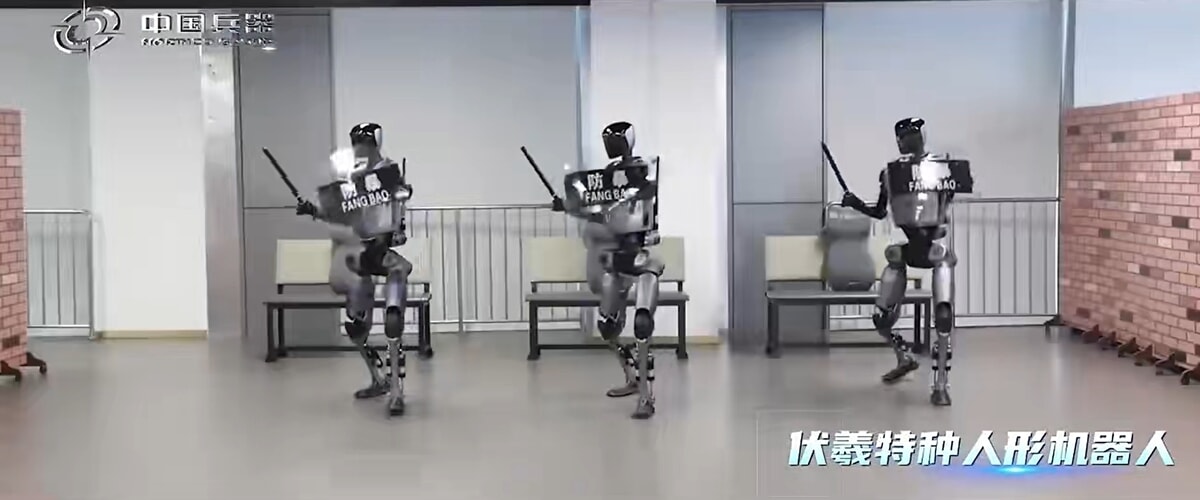
The defense industry is also moving. Norinco, a Chinese public arms giant, developed the humanoid Fuxipresented as a machine intended for surveillance, reconnaissance, patrolling and missions considered too dangerous for men. The robot can also be controlled remotely by an operator.
China is not the only country to imagine soldiers flanked by humanoid robots. The US Army has also entered a competition to develop militarized humanoid capabilities. Among the hypothesized uses are reconnaissance, surveillance, removal of obstacles, interventions in the presence of dangerous substances and offensive or defensive missions in an urban environment.
However, Beijing starts with an enormous industrial advantage. According to BofA Global Research, cited by Reutersin 2025, Chinese manufacturers accounted for approximately 95 percent of global shipments of humanoid robots. It is this combination of mass production, research into artificial intelligence and the growing interest of the military that makes the Chinese race particularly significant.
For now, soldier robots still belong more to laboratories than to battlefields. But for Wang Yonghua, a researcher at the Chinese Academy of Military Sciences, the limit may only be temporary. If movement and perception improve and costs continue to fall, he wrote, humanoids could one day “flock to the battlefield.”