

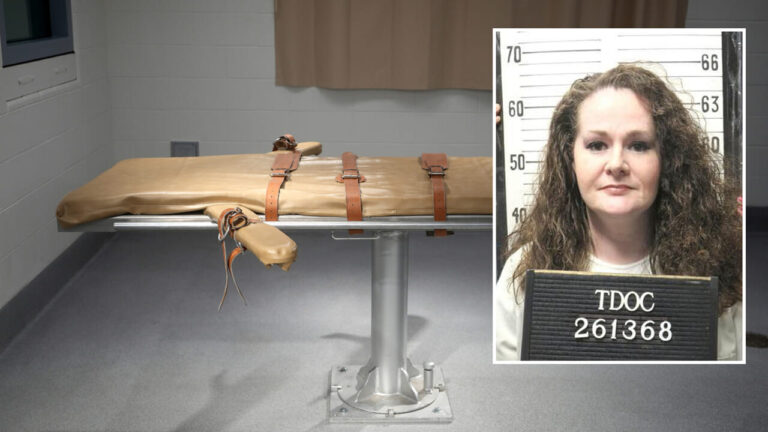
Christa Pike remains unconscious and on an artificial respirator in the hospital where she was admitted after surviving two lethal injections. The 50-year-old Tennessee death row inmate was scheduled to be executed last week, but prison authorities suspended the procedure after the drug failed to produce the expected effect. Now his lawyers are asking for the sentence to be commuted to life imprisonment.
The story of Christa Pike
Pike had been sentenced to death for the murder, committed in 1995 when she was 18, of Colleen Slemmer, 19, a classmate of hers in Knoxville’s Job Corps vocational training program. The crime was linked to a romantic rivalry. Her two accomplices, also teenagers — her boyfriend at the time, 17, and another 18-year-old girl — avoided the death penalty. The first was sentenced to life imprisonment, while the second obtained a suspended sentence in exchange for her testimony against the other two.
In these thirty years there have been many requests for mercy made by NGOs and human rights associations, both in consideration of the young age at which Pike committed the crime and for her psychological conditions: in prison she was diagnosed with bipolar disorder and post-traumatic stress disorder. Tennessee’s Republican governor, Bill Lee, had rejected calls on Monday to have his sentence commuted before the failed execution.
The two lethal injections
The execution was scheduled to take place in a Nashville prison. The first injection was suspended by a judge for formal reasons. Then came the green light from the Supreme Court, but, according to what was reported by the journalists present and the defense, despite the two injections the woman survived. Doctors are now trying to clear his system of the lethal dose of pentobarbital administered.
It’s the second time this year that lethal injection doesn’t go as planned in Tennessee. Tony Carruthers, convicted of three murders committed in 1994, lay in agony for an hour because they couldn’t find a vein for the injection. Governor Lee has suspended further executions scheduled between now and the end of the year.
According to the Death Penalty Information Center, lethal injection is the most error-prone procedure. In a 2022 annual review, the organization found that 35% of 20 execution attempts made that year had “obvious problems.”
The lawyers’ request
“The least we can do now is take the death sentence off the table and start evaluating what the future could be for her,” said Steve Ferrell, one of Pike’s lawyers, interviewed by CBSnews. The lawyer explained that it is not known whether the woman will be able to regain consciousness, but he nevertheless urged the governor to grant pardon and commute the sentence to life imprisonment.
Ferrell added that he and other members of Pike’s legal team “are ready to have discussions with the governor and whoever may make this decision.” Even if Pike were to regain consciousness, his future would remain uncertain: the lawyer stressed that “a long time may pass before he is able to participate in legal proceedings.” In any case, the legal team will try to get the sentence commuted, to exclude the possibility that Tennessee could set a new execution date.