

On 10 September 2026, the Meloni government launched decree law number 157 “Urgent provisions regarding oil prices connected to the continuation of the new crisis of international markets and strategic energy infrastructures and activities”. The measure is divided into two parts. The first, and the most well-known, concerned the extension until 17 September of the reduction in excise duty on diesel fuel, equivalent to approximately 17 cents per litre. The second, however, aims to accelerate hydrocarbon exploration, research and cultivation activities on land. In essence, the government intends to unblock the bureaucratic process of the still stalled requests.
What the new decree law says
First the cuts on excise duties to discount the price of petrol and diesel, then the moral suasion on energy operators (Eni, Ip, Q8, Tamoil) so as to apply voluntary caps in their distributors. Giorgia Meloni’s government is moving on multiple fronts to address the increases in fuel prices due to the conflict between the United States and Iran. The latest move is in fact to increase national production in two ways: refining and extracting more. On 8 October the Minister of the Environment, Gilberto Pichetto Fratin, and the Minister of Business, Adolfo Urso, will meet oil companies and refiners to ask for an increase in production. In the meantime, with a legislative decree we are aiming for new resources.
Because every year we leave 7 billion euros in the ground: “Here’s how to pay 20 cents less for petrol” – by Pierfrancesco De Robertis
In the explanatory report to the decree, the government accuses the inertia of the Regions capable of “causing delays incompatible with the country’s energy security needs”. For this reason, the executive is determined to intervene in cases where operators’ requests remain blocked in the bureaucratic process. The provision only concerns agreements on which the Region has not expressed its opinion, effectively stopping everything, and not cases of denial.
Article 2 regulates all this. If the entity does not decide on the agreement presented within 45 days, then the Prime Minister assigns an ultimatum of up to 60 days to give a decision. A period that can be shortened to 30 days in some cases, but which still involves the opening of a discussion table. If the Region is still in default, and national interests are at risk, then the Council of Ministers appoints an ad acta commissioner who has the task of expressing his opinion on the agreement. This official, who however does not receive compensation, attendance fees or expense reimbursements, can also be chosen by the Prime Minister.
It should also be remembered that from the end of 2024, as a result of legislative decree no. 153, it is no longer permitted to grant new permits for the exploration and production of liquid hydrocarbons. The titles already granted before the entry into force of the law continue for the useful life of the field.
Applications for new mining titles
To get to the extraction of hydrocarbons you must first look for them and then “cultivate” them. Operators submit requests for research permits and those relating to cultivation concessions to the State and Regions. Mining licenses are issued by the Ministry of the Environment in agreement with the Region concerned regarding activities on land. At sea the government must request the opinion of the Committee for the Safety of Offshore Oil and Gas Operations.
The decree approved by Meloni only concerns requests relating to the mainland. As reported in the Official Bulletin of Hydrocarbons and Georesources (September 2026 issue), there are currently 27 exploration permits in force on the mainland (of which 13 in Emilia-Romagna, 7 in Abruzzo and 5 in Lombardy). Added to these are 3 titles in Sicily, which has autonomous regulatory competence. The number of cultivation concessions along the Peninsula is significantly greater: 82 (33 in Emilia-Romagna, 13 in the Marche, 11 in Basilicata). The 13 from Sicily must be added to the total.
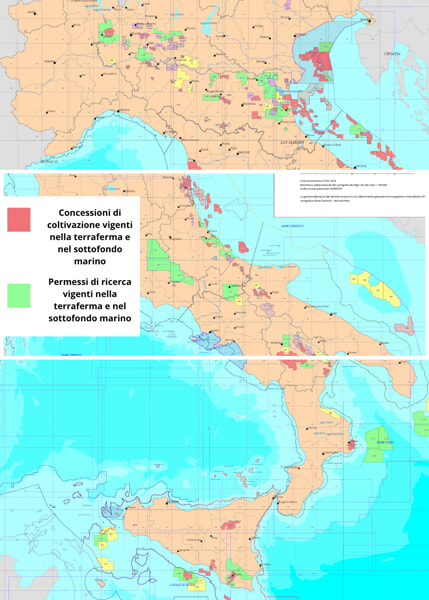
In addition to these there are the concessions that have ceased pending the mineral restoration of the area, but those that interest us are others. According to the latest bulletin from the Ministry of the Environment, there are 15 requests for the awarding of new mining titles: 12 research permits and 3 cultivation concessions. Among the companies involved are Eni (Anzi, in Basilicata; Agosta, in Emilia Romagna), Aleanna Italia (Valle del Mezzano, San Patrizio and La Stefanina, Emilia Romagna; Gallia, Lombardy), Apennine energy (Solfara Mare, Calabria; Posta del Giudice, Puglia), Delta energy (Il perito and La capriola, Basilicata; Pietra Spaccata, Campania).
What immediately catches the eye is the request from Agosta, in the territory of the Ferrara municipalities of Comacchio and Ostellato, which from the list appears to have been presented on 1 September 2003. The request has a complex bureaucratic history. Suffice it to say that the Ministry of Economic Development had given the approval to the cultivation concession in 2004, conditioning it on the pronouncement of environmental compatibility. In 2006 the Emilia-Romagna Region called the services conference. However, the institution suspended the process in 2014. Which only resumed in 2015.
| Instance | Applicants | Presentation | Region | Municipalities |
| ANZI (research permit on the mainland) | Eni (100%) | 01/09/2005 | Basilicata | Abriola, Anzi, Brindisi Montagna, Calvello, Pignola, Potenza, Trivigno |
| FONTEVIVO (research permit on the mainland) | Italian Pengas (100%) | 12/19/2015 | Emilia Romagna | Busseto, Collecchio, Fidenza, Fontanellato, Fontevivo, Medesano, Noceto, Parma, Polesine Zibello, Salsomaggiore Terme, San Secondo Parmense, Sissa Trecasali, Soragna, Torrile. |
| GALLIA (research permit on the mainland) | Aleanna Italy (100%) | 12/20/2013 | Lombardy | Ferrera Erbognone, Galliavola, Lomello, Mede, Mezzana Bigli, Ottobiano, Pieve del Cairo, Sannazzaro de’ Burgondi, Sartirana Lomellina, Scaldasole, Semiana, Valeggio, Villa Biscossi |
| GUSSOLA (research permit on the mainland) | Italian Pengas (100%) | 12/19/2015 | Lombardy | Bozzolo, Calvatone, Cappella de’ Picenardi, Casalmaggiore, Casteldidone, Cella Dati, Cicognolo, Cingia de’ Botti, Derovere, Gussola, Isola Dovarese, Malagnino, Martignana di Po, Motta Baluffi, Pessina Cremonese, Piadena Drizzona, Pieve d’Olmi, Pieve San Giacomo, Rivarolo del Re ed Uniti, Rivarolo Mantovano, Sabbioneta, San Daniele Po, San Giovanni in Croce, San Martino del Lago, Scandolara Ravara, Solarolo Rainerio, Sospiro, Tornata, Torre de’ Picenardi, Torricella del Pizzo, Voltido |
| THE EXPERT (for research permit on the mainland) | Delta energy (100%) | 02/28/2011 | Basilicata | Montescaglioso, Pomarico |
| LA CAPRIOLA (research permit on land) | Delta energy (100%) | 02/04/2012 | Basilicata | Bernalda, Montalbano Jonico, Montescaglioso, Pisticci, Pomarico |
| LA STEFANINA (with research permit on the mainland) | Aleanna Italy (100%) | 29/10/2014 | Emilia Romagna | Argenta, Alfonsine, Comacchio, Ravenna |
| SPLIT STONE (for research permit on land) | Delta Energy (100%) | 02/28/2011 | Campania | Baselice, Castelpagano, Circello, Colle Sannita, Foiano di Val Fortore, Molinara, Pesco Sannita, Reino, San Giorgio La Molara, San Marco dei Cavoti |
| JUDGE’S MAIL (for research permit on the mainland) | Apennine Energy (100%) | 01/31/2006 | Puglia | Casalvecchio di Puglia, Castelnuovo della Daunia, Lucera, Pietramontecorvino, San Severo, Torremaggiore |
| SAN PATRIZIO (research permit on the mainland) | Aleanna Italy (100%) | 30/12/2010 | Emilia Romagna | Bagnacavallo, Conselice, Fusignano, Imola, Lugo, Massa Lombarda, Medicina, Mordano, Sant’Agata sul Santerno |
| SANTA MARIA DEL PIANO (research permit on the mainland) | Italian pengas (100%) | 11/17/2018 | Emilia Romagna | Felino, Parma, Langhirano, Lesignano de’ Bagni, Traversetolo, Montechiarugolo. |
| SOLFARA MARE (research permit on the mainland) | Apennine Energy (100%) | 27/11/2008 | Calabria | Calopezzati, Caloveto, Cariati, Corigliano Calabro, Cropalati, Crosia, Mandatoriccio, Paludi, Pietrapaola, Rossano, Scala Coeli, Terravecchia |
| AUGUSTA (mainland cultivation concession) | Eni (100%) | 01/09/2003 | Emilia Romagna | Comacchio, Ostellato |
| COLLE SANTO (concession for cultivation on land) | LNEnergy (100%) | 24/02/2009 | Abruzzo | Arches, Atessa, Bomba, Colledimezzo, Pennadomo, Roccascalegna, Torricella Peligna, Villa Santa Maria |
| VALLE DEL MEZZANO (concession for cultivation on land) | Aleanna Italy (100%) | 07/28/2017 | Emilia Romagna | Hosted |
On 28 April 2017, Emilia Romagna expressed a negative opinion with council resolution number 539, but on 9 June of the same year the positive opinion arrived with prescriptions from the Technical Commission for Environmental Impact Verification (Via and Vas). And in 2023 the Ministry of the Environment communicated its favorable opinion of environmental compatibility for the production project. If the agreement phase is reached and the Region is slow to respond, then the government will be able to intervene.
How much Italian oil is really worth and where it is found: the numbers behind Giorgia Meloni’s plan – Manlio Pistolesi
On the other hand, the executive has repeatedly reiterated the urgency of investing in Italian reserves. Which are also quite limited: around 34 billion cubic meters of gas and 76.9 million tonnes of oil. Over the last decade, however, there has been a dramatic decline in research permits, from 111 (2016) to 44 (2026). While those linked to extraction suffered a slight decline, from 202 (2016) to 182 (2026). A slowdown due both to the Conte I government’s moratorium (2019) and to the sustainable energy transition plan for eligible areas (2022), then canceled with some sentences of the Lazio Regional Administrative Court in February 2024.
How much can a municipality earn
For the territories involved in these new activities there could be significant economic compensation. European Directive 2013/34 recommends that companies active in sectors such as oil and gas disclose payments to public bodies in an annual report.
In the year 2025, Eni paid 144 million euros between royalties, rights and other fees. Of these, 55.6 went to the Ministry of Economy, 38.3 to the Basilicata Region and the rest to the municipalities and other bodies where the structures are located. The Municipality of Gela (Caltanissetta) collected 6.6 million euros, Viggiano (Potenza) 4.2 million, Bronte (Catania) 2.6. This can also be said for other operators: TotalEnergies distributed 114 million dollars, while Shell distributed 144 million dollars.
The meeting on 8 October 2026
There are many intersecting interests and the government wants to bring them together at the table on 8 October. At Palazzo Piacentini, at 4.30 pm, oil companies and refiners were summoned: Unem (Energy Union for Mobility), Sonatrach, Socar-IP, Iplom, Kpi, Alma Petroli, Ludoil/Isab, Eni, Saras and Innovhub. Representing the government will be the Minister of the Environment, Gilberto Pichetto Fratin, and the Minister of Business, Adolfo Urso.
“It’s about making a national point, but also a point about how we evaluate the issue with respect to the European Union,” Fratin said. But during the meeting we will examine how the 10 Italian refineries, plus the biorefineries of Gela and Marghera and the one in Livorno which is currently being reconverted, can increase their production to alleviate the increase in fuel prices. Considering that their usage rate is around 77 percent.
Dossier is the exclusive subscription investigative section of The Vermilion. If you want to support our journalistic work and subscribe, Click here.