

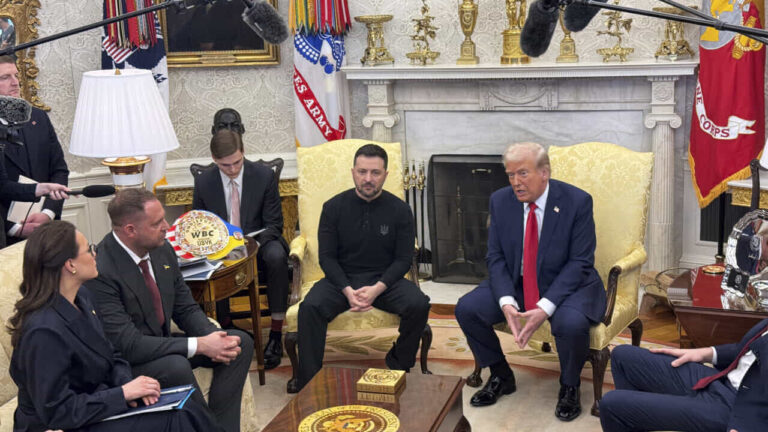
On the day that will mark the fourth year since the start of the Russian invasion, next February 24, President Volodymyr Zelensky could break the deadlock and announce the path that will lead Ukraine to new presidential elections and a national referendum on a possible peace agreement. The indiscretion, launched by Financial Timesbrings about a drastic change of direction for a country still under martial law.
Between revelations and denials: what is true?
The Trump administration would have posed an either/or in Kiev: a clear diplomatic “exit strategy” and the restoration of democratic processes as a condition for maintaining US security guarantees. In exchange, Ukraine must plan presidential elections and a referendum on a possible peace agreement with Russia, setting the insurmountable deadline of May 15, 2026. But there are many doubts about this reconstruction. Because a source from the Ukrainian presidential office denied the Kyiv Independent Zelensky’s intentions. “If Russians kill people every day, how can we announce or seriously consider elections in the coming weeks?” the Ukrainian source stressed. “No one is against voting, but there must be security.”
The obstacles to calling the vote
The safety of citizens during elections remains the main obstacle. The central issue is martial law, introduced by Kiev in February 2022. The current legislation not only suspends normal democratic activities, but explicitly prohibits the holding of any elections as long as Russian troops occupy the national territory.
Lifting martial law would be a necessary first step to begin an electoral process. Ukrainian law requires at least 60 days for the election campaign, but there are those who push that the election campaign should instead last three months, the time needed to rewrite the electoral lists in the midst of the war. Then there is the limit set by the Constitution, which should be amended with a two-thirds majority in parliament. But this is an unlikely scenario, also because several opposition parties remain against holding the vote in full conflict. According to a poll conducted late last year by the Kyiv International Institute of Sociology (Kiis), only 10% of Ukrainians favor holding elections before a ceasefire.
Yet, something is moving behind the scenes. A working group composed of politicians and military leaders has been active since last year with a complex task: to define an emergency legislative framework that allows voting as soon as martial law is lifted.
Logistical challenges: soldiers on the front and refugees abroad
Logistical issues also make the scenario of new elections in wartime complicated: millions of citizens are abroad, many others are engaged at the front or live in occupied areas. Kiev, under constant attacks from Russia, should be able to protect millions of citizens during voting operations. An arduous, if not impossible, undertaking. For four years, Russian troops have been bombing cities close to the extended front line on a daily basis, but they have also gone further, hitting the capital Kiev and more distant urban centers such as Lviv.
How close is a peace agreement between Russia and Ukraine
It is not the first time, therefore, that word has circulated of President Zelensky’s intentions to call Ukrainians to vote. For years, the Ukrainian president has resisted attacks from his Russian counterpart Putin, who questions his legitimacy. If at the beginning of the invasion Moscow’s objective was to depose the “Kiev regime”, today the Russian strategy focuses on institutional delegitimization. The Kremlin has deemed the Ukrainian president illegitimate, claiming that his five-year term would expire in 2024 and that he has not called new elections.
In order to see the polls open, Moscow has assured that it could stop the fighting. But under certain conditions. Ukrainians living in Russia and in the areas under Moscow’s control must also vote in the elections. The White House enters forcefully into this stalemate. President Trump, committed to mediating an ambitious peace agreement, has made the return to the vote one of the essential pillars to ensure security guarantees.
How would Zelensky emerge from the elections?
The vote, however, could bring an unwelcome surprise to Moscow and Washington. Analysts, in fact, believe that Zelensky will secure a second mandate, despite having said he is willing to step aside in the event of a peace agreement. The Ukrainian leader’s support among the public has gradually declined since the invasion began as he has been accused of centralizing too much power during the war with his top adviser, Andriy Yermak fired in late 2025 in the wake of a vast corruption scandal. There has also been criticism for having removed opponents of his line, such as Valery Zaluzhny, the former supreme commander of Kiev’s armed forces, currently ambassador to London.
But something changed at the end of last year, probably due to the firm posture held towards the United States. According to a Kiis poll, around 59% of Ukrainians trust the former comedian and now president. Another poll on voting intentions places Zelensky neck and neck with the popular Zaluzhny, while other statistics give the former head of the armed forces a landslide victory. Between denials and confirmations, there is one certain fact: if Zelensky were to announce the date of the elections and referendum on February 24, he would transform the anniversary of the invasion from a day of resistance into a starting point for a new political era in Ukraine.