

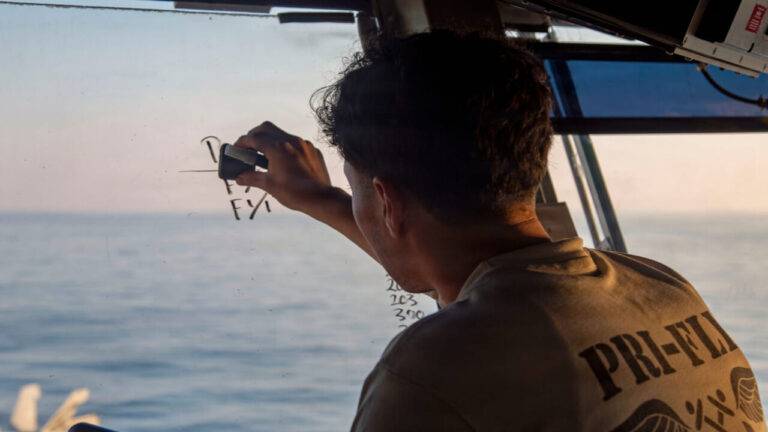
Morale is low for a mission that seems endless. All exhausted, after more than two hundred consecutive days at sea. The situation for the more than five thousand sailors and marines who are on board the American aircraft carrier USS Abraham Lincoln, at sea for nine months, of which five are at war against Iran, is becoming increasingly worrying. In recent hours the Guardian, citing the Navy Times and other industry sources, has spoken of at least two suicide attempts.
In one case, a sailor’s wife said her husband tried to jump overboard after his tour of duty at sea kept getting longer. “He’s scared. He thinks he’s going to be dishonorably discharged and that just because he was exhausted, his 13-year career is ruined,” she said. In another case, also revealed by the wife of a military man, the husband was involved in another accident aboard the Lincoln, during which he prevented a crew member from jumping overboard, grabbing him and bringing him back to the deck.
The US Navy did not provide precise figures on self-harm cases, but confirmed that the ship’s command is constantly monitoring the well-being of personnel on board.
Two hundred days at sea, from China to Iran
The vessel, a Nimitz class, left San Diego, California, on Nov. 21, 2025, for a mission in the South China Sea. From there it was diverted towards the Middle East in view of the start of the offensive by the United States and Israel against Iran on February 28th. The deployment, initially scheduled to conclude between May and a total of seven months, progressively lengthened to become the longest ever undertaken by a US aircraft carrier in the modern era. As the weeks went by, according to various testimonies, the hardships for the military increased: reduced food supplies, borderline hygienic conditions, exhausting shifts.
Stories from family members
The relatives made public what was happening on board, as the military could not do so directly. To Military Times magazine, partners of some sailors reported incidents in which crew members attempted to jump overboard. Annabelle Loma told the newspaper that the mediator in charge of assisting the families had told her about her husband’s attempt to jump into the water: since then, she said, she has only managed to speak to him a few times and the man is now under medical observation. “He’s scared,” he explained, fearing a dishonorable discharge after a thirteen-year career “just because he was completely exhausted.”
Another relative, Maria Rodriguez, reported that her husband stopped a fellow soldier as he was preparing to jump into the sea, managing to save him. Similar episodes were also collected by the magazine Stars and Stripes. Last week, in San Diego, the families of more than two hundred crew members met with Acting Secretary of the Navy Hung Cao. In a second discussion, remotely, they reported mental health problems, safety at risk and personnel exhausted after a non-stop combat mission that lasted five weeks.
Political lunge against Trump
The case turns into a political attack against Trump and his management of the war on Iran. Democrats in the US Congress are demanding clarification on living conditions aboard the nuclear-powered aircraft carrier, after reports of shortages of basic necessities, hygiene problems and deteriorating mental health among the approximately five thousand crew members. The pressure on the defense leaders comes as alarming stories emerge from the sailors’ families, some of whom speak of attempts to take their own lives on board. A case that is intertwined with the war unleashed by the United States and Israel against Iran and which is rapidly turning into a new problem for the White House.
The letter to the Pentagon
The first to move was Democratic Senator Richard Blumenthal, who wrote to Defense Secretary Pete Hegseth asking the Navy to account for the situation on board. In the letter, Blumenthal recalls that the aircraft carrier has been deployed for more than 250 days and has not docked for over 200, thus establishing the record for the greatest number of consecutive days at sea. The senator cited “numerous reports of shortages of basic necessities, water contamination, plumbing problems, deteriorating mental health and safety issues on the bridge,” among other critical issues. Along the same lines, Senator Ruben Gallego, who on X urged “an official monitoring visit conducted by the bipartisan Senate delegation on board the USS Lincoln to investigate the alarming conditions reported”.
“Reports of crew members threatening to jump from the ship are a terrifying warning sign of the gravity of the situation,” Senator Gallego denounced, listing “moldy showers, intermittent hot water, rationed meals and soap, out-of-use toilets and grueling 12-16 hour shifts with no days off.” Then the direct attack: “The way Trump treats our military while waging this illegal war is not just sickening, it’s dangerous.”
Trump had assured that the conflict would last “a few weeks”. Many months later, conditions on board the USS Abraham Lincoln have worsened, casting a shadow on the transparency of the Pentagon’s communication, which until now had offered a celebratory picture of the operation against Iran.