
47% of companies in the Electrical and Electronic Equipment (EEE) sector have low levels of both knowledge and implementation of the provisions introduced by the new European Packaging Regulation (PPWR), which came into force on 12 August. Only 4%, made up exclusively of large companies, have a high level of knowledge accompanied by concrete implementation of the necessary measures.
This is what emerges from the study “State of the art and opportunities for packaging of electrical and electronic equipment” Of Erion Packagingedited by RISE laboratory of the University of Brescia And Digital360 Advisorywhich was of interest 51 companies and took into consideration six of the main technical requirements introduced by the Regulation: dangerous substances present in packaging, recyclability, recycled content, reduction, reuse and labeling of packaging.
ABOUT 455 THOUSAND TONS OF EEE PACKAGING PLACED ON THE MARKET IN ONE YEAR
One of the first results of the study concerns the dimension of the phenomenon: in By 2025, approximately 454,722 tonnes of packaging associated with EEE were placed on the Italian marketequal to approximately 3% of the 14.2 million tonnes of packaging overall placed on the national market. The ones that generate the greatest amount of packaging are the small EEEwith which they are associated approximately 235,554 tons of packaging, equal to 51.8% of the total. They follow large EEE (90,682 tonnes, 19.9%), IT and telecommunications equipment (54,268 tonnes, 11.9%), the Cold and Climate sector (39,288 tonnes, 8.6%) and Televisions and monitors (34,931 tonnes, 7.7%).
AN IMPORTANT GAP REMAINS BETWEEN KNOWLEDGE OF THE REGULATION AND CONCRETE APPLICATION
The study highlights how knowledge of the new provisions is still predominantly general and has not always been translated into structured processes within companies. The highest level of lack of knowledge concerns the reuse of packaging (47%)followed by recycled content and packaging reduction, both at 43%. At the same time, 43% of companies declare that they know, at least in general terms, all six requirements analysed, while 22% do not know any. The main element of attention, however, concerns the transition from knowledge to concrete measurement of one’s position with respect to the Regulation. For five of the six requirements analysed, in fact, the majority of companies have never carried out a structured evaluation. The percentage varies from 57% for packaging minimization to 78% for recycled content. Systematic and continuous evaluation activities are also still not widespread. A similar situation emerges on the documentation front: depending on the requirement, between 65% and 84% of companies have not yet prepared documentary evidence to support their compliance.
Even in terms of concrete actions, the path is still evolving: between 63% and 84% of companiesdepending on the requirement considered, has not yet launched specific improvement initiatives, such as the redesign of packaging, the reduction of the number of materials used, the replacement of plastic and polystyrene with alternative materials and greater involvement of suppliers in the collection of information and certifications.
ONLY 4% OF THE SAMPLE IS ALREADY “BEST IN CLASS”
By crossing the level of knowledge with that of implementation, the largest group, equal to 47% of the sampleis made up of “Laggards”characterized by still low levels on both indicators. Followed by “Theoretical” (31%)companies that show good knowledge of the provisions but have not yet fully translated it into operational activities. The 18% of companies are instead “On the move”with an intermediate level of both knowledge and implementation. Only the 4% are among the “Best in class” and presents high levels in both dimensions, represented exclusively by large companies.
A ROADMAP IN SIX STEPS TO GET PREPARED
Starting from the results of the survey, the interviews and the analysis of the quantities of packaging placed on the market, the study offers companies in the AEE sector a six-step processconceived as a process of continuous improvement.
The first step consists inincrease awareness of the Regulation And constantly monitor its evolution. They follow the construction of structured measurement processesthe periodic verification of compliance with individual requirements, the introduction of concrete improvement actions on packaging, the achievement of documentary compliance and, finally, the possibility of go beyond simple regulatory compliancetransforming the adaptation process into an opportunity for efficiency and innovation.
«The results of the study tell us that the PPWR can no longer be approached exclusively as a new standard to be known: it must progressively translate into data, processes, internal responsibilities and concrete choices on packaging» – he declares Andrea Bizzi, General Director of Erion Packaging. «Companies have a complex path ahead of them and a technical framework that is still evolving, but precisely for this reason it is important to start mapping their flows today, involving the supply chain and building systems capable of measuring their position over time with respect to the different requirements.»
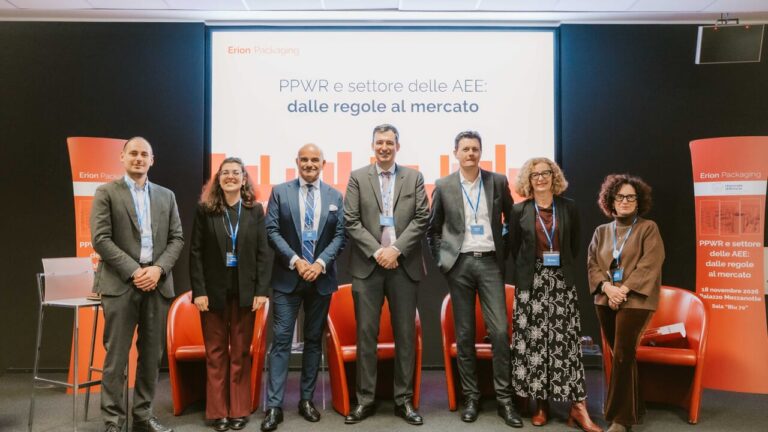
The study was presented on 18 November 2026 at Palazzo Mezzanotte, in Milanduring the event “PPWR and the EEE sector: from rules to the market”. Speakers: Claudio FormisanoPresident of the Board of Directors of Erion Packaging, Irene PellucchiErion Compliance Organization, Gianmarco BressanelliRISE Laboratory of the University of Brescia, Francesco BeneventiMASE, Elena GrandiCouncilor of the Municipality of Milan. They participated in the round table Federico MagaliniDirector Sustainability & Circular Economy at dss+, Davide RossiAIRES Confcommercio, Nadia CarbonaroAPPLiA Italia, e Barbara CarnivalANITEC-ASSINFORM. The conclusions were entrusted to Andrea BizziGeneral Manager of Erion Packaging.