

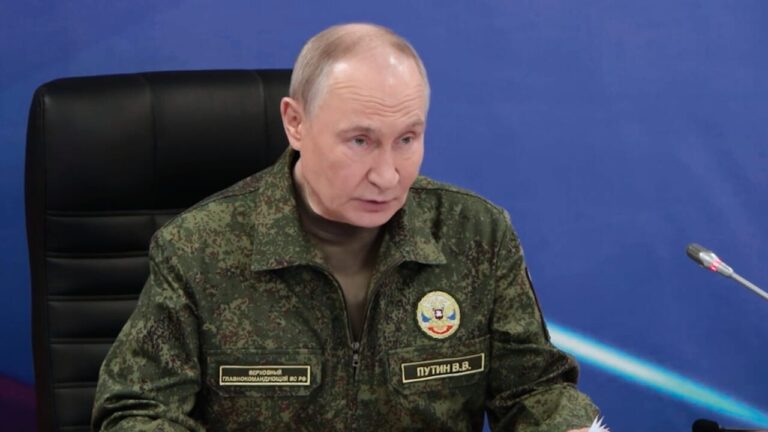
With the beginning of the large-scale invasion of Ukraine, Russian President Putin converted the national economy into an economic force producing munitions, uniforms and fortifications. But after a couple of years of high growth, Russia’s GDP – while still remaining positive – is recording a constant decline. And the ones who pay the highest price are the Russians, who are starting to pay the bills in their own pockets. Fish, chicken, meat and, above all, cucumbers. Everything is much more expensive in the Federation led by the Russian “tsar”.
How is the Russian economy (really) doing?
We have to ask ourselves how we got to this point. Let’s take a step back to four years ago. When Western leaders imposed sanctions on Russia after invading Ukraine in 2022, they believed they would soon see the collapse of Moscow’s economy. But that wasn’t the case. After the immediate shock of the sanctions (GDP recorded a contraction of 1.4%), Russian military spending increased and the economy recorded a boom (+4.1% in 2023 and +4.3% in 2024, according to World Bank data).
Then in 2025 the first sign of a slowdown arrived, thanks to the decline in oil prices and productivity. “Russia’s GDP grew by 1% last year, marking a slowdown compared to the previous two years”, underlined President Vladimir Putin during a government meeting, explaining that the slowdown was expected and linked to the policies adopted to contain the increase in prices.
The Kremlin puts its hands in Russian pockets to finance the war in Ukraine
The Kremlin did not fail to take action. To contain the loss of economic momentum, which occurred mainly in the wake of falling oil and gas revenues, Moscow last year raised corporate tax from 20% to 25% and introduced higher income tax brackets. And, starting from January 1st, it introduced an increase in VAT from 20% to 22%. The Ministry of Finance was keen to reassure the population, specifying that the reduced rate of 10% will remain in force for medicines, basic foods, baby products and other goods considered of social importance, in an attempt to mitigate the impact on the most fragile consumers. But the exemption on some essential goods has not curbed rising inflation in Russia, where prices of basic goods have risen.
Cucumbers double the price
One of the key foods of Russian culinary tradition is the cucumber. It is not just a vegetable, but represents the heart of the Russian food basket, whose price variation immediately reflects the perception of the high cost of living among consumers. In recent weeks, the vegetable has arrived on the shelves with a price that has increased by 43% since January, according to data from Rosstat (the Russian Istat). According to the latest findings from the trade association Rusprodsoyuz, the price of cucumbers experienced a surge in the last quarter, recording an increase of 111%. In February, the average retail cost was close to 300 rubles per kilogram. However, if we look at the annual comparison, the increase appears more limited: compared to February 2025, vegetable prices grew by 1.8%. As he explained to Forbes Russia the vice-president of Rusprodsoyuz, Dmitry Leonov, in the same period last year prices had recorded an even more marked increase, equal to 120% in three months.
In Russia, cucumber prices regularly increase in winter, but this year the increase has been accentuated by one of the harshest winters in the last thirty years, which has slowed down processing, harvesting and distribution. Added to the seasonality was above all the increase in tax pressure, which also affected small businesses previously subject to the simplified regime, together with the increase in VAT. The increases have affected the entire supply chain, from greenhouse production to retail sales, with rising costs for electricity – particularly relevant in the cold months – as well as spare parts, logistics and staff wages. Although grown domestically, cucumbers rely on imported planting material, which further contributes to rising costs.
Therefore, even the small increase along each step of the supply chain produced a strong final increase in prices. As warmer temperatures arrive, the surge in cucumber prices may slow, but inflation is not expected to decline.
Дожили..
Let’s see what the story is about..!
Let’s see what happened, let’s see what happened the story of the story, the story of the story земель. pic.twitter.com/m3qAFMbjaQ— ⭐⭐⭐Сергей Васин⚡️❤️ (60+) (@VasinSerg) February 16, 2026
The biggest problem for Putin is inflation
Keeping inflation under control remains one of the Russian government’s economic priorities in 2026. At the recent government summit, President Putin claimed the progress made: inflation fell to 5.6% last year, a marked improvement compared to the peak of 9.5% reached in 2024. However, the most recent data suggests that the road to normalization remains uphill. According to weekly findings from the state statistics agency Rosstat, price dynamics showed signs of nervousness at the beginning of the year, reaching a peak of 6.46% on February 2, before falling to 6.36% by February 9, while at the end of December it stood at 5.59%. Despite these fluctuations, the Russian Central Bank’s (BCR) projections for the current year remain anchored at a range between 4% and 5%.
To respond to the first signs of cooling, on February 13th the Bcr broke the delay, reducing the reference rate from 16% to 15.5%. The strategy is clear: to extremely cautiously ease a monetary policy which, if on the one hand slows down the price race, on the other is freezing the real economy. Experts predict that inflation will continue to slow, approaching the target of 4-5%, giving the Central Bank room for further rate cuts. The BCR itself has issued a warning: the rigor necessary to bring prices back under control risks resulting in a stagnation of the Russian GDP. Estimates for 2026 indicate an economic rebound close to zero. According to the International Monetary Fund, growth forecasts for Russia in 2026 stand at 0.8% and the BCR itself has placed them in a range between 0.5% and 1.5%, while the Ministry of Economic Development in Moscow spoke of 1.3%. The IMF also forecasts limited growth for 2027, around 1%.
The slowdown in oil sales
The heart of the Russian economy beats in the export and sale of hydrocarbons. But what has been Moscow’s financial lung for decades, and which in recent years has directly fueled the war effort, is undergoing an unprecedented contraction. The data illustrates a difficult situation. In January 2025, state coffers collected 1.12 trillion rubles (about 14.5 billion dollars) from the sale of hydrocarbons. Just 12 months later, the figure has plummeted to 393 billion rubles ($5.1 billion). The data is unequivocal: in just one year, tax revenue from fossil fuels decreased by almost two thirds (-65%), reaching the lowest levels since the pandemic period. To date, global earnings from fossil fuel exports are 13% lower than levels recorded before the outbreak of conflict in 2022.
Who finances Putin’s war in Ukraine
After the drastic drop in exports to Europe due to the war in Ukraine, Moscow has bet everything on China, India and, partly, Türkiye. However, this strategy is now threatened by two new pressure factors: Western sanctions against the so-called “shadow fleet”, used by Moscow to circumvent oil price caps, have discouraged large international buyers. Then there is Donald Trump’s threat of new punitive duties against Beijing and New Delhi. Pressure from Washington aims to force Asian giants to drastically reduce purchases of cheap Russian crude, closing the Kremlin’s main economic channel. Complicating the picture is the strengthening of the ruble: when revenues from sales abroad (in foreign currency) are converted into the local currency to pay salaries, pensions and military expenses, the real value collected by the state is lower, further eroding the government’s room for maneuver. The next few months will therefore be crucial for the Kremlin, which will have to find effective solutions to maintain internal, economic and political stability.