

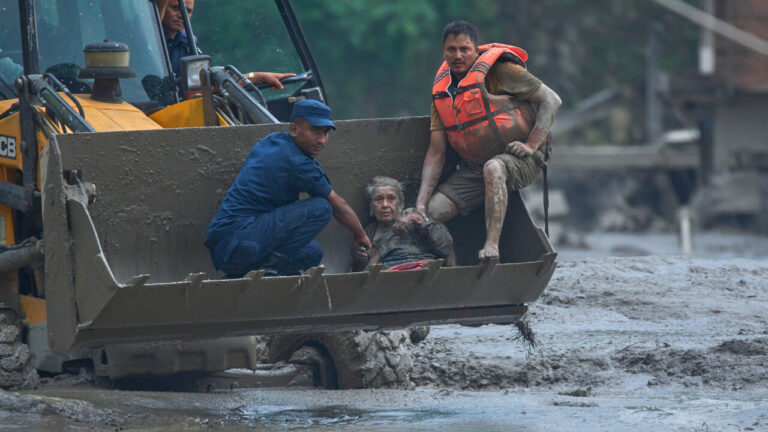
At least 100 people have died and over 500 are missing after the devastating flood that hit the Nepalese district of Rasuwa, along the border with Tibet. Among those untraceable there would be hundreds of foreign travellers, while the two Italian citizens involved have been evacuated and are in good condition.
The provisional budget and the note from the Farnesina
The most recent death toll was given by Nepalese Prime Minister Balendra Shah, who urged the population to remain united. “The government takes full responsibility for relief, medical care, food and shelter,” he assured. The figures, however, remain provisional and have increased rapidly as the hours have passed.
According to a preliminary list from the Nepalese police, 579 travelers are missing, 466 of them foreigners and 93 Nepalese. Those missing include Indian, British, Malaysian, South African, US, Australian and Dutch citizens. The nationality of more than one hundred people has yet to be ascertained.
The Farnesina took action to verify the possible involvement of the approximately 90 Italians present in the area. Two compatriots, who were with a group of Russian hikers, were evacuated unharmed from the Nepalese side of Tibet.
“The two Italians involved are in good condition, they are assisted by our diplomacy and we will help them return when they deem it appropriate. We have no news of other Italians involved”, declared the deputy prime minister and foreign minister Antonio Tajani. The crisis unit maintains contact with the Italian consulate general in Calcutta, the honorary consulate in Kathmandu and the Italian embassy in Beijing.
The wave of mud overwhelmed bridges, roads and power plants
The flash flood reached the Rasuwagadhi-Timure area around 8.40 local time today, Wednesday 26 August, overwhelming settlements, vehicles, goods and bridges. Syabrubesi, Rasuwa and the Bhote Koshi valley were also particularly affected, while damage was reported in the nearby districts of Nuwakot and Dhading.
The mass of water swept away vehicles, goods and structures and damaged several energy projects. According to Reuters, about 430 megawatts of hydroelectric capacity, more than 12 percent of Nepal’s, would be affected by the disaster.
Videos released by Nepalese police show huge torrents of water and mud cascading down mountain valleys. Several roads were closed and the authorities ordered residents in areas near waterways to move to safer places. Kathmandu is not affected, but the flood is expected further downstream along the Trishuli river.
Hypotheses on the causes of the catastrophe
The exact causes of the catastrophe are still being ascertained and different reconstructions have been received from the authorities. According to the preliminary assessment of the Nepal National Disaster Risk Reduction and Management Authority, reported by the local newspaper Republicthe flood would have been caused by the sudden release of a watercourse in Tibet, previously blocked by an avalanche.
The collapse of the natural barrier would have released an enormous mass of water in a few minutes, which flowed into Nepal through the Lende and the Bhote Koshi. The lack of timely information from the Tibetan side would have prevented a preventive warning from being issued to the communities located downstream.
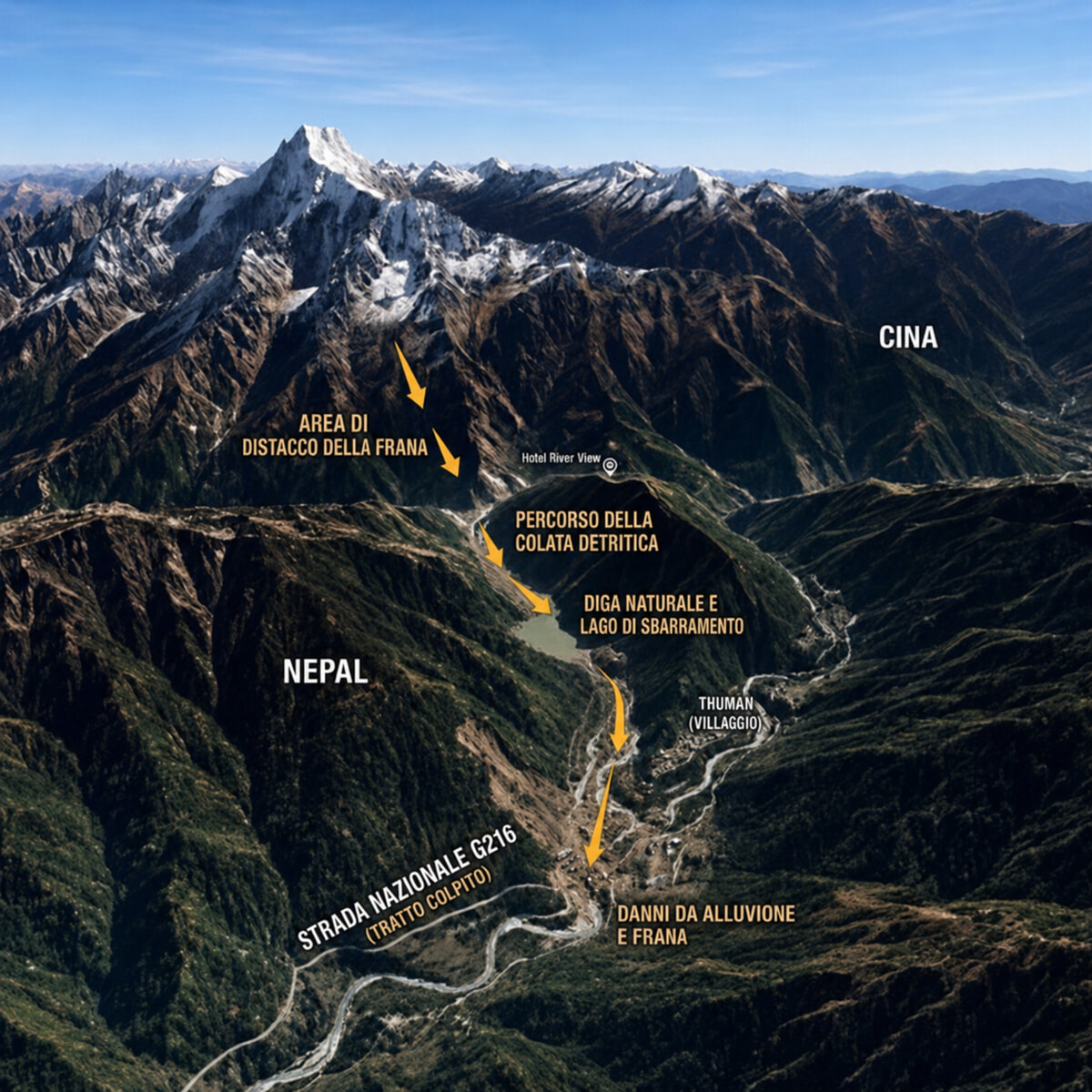
A second reconstruction, provided by the Nepalese government, tries to explain what could have caused the avalanche. At 8.37 a magnitude 4.4 earthquake was recorded, with its epicenter approximately 77 kilometers north-west of Kodari. The quake may have caused the detachment of a large mass of ice and rocks, which ended up in the watercourse and was responsible for the formation of the natural barrier. The relationship between the earthquake and the avalanche, however, has not yet been proven.
Scientists from the International Center for Integrated Mountain Development (Icimod), an intergovernmental organization based in Kathmandu, are also verifying the possible fall of a large mass of ice and rocky debris in the Lende Khola, a tributary of the Bhote Koshi. According to an initial analysis of the videos and information from the affected areas, the material could have directly generated the wave or formed a temporary barrier, which subsequently collapsed.
The three reconstructions, therefore, are not necessarily exclusive, but could describe different phases of the same chain: an earthquake would have caused an avalanche of ice and rocks; the material would have blocked the river; the failure of the dam would finally release the flood. However, this is a dynamic that still needs to be verified.
“It’s a cascading danger,” explained Saswata Sanyal, Icimod’s disaster risk reduction manager. In phenomena of this type, the detachment of ice and rocks can in fact produce a succession of events and rapidly transform into a flood capable of dragging water, mud, sediments and large boulders downstream.
These explanations are obviously still to be verified, while the authorities are mainly kept busy at the moment by providing relief. Even in neighboring Tibet where there are victims and missing people, in particular in the area of the Gyirong customs post. Chinese President Xi Jinping has ordered “all-out” rescue operations, while local authorities have warned that roads in the area remain exposed to new landslides and are unsafe to travel on.
Meanwhile, conditions on the ground are complicating rescue operations. The Nepalese army mobilized helicopters, but in some of the most affected areas the water level initially prevented the vehicles from landing. Police, armed forces and emergency teams were sent to the region, while Prime Minister Balendra Shah ordered the evacuation of the inhabitants of the most exposed areas.