

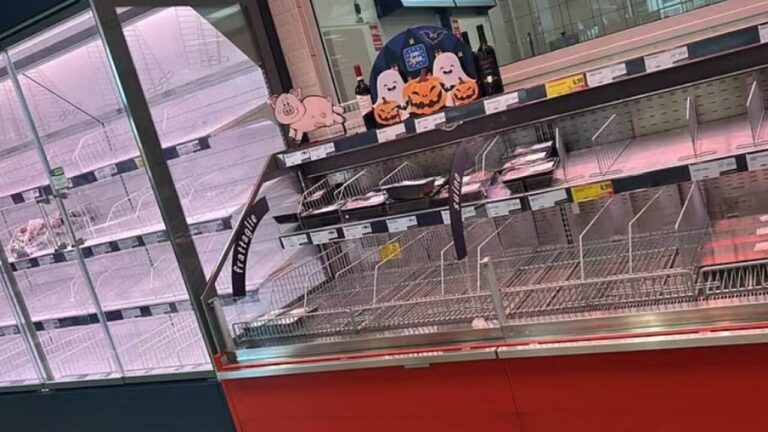
Paralyzed streets, shops with empty shelves and food rotting in warehouses. The anger of hauliers against expensive diesel explodes and the consequences, which are already starting to be tangible, risk triggering an ever-increasing spiral of inconvenience. The government is trying the option of dialogue, but the inconveniences are destined to last for another few days. What happens.
The truckers’ protest
The protest exploded especially in the South: Campania, Puglia, Calabria and Sicily are the hottest regions. Heavy vehicles block the main road arteries, motorway toll booths and port junctions in a protest that arises from the mobilization of trade unions and spontaneous committees. Faced with this scenario, the deputy prime minister and minister of transport, Matteo Salvini, brings forward the convening of the table with the hauliers to Tuesday 20 October. However, it is not enough to stop the protest.
In Campania, truck drivers man the key points of the provinces of Caserta and Naples. In Calabria, Fedralog’s mobilization includes fifteen garrisons that narrow the roadways near strategic hubs such as the Lamezia Terme airport and the port of Gioia Tauro. “We are ready to go to Rome with our trucks if by October 20th we have not had concrete answers to our requests”, warns Mario Pansini, regional coordinator of Fedralog.
In Sicily, protesters have armored the entrance to the Santa Lucia pier in the port of Palermo, blocking outgoing trucks and preventing ships from unloading. “The membership is total, there are no heavy vehicles circulating in Sicily”, says the coordinator of the Sicilian transport committee, Salvatore Bella, explaining that with the price of fuel at 2.30 euros, each full tank “costs around a thousand euros more” to which another 700 euros are added for the ships and the cost of the ticket. “Unsustainable”, denounces the trade unionist.
Bella confirms, however, that the stoppage of the trucks remains despite the advance of the meeting to October 20th and could continue beyond the announced deadline, indefinitely, if the “peace” is not signed.
Empty supermarkets and wasted food
The hauliers’ protest has immediate and tangible effects for everyone. It has a major impact on the food supply chain and supplies. In Italy, over 80% of goods are transported by road and there is a risk of a dangerous domino effect. If trucks full of goods remain stationary, supermarkets cannot replenish. So empty shelves. At the same time, however, the food that does not make it to sale rots in the warehouses. For fresh products it means having to throw them away. The alarm also affects farms, because the delivery of animal feed is also blocked. And in addition to food, even the supply of petrol and diesel at local stations cannot be guaranteed.
If this were to continue indefinitely, there is a risk of cascading consequences also in the pharmaceutical supply chain, with delays in deliveries of medicines to warehouses.
In Sicily there is also the risk that buses and coaches will also stop. If the fuel does not arrive, the service provided by private individuals cannot be guaranteed. “We share the problem with the hauliers because our vehicles also run on diesel – explains Antonio Graffagnani, president of Anav Sicilia, the trade association that brings together traveler transport companies – The failure to deliver fuel is also starting to have consequences on our companies that provide the local public transport service. Already yesterday, some hauliers did not deliver the diesel necessary for the regular performance of services to the fuel depots. Consequently, we cannot hide – continues Graffagnini – the strong concern because the protests are growing in level, day by day, and we seriously run the risk of not being able to carry out the scheduled services linked to the operating programmes. There are several companies that supply themselves on the road that have received notification of the non-arrival of diesel fuel. If the companies are unable to get supplies on Monday, they will organize themselves with the remaining fuel to guarantee the minimum essential services dedicated to students and workers who have to reach schools and workplaces in the early hours of the morning”.
The strike commission is activated
However, another cloud is gathering over hauliers. The guarantee commission on strikes has been activated, which “is taking the appropriate initiatives to identify those responsible for the blockades in order to prevent citizens’ fundamental rights from being compromised”.
“While understanding the motivations underlying the category’s claims, the Commission reiterates the need for any form of protest to take place in compliance with the rules and procedures established by law 146 of 1990”, reads the note from the Guarantor.