

The grip is tightening around Saudi Arabia and the bill risks reaching Italian petrol pumps soon too. After the near paralysis of the Strait of Hormuz, the Middle Eastern conflict also threatens the second major route used by Riyadh to bring its oil to international markets: the Red Sea.
On Thursday 10 September the Houthis, the Yemeni movement supported by Iran, took control of the port city of Mocha, on the western coast of Yemen, strengthening their position close to the Bab el-Mandeb Strait. According to Yemeni military sources cited by Reutersthe rebels simultaneously attacked the strategic Hanish Islands, subsequently arriving on the islands themselves. The government forces are instead repositioning themselves towards Dhubab and the island of Perim, two other decisive points for control of the strait.
It is difficult to underestimate what is happening. Saudi Arabia, the world’s leading oil exporter, had progressively moved a growing part of its flows towards the western port of Yanbu, connected to the eastern fields through the East-West pipeline, precisely to bypass Hormuz. Now this route also risks becoming vulnerable.
Arabia caught between two seas
On one side there is Hormuz. Before the war, around 21 million barrels of oil per day passed through the strait, roughly a fifth of world consumption. The current situation is completely different: on Wednesday just seven ships were recorded in transit, against an already depressed average of 14 in the previous ten days. No liquefied natural gas tankers made it through.
On the other side of the Arabian Peninsula is Bab el-Mandeb, the “Gate of Tears”, the strait between Yemen, Djibouti and Eritrea that connects the Red Sea to the Indian Ocean. In the second quarter of 2026, approximately 8.1 million barrels per day of crude oil and petroleum products passed through it, almost double the average for the first half of 2025. It is the route that allows oil headed for Europe and the Mediterranean to reach the Suez Canal without circumnavigating Africa.
If the Houthis succeeded in imposing a blockade or even just making passage too risky, Iran would then have leverage over both major maritime corridors of the Arabian Peninsula. And it is precisely this new scenario that is scaring the markets.
Saudi production has collapsed
The effects are already visible. Saudi production plummeted to around 6.24 million barrels per day in August, nearly 1.9 million less than in July. OPEC as a whole lost around 640,000 barrels a day according to the survey Reutersbecause the increase in production of some members was offset by the difficulties of Saudi Arabia and the collapse of Iranian exports.
For Riyadh the problem is managing to get oil out of the country. In the first weeks of September cargoes of crude oil and condensates from the Saudi port of Yanbu had begun to recover, reaching around 3.7 million barrels per day according to Vortexa. The conquest of Mocha, however, reopens the unknown precisely on the route that should have compensated for the Hormuz crisis.
Making the situation even more explosive are the direct attacks by the Houthis against Saudi territory. Riyadh issued four civil defense alerts in 24 hours in the southwestern city of Khamis Mushait, while Pakistan conveyed a Saudi request to Tehran to contain Yemeni rebels.
Oil flies above 105 dollars
The markets reacted immediately. Brent rose about 4% to $105.26 a barrel, while US WTI surpassed $100 for the first time since May. Compared to the lows reached at the beginning of August, Brent has now gained more than 30%. And the risk is that it’s not over.
Iran announced on Wednesday that it had attacked ten ships near Hormuz after the United States struck five Iranian oil tankers. Donald Trump also threatened new attacks against the fortified site of Pickaxe Mountain and said he expected the war to end only after the US mid-term elections in November. In short, the market is starting to price no longer a crisis lasting a few weeks, but a conflict destined to continue.
How much petrol and diesel can go up
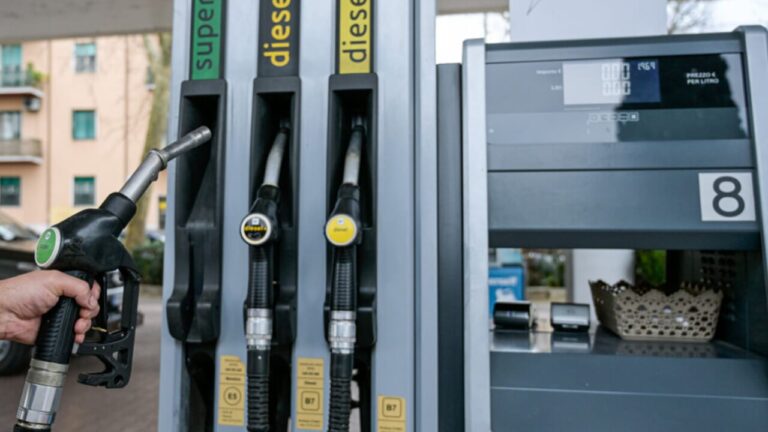
In Italy the increase has already started. The latest official data from Mimit, updated on 9 September, indicates an average self-price of 2.067 euros per liter for petrol and 2.177 euros for diesel. On the motorway it costs 2,152 and 2,248 euros respectively.
We can try to understand what would happen if oil continued its run. Starting from a Brent of around 105 dollars and keeping the exchange rate, refining and distribution margins unchanged, every increase of 10 dollars per barrel translates approximately into 6-7 cents more per liter at the pump, including VAT.
| Brent | Self-service petrol | Diesel with excise discount | Diesel without discount |
| $105 today | €2,067 | €2,177 | €2,348 |
| $110 | €2.10 | €2.21 | €2.38 |
| $120 | €2.16 | €2.27 | €2.45 |
| $130 | €2.23 | €2.34 | €2.51 |
It is a prudential simulation, because it assumes that refinery margins, oil tanker insurance costs and maritime freight rates do not also increase. All elements that a prolonged crisis in the two main Middle Eastern straits could instead increase.
Then there is the state’s parachute on diesel. The 17.1 cents per liter discount on excise duties formally expires this evening, but the Council of Ministers is expected to approve a new extension. Matteo Salvini, after speaking with the Minister of Economy Giancarlo Giorgetti, indicated the objective of arriving almost at the end of September, probably around the 24th. The definitive date will depend on the resources available.
Without that fiscal intervention, however, the average price of diesel would already theoretically be close to 2.35 euros per liter today. And with Brent at 130 dollars it could exceed 2.50 euros.
The shock doesn’t stop at the distributor
This is why the new escalation in Yemen affects much more than motorists. Diesel powers a large part of Italian road transport: when the cost of moving a truck increases, part of the increase progressively ends up in the prices of food, industrial goods, construction materials and deliveries.
Added to this are the effects on air transport, agriculture and the energy costs of businesses. And the longer oil and fuel remain high, the greater the possibility that the shock will return to push inflation and make it more difficult to reduce interest rates.
The ECB raises rates again: how much mortgages and loans increase
When will the price of petrol drop? Trump’s prediction on Iran’s surrender after November 3