

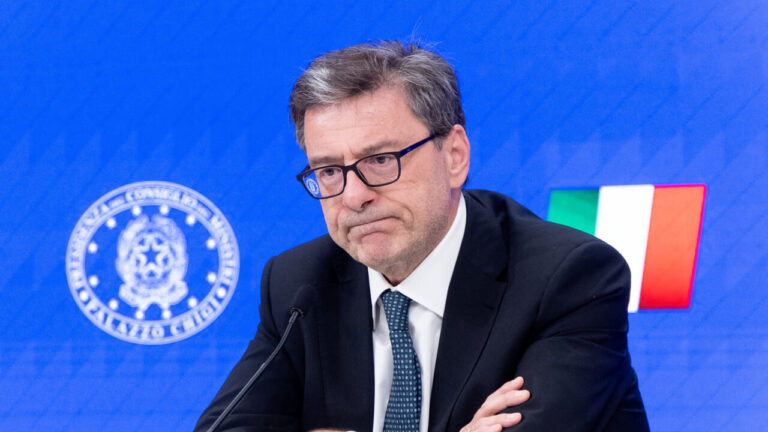
The salaries of Italians will be at the center of the “construction site” in the next budget law. The government is ready to intervene through taxes and contributions, but increasing wages cannot only be the task of the State: businesses must also do their part. The message comes from the Minister of Economy, Giancarlo Giorgetti, who spoke at the Teha Forum in Cernobbio, where the owner of the Mef also took stock of the almost four years of the Meloni government and claimed the results obtained
Giorgetti: government ready to intervene on salaries
According to the latest available Istat data, in the period January-June 2026 the average hourly contractual salary increased by 2.6% compared to the same period in 2025. In June the growth was 2.4% on an annual basis. At the end of the month, however, 25 national collective agreements, relating to approximately 3.9 million employees, were still awaiting renewal.
But the problem is the purchasing power lost by Italians in recent years. According to the OECD, in the first quarter of the year Italian real wages grew by 1.3% compared to twelve months earlier, but were still 6.1% lower than in the first quarter of 2021: the widest gap among the major OECD economies. The organization also forecasts a new decline of 0.9% in real wages for the whole of 2026, also due to the increase in electricity and gas bills.
The government – he says – will do its part with tax and social security incentives, but then it’s up to entrepreneurs who – in his opinion – “must look at wages as an investment to restart the economic cycle”. He then warns the audience in the ‘Sala Impero’ of Villa d’Este of the “demographic desert” that is “knocking at the door”, for which “investments must be made and the budget law will certainly have to pay special attention to this aspect” favoring – another chapter that will arrive in the budget law – the repatriation of young people who have gone abroad.
What could be included in the 2027 budget law
The dossier is part of the construction site for the next maneuver, on which requests from the majority parties have already begun. In recent weeks, various hypotheses have been put forward, from the cut in Irpef to the tax relief on thirteenth wages, up to the extension of the preferential taxation of increases resulting from contract renewals.
“Italy is much more respected abroad than at home”
Giancarlo Giorgetti
In an increasingly complicated geopolitical context “we were not phenomena, but the boat remained afloat”, highlights the minister, ensuring that “Italy is much more respected abroad than at home”.
Above all, according to the minister, “the financial stability that we have achieved in recent years, in terms of ability to manage public debt, has certainly given us the ability to face the storm that is looming on the long-term interest rate bond market with a different attitude”.
Our country, in what is “the great issue of the energy challenge, pays for two wars we are witnessing, that of the Middle East and that of Ukraine, and pays for them twice raised to power”. And this is because “we used to supply ourselves with Russian gas, we can no longer do so, we have trusted other suppliers and if you think about it, other suppliers have difficulty supplying it to us and have increased prices, half of the Russian refining capacity has been destroyed by the Ukrainians, so the price of diesel depends on the fact that no one refines anymore”, summarizes Giorgetti.
Jp Morgan, Benetton and foreign funds: who will collect the billions in incentives for renewables
“We have to do Europe – he explains – but we also have something to evaluate at home, for example complementary prevention funds, why do they invest anyway except in Italy? Are there no investment opportunities for patient capital and other activities in Italy?”, he asks. Giorgetti then points out that “Canadian pension funds, the whole world invests in Italy, in this and that company and Italian prevention funds do not”. According to Giorgetti “we don’t just have to wait for European rules to promote or facilitate the retention of capital in Europe”.
What happens on September 22nd
And on the deficit-GDP ratio, in view of next September 22nd with the definitive Istat data for 2025, Giorgetti does not say too much: “We will see if we will have a thousandth more or less than this blessed 3%. I take note of the rules. They are the ones and therefore we must accept them. If we are a thousandth above we will remain in the procedure, if we are a thousandth below we will be out”.
A new “bonus” in the pay slip at Christmas: the hypothesis of a cut in personal income tax up to 135 euros on the thirteenth
Regarding GDP “we had made prudent assessments for growth indicating 0.6%: for now we have achieved 0.8%.
If things go as per the indicators we could get close to 1%, above the forecasts contained in the programmatic documents”, explains the minister in underlining that “we live in a complicated world” and “the type of challenges in terms of increased productivity and in terms of safety are an element of objective concern”.
The minister closed the Teha Forum in Cernobbio with a GDP estimate of around 1%, but did not hide his concerns about the international situation. At the same time he defined himself as a “pragmatic sovereignist” in managing public debt.