

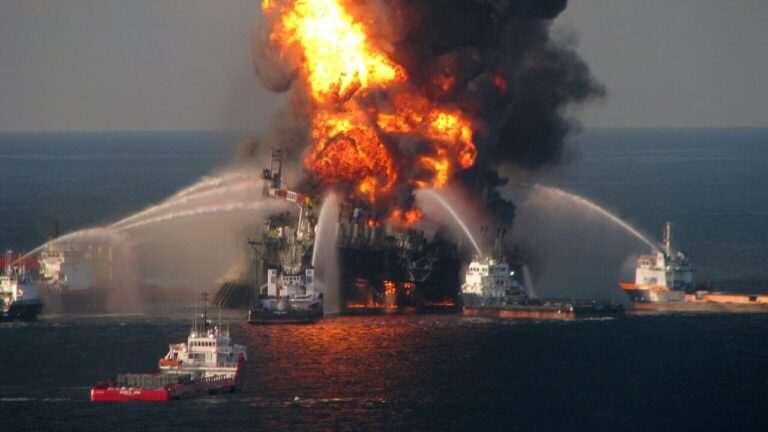
Sixteen years after the collapse of the Deepwater Horizon oil platform in April 2010, the deep sea ecosystems of the Gulf of Mexico show no sign of recovery. This is documented by newly published research on Proceedings of the National Academy of Scienceswhich identified a drastic decline in the abundance of marine species that inhabit the depths of the gulf waters, tracing the cause to the oil spill from the oil platform accident and the mitigation treatments adopted at the time.
The analysis
The research is based on the analysis of over two thousand samples collected through oceanographic networks between 2011 and 2023. The comparison with the data collected immediately after the disaster highlighted a generalized contraction of the populations of vertebrates and invertebrates that populate deep waters. Fish decreased by 63.5 percent, crustaceans by 62 percent, and cephalopods by 59.7 percent.
The decline has particularly affected taxa considered critical to the ecological stability of the ocean. The populations of krill (microscopic crustaceans on which the diet of many marine creatures is based) have suffered a decline of 72.8 percent, lantern fish (a family that includes some of the most common deep-sea fish) by 62.9 percent and fish of the Cyclothone genus (another very widespread genus in the deep sea) by 69%. Many of these organisms are part of the so-called deep dispersion layer, whose daily vertical migrations drive the biological carbon pump, transporting organic matter (and therefore carbon) from the surface to the deep sea, thus contributing to storing part of the excess carbon present in the atmosphere (in the form of CO2).
The role of chemical dispersants
According to the authors of the study, the most plausible hypothesis is that the decline of deep marine fauna is due to the direct impact of the crude oil spilled following the Deepwater Horizon accident, and the chemical treatments used to contain the emergency. During the eighty-seven days it took to cap the well, approximately 134 million gallons of oil and nearly eight billion cubic feet of gas spilled into the marine environment. Added to these emissions was the injection of approximately 770,000 gallons of the chemical dispersant Corexit 9500A near the wellhead.
The combination of crude oil and chemical compounds would therefore have generated an environment that was absolutely harmful to marine life, compromising the delicate balance of the entire ocean ecosystem. The result is a change and depletion of biodiversity in the Gulf of Mexico that could make the entire area unrecognizable for decades. “Overall – the authors write in the study – these results indicate a sudden and persistent decline in the deep pelagic fauna of a large marine ecosystem, which have led to a lasting reduction of species which represents a genuine change in the ecological regime”.