

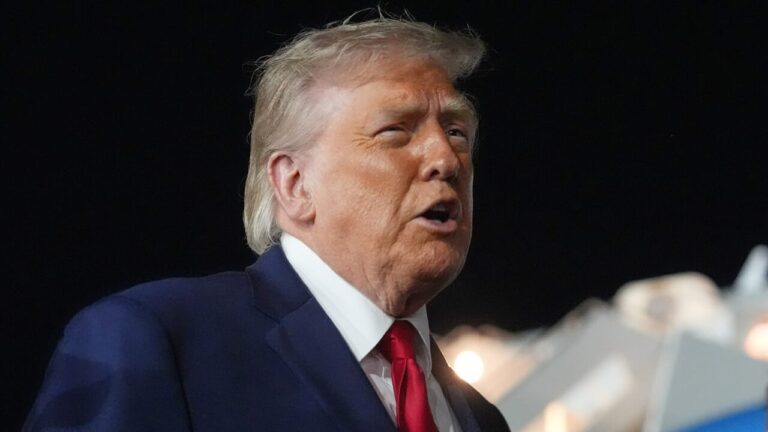
“The agreement with the Islamic Republic of Iran is now complete. Congratulations to all!”. It is US President Donald Trump who announces the signature of the memorandum of understanding with the Iranian leaders. A signature that arrived remotely, digitally, and which will have to be confirmed in person at a bilateral meeting in Switzerland on 19 June. Only then will phase two of the negotiations begin which must lead to a definitive peace agreement between the parties.
The announcement
“I hereby fully authorize the toll-free opening of the Strait of Hormuz and, at the same time, authorize the immediate removal of the United States naval blockade. Ships of the world, start your engines. Let the oil flow!”, writes the tycoon on his social network Truth. Trump’s enthusiasm is such that he leaves out some details that are not of little importance for international trade.
So much so that the president is forced to publish another message to clarify the contours of the agreement. After the usual panegyric – “This great agreement will bring peace and security to the entire region. Many presidents have tried to make peace with Iran, but they have all failed before me. The leaders of the region have found, for the first time, a president capable of helping them achieve authentic peace” – Trump clarifies: “With the opening of the strait, scheduled for Friday on the occasion of the signing of the agreement, in order to proceed with the clearance of mines, oil will once again flow in both directions, to the benefit of the region and the whole world!”.

So yes, Hormuz will reopen, but intense demining work will be necessary which could take several weeks as has been noted by many analysts in recent months.
The Strait of Hormuz is blocked, Italy has an ace to play: the “invisible” minehunters
Iran: “Negotiations will continue if Washington respects its commitments”
Across the ocean, the Iranian military claims to have humiliated the United States and Israel. “The enemy has no choice but to accept defeat and surrender,” the Iranian General Staff said in a statement broadcast on state television. Beyond the propaganda, Gharibabadi, the Iranian Deputy Minister for Foreign Affairs, published on X a note from the secretariat of the Supreme National Security Council regarding the agreement.
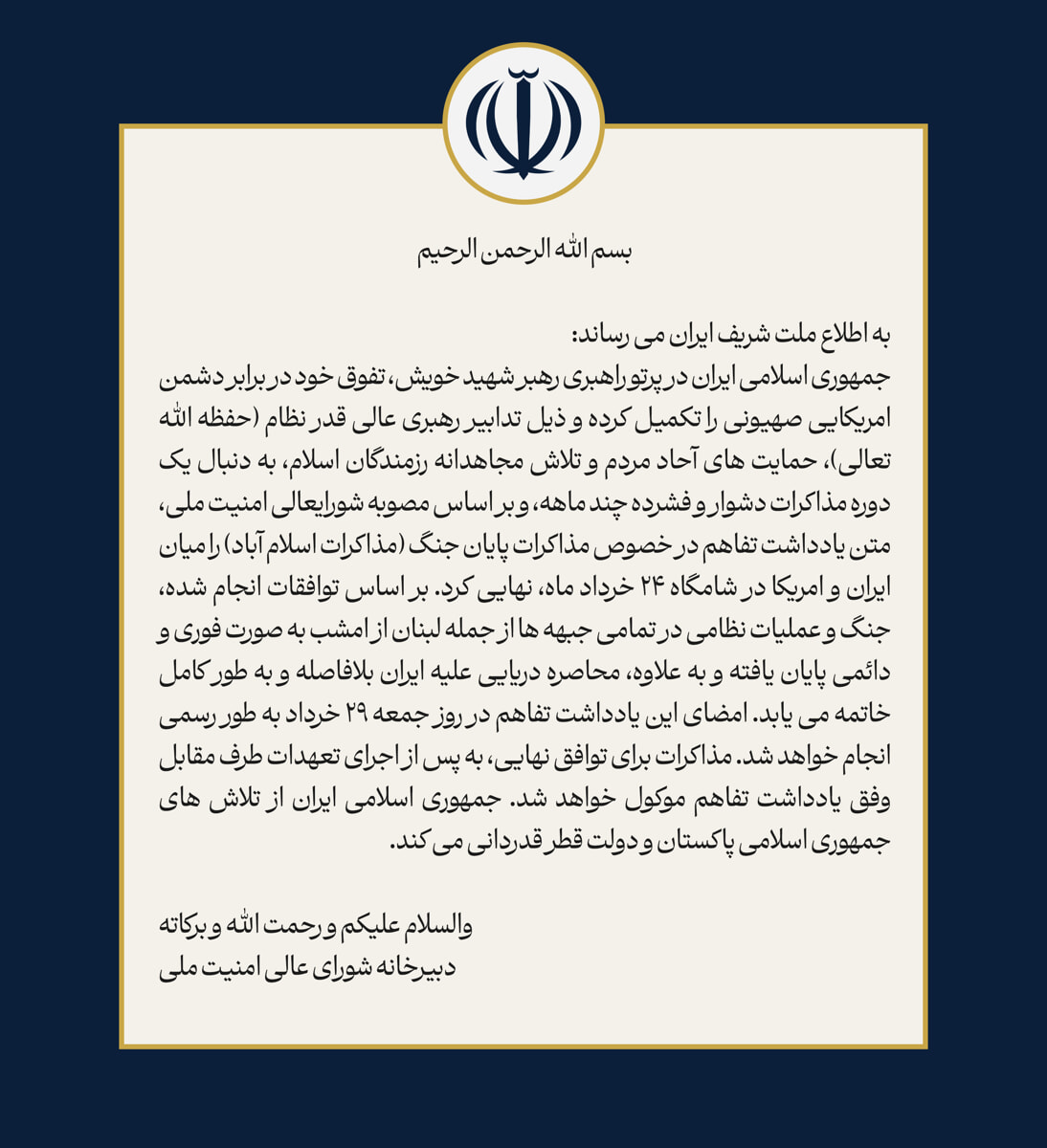
The document says that the Islamic Republic “has finalized the text of a memorandum of understanding regarding the cessation of the war (Islamabad negotiations) between Iran and the United States”. “According to the agreements reached”, we read, “the war and military operations on all fronts, including those relating to Lebanon, will cease immediately and permanently starting from this evening (June 14, ed.). Furthermore, the naval blockade against Iran will be lifted completely and without delay”. The signature is confirmed on 19 June (“29 Khordad”, according to the Iranian calendar) and finally it is specified that the “negotiations for a definitive agreement will continue after the counterparty has implemented the commitments set out in the memorandum”.
What was decided
The Iranian News Agency Mehr shared a document presented as a 14-point memorandum of understanding between Iran and the United States. Among the clauses in the text is the immediate release of 12 billion dollars of assets frozen abroad. The document explains that “the release of 24 billion will be completed during the 60-day negotiation period” which begins at the signing of the memorandum of understanding. “Half of this sum,” the document continues, “must be made available to Iran before the start of negotiations.”
Washington has not yet published an official text. Such documents were usually made available on the White House website. All that remains is to rely on the rumors leaked through anonymous US officials. First of all, the official signature will arrive on June 19th, barring any surprises. The signed text will not be a peace agreement, but a memorandum of understanding that will start timed negotiations lasting 60 days. The truce will therefore be prolonged and it is not certain that it will be postponed further if an agreement is not reached.
The document moves in two stages. One short term and another long term. Upon signing the memorandum, the Strait of Hormuz must be reopened, without tolls. At the same time, the US blockade on Iranian ports will be lifted. The text will also present the framework within which the negotiations will take place. That is, what still needs to be agreed upon. The nuclear issue will be decisive: the United States does not accept that Iran could have a nuclear bomb, which is why they demand a stop to the military program. It will not be definitive, Washington is asking for a blockade of at least 20 years, Tehran is willing to lose 5. A compromise could be found halfway, 10 years. Another topic is uranium enriched to 60 percent. Trump demands that those 450 kilos be destroyed or handed over to the United States.
A particularly important dossier concerns Iranian assets frozen abroad. We are talking about around 24 billion dollars. Half could be guaranteed immediately, and the rest could come based on a rewards process. If the agreements are met, Washington would authorize wire transfers from countries holding Iranian assets.
Finally, there is the issue of proxies. Tehran asks that the agreement guarantee a ceasefire also in Lebanon where Hezbollah, the armed militia supported by Iran against Israel, is based. Tel Aviv could resist or not cede the occupied territories in the southern area of the Cedar Country.