

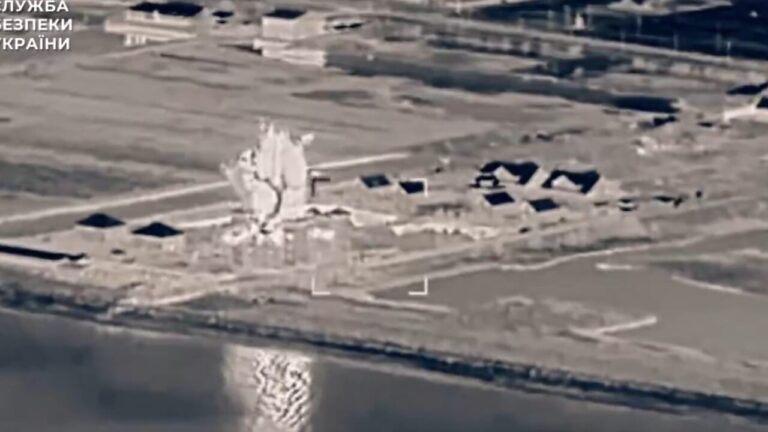
In the last few hours, the Ukrainian army has launched two surgically effective attacks which, rather than recounting an isolated tactical success, reveal a precise evolution of Kiev’s military doctrine. The hardest blow was struck in the village of Genicheska Hirka, in the occupied Kherson region. Here, the elite “Alpha” unit of the Ukrainian Security Service SBU has hit the headquarters of the FSB, the Russian secret service apparatus that manages the security and control of the occupied territories.
The raid and decapitation of the intelligence center in Kherson
The shock wave of the raid did not spare the enemy defenses: in the action a Pantsir-S1 anti-aircraft system was pulverized, one of Moscow’s technological jewels with an estimated value of between 15 and 20 million dollars. The toll confirmed by Volodymyr Zelensky speaks of around 100 losses between dead and wounded in the Russian ranks.
The attack took place in an area that the Kremlin considered a consolidated rear area, used as a focal point for the control of the territory and counter-guerrilla operations. The success of the operation by Kiev shows a strategy increasingly based on the systematic use of a new class of drones and on the increasingly targeted search for the economic and operational attrition of the adversary.
Striking an FSB headquarters in the occupied territories means, in fact, disarticulating the chain of command and control of Russian internal security. In these areas, the FSB manages the information apparatus, the monitoring of local resistance forces and the protection of the logistical lines behind the Kherson front. Neutralizing such a leadership unit deprives Russian forces of the ability to develop tactical intelligence and coordinate area security, albeit temporarily.
The neutralization of the Pantsir-S1: the tactical background
The most significant technical element of the blitz is the simultaneous destruction of a Pantsir-S1 anti-aircraft missile system, one of the most modern close air defense platforms supplied to Moscow, with a commercial value estimated between 15 and 20 million dollars.
The Pantsir-S1 was deployed to protect the headquarters precisely to intercept low-altitude aerial threats, rockets and drones. The fact that the Ukrainian operators managed to evade the sensors of the Russian defense system suggests two possible scenarios: a deficit in operational readiness on the part of the Russian crew or, more likely, the use by the “Alpha” unit of coordinated attack tactics, capable of blinding the Pantsir’s radars before the lethal impact.
The “Middle Strike” doctrine and asymmetric attrition
The Kherson attack is part of a Ukrainian war strategy that appears increasingly based on medium-range armaments. The latter are replaced by small FPV (First Person View) drones used on the front line and by long-range strategic platforms, used instead to strike deep into Russian territory.
The strategy is based on “Middle Strike” drones, systems with a range of action between 50 and 200 kilometers. The objective is the systematic demolition of the operational rear areas. Primarily through logistical attrition: by hitting ammunition depots, command centers and air defense networks, Ukraine forces Russian commands to move heavy equipment away from the contact line.
Kiev is also aiming for a slow attrition of Russian supplies: the more the logistical bases are set back, the more complex and slow the supplies to the front line become. In this way, territories previously considered safe by Russian forces are transformed into high-friction zones, reducing the safety margins of the Kremlin troops.
A refinery also hit: Kiev aims at the energy front
A few hours after the blitz in Kherson, Kiev’s drones hit the Syzran oil refinery, owned by the giant Rosneft, in the Russian region of Samara, over 800 kilometers from the border.
“Overall, our long-term plan for May is largely unfolding. The main targets are Russian oil refineries, warehouses and other infrastructure related to these oil revenues,” Zelensky claimed, publishing a video showing the consequences of the attack on the refinery.
If the attack on the FSB undermines operational security on the ground, the raid in Syzran (which cost the lives of two people, according to local authorities) in fact affects the Kremlin’s war economy. In an international situation in which Russian oil benefits from partial exemptions due to the energy crisis in the Middle East, Kiev aims to directly damage refining infrastructure, so as to dry up the financial flows that fuel Moscow’s war effort.
Diplomatic efforts and the possible EU mediator (Draghi?)
While Ukraine intensifies medium and long-range pressure, the surrounding scenario remains characterized by strong tensions and deterrence maneuvers. On the northern front, the SBU and the Ukrainian Armed Forces have initiated enhanced security measures to prevent potential incursions from Belarus. This comes in conjunction with the conclusion of joint nuclear exercises between Moscow and Minsk, culminating in the test of hypersonic Zirkon and intercontinental missiles, maintaining Kiev’s alert level at maximum.
At the same time, there are China’s attempts at mediation, which emerged during the last summit in Beijing between Xi Jinping and Vladimir Putin, and the discussions within the European Union for the appointment of a dedicated negotiator.
Draghi or Merkel to deal with Putin: Europe’s secret plan to reopen channels with Moscow
On the military procurement front, it received the green light from the US State Department for the acquisition of support and maintenance equipment for the Hawk air defense missile system, a contract worth 108.1 million dollars intended to strengthen the national air shield against Russian missile raids.
The attack on the headquarters of the Russian FSB demonstrates how the combination of accurate intelligence and medium-range unmanned technologies allows Kiev to strike at the vital nerves of the Russian military and security apparatus. A coordinated action which, in Zelensky’s intentions, aims to impose a human, economic and technological cost such as to force the Kremlin to reconsider the sustainability of the war of occupation.